

Introduction: Two Institutions, One Lighting Problem
The Supermarket as a Visual Merchandising Environment
A supermarket is not a warehouse with shelves. It is a retail environment in which lighting directly participates in the sale of goods. The visual appearance of fresh produce, packaged goods, and prepared foods depends on the spectral quality and stability of the light source. A lamp with poor color rendering or visible flicker does not merely "look bad"-it makes merchandise look less fresh, less appetizing, and less trustworthy. Research in retail lighting consistently finds that color rendering and illuminance uniformity influence dwell time, product perception, and purchase confidence. A supermarket that tolerates dim, flickering, or color-shifted lighting is, in operational terms, tolerating a merchandising defect at every aisle and display case.
The School as a Visual Task Environment
A classroom is a sustained visual task environment. Students read text at desk height, read from whiteboards at a distance, and transition their gaze between near and far focal planes for hours at a time. The Illuminating Engineering Society (IES) recommends 30–50 foot-candles (300–500 lux) for general classrooms, with higher levels for laboratories, art rooms, and drafting areas. These recommendations are not aimed at "brightness" as an aesthetic preference. They are calibrated to the visual demands of reading, writing, and board work.
More importantly, the quality of classroom light-not just its quantity-has measurable effects on the occupant. Flicker, glare, and poor color rendering contribute to visual fatigue, headache, and reduced task persistence. In a school, lighting is not a back-office utility. It is part of the learning environment, and its deficiencies are experienced by students for six to eight hours per day.
The Common Constraint: High Ceilings, Continuous Duty, and Thermal Reality
Despite their different functions, supermarkets and schools share a set of physical and operational constraints that determine whether a lighting installation succeeds or fails. Both typically mount fixtures at heights of 12 to 25 feet, which means the light source must deliver enough lumens to reach the working or shopping plane without excessive loss. Both operate for long hours-supermarkets often 14–16 hours per day, schools 8–10 hours per day plus evening events-which places the lighting system under near-continuous thermal load. And both are cost-sensitive environments in which lamp replacement is not a trivial maintenance event but a disruption to operations that must be scheduled around shoppers or class schedules.
These shared constraints mean that the decisive question for a lighting upgrade is not "how bright is the bulb when new?" but "how much of that brightness will still be there in year three, and what will it cost to maintain it?" That question is fundamentally a question about thermal architecture. And that is where the fan-cooled E27 LED bulb enters the analysis.
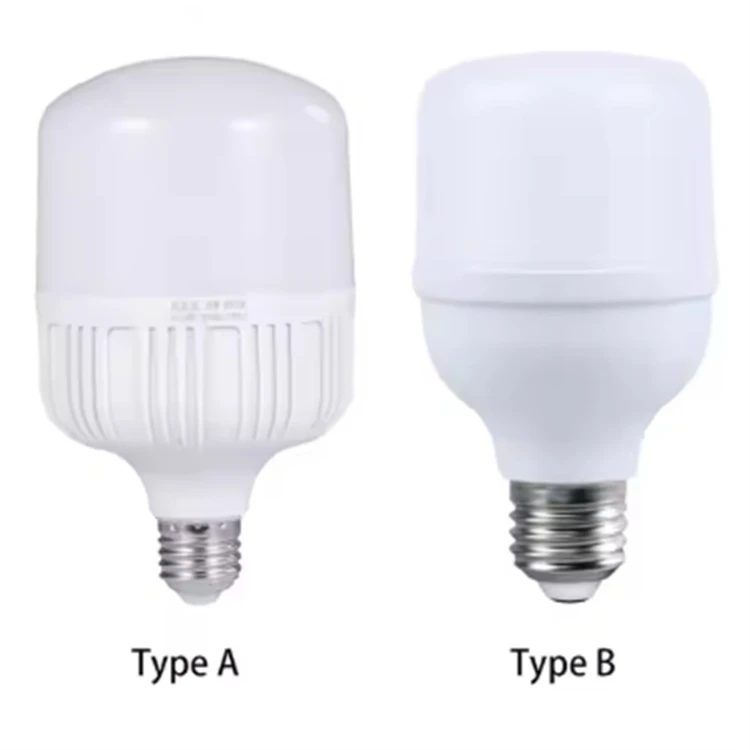
What Supermarkets Actually Need from a Light Bulb
Color Rendering and the Psychology of Freshness
Supermarket lighting must render color accurately. A tomato should look red, not orange-brown. Leafy greens should look crisp, not grayish. Packaged goods should display their brand colors as the manufacturer intended. The Color Rendering Index (CRI) quantifies this fidelity on a scale where 100 represents incandescent-equivalent rendering; a CRI of at least 80 is generally recommended for commercial and indoor applications, and higher values are desirable in fresh-food zones.
The problem with thermally degraded LED bulbs is that CRI is not static over life. High junction temperatures reduce the LED's color rendering index, shifting the spectral output in ways that make merchandise look duller and less saturated. A supermarket that installs a high-output LED bulb without adequate thermal management may find that the initial color quality-acceptable at installation-degrades within the first year or two, precisely in the aisles where color perception matters most. The fan-cooled architecture addresses this not by improving the phosphor chemistry but by keeping the junction temperature within the window where that chemistry performs as designed.
Flicker: The Invisible Defect in Retail Lighting
Flicker is often imperceptible in isolation but becomes conspicuous under the conditions supermarkets actually encounter: high-frequency scanning at checkout, video surveillance, and the mere-exposure effect of a shopper walking down a long aisle of display cases. LED flicker originates in the driver's current regulation. A driver that modulates current to save cost or simplify circuit design will produce flicker that is invisible to the naked eye in a single glance but is registered by the visual system over time, contributing to eye strain and, in retail environments, to a vague sense that something is "off" about the space.
The IC constant-current driver shown in the product's internal architecture is designed to stabilize current delivery and suppress flicker. Constant-current regulation, when properly implemented, eliminates the current ripple that produces visible or sub-visible flicker, and "anti-interference" design reduces susceptibility to electrical noise on the mains circuit-a relevant consideration in supermarkets with refrigeration compressors, bakery ovens, and HVAC systems on the same supply. A flicker-free bulb is not a luxury in a supermarket. It is a baseline requirement for a comfortable and trustworthy shopping environment.
Cold-Aisle Performance and Instant-On Reliability
Supermarket lighting is not installed in a uniform thermal environment. Open refrigerated cases and cold aisles create localized zones of low ambient temperature adjacent to the warmer general sales floor. Legacy lighting technologies can exhibit delayed start-up or reduced output in these conditions. LED sources, by contrast, are inherently instant-on and do not depend on electrode warm-up or arc stabilization, which makes them well-suited to the mixed thermal landscape of a supermarket.
The more consequential thermal issue, however, is at the opposite end of the spectrum: the heat generated by the lamp itself in continuous operation. A high-output LED bulb that runs 14–16 hours per day generates a sustained thermal load within its own form factor. The aluminum cooling fins and built-in fan are what allow that load to be rejected to the ambient air rather than accumulating at the junction. In a supermarket where the lighting operates for the entire trading day, this continuous thermal management is the difference between a lamp that maintains its output through the afternoon rush and one that has already begun to dim by mid-day.
Lumen Maintenance and the Visual Consistency of the Sales Floor
Supermarkets depend on visual consistency. A shopper who walks from the produce section to the dairy aisle should not perceive a step-change in brightness or color. When a subset of lamps in a sales floor degrades faster than others-because some are in fixtures with poorer ventilation or higher ambient temperatures-the floor develops "dark patches" and color inconsistency that read as neglect. The product's thermal architecture is designed to minimize this differential degradation by keeping junction temperatures within a controlled band across the installed population. The practical result is a sales floor that looks uniform in year three and year five, not just on the day of installation.
What Schools Actually Need from a Light Bulb
Illuminance Targets and the Maintenance Factor Problem
IES guidance for general classrooms calls for 30–50 foot-candles at desk height, with laboratory classrooms at 50–75 fc and art or drafting rooms higher still. These targets are measured at the visual task-the desk, the workbench, the drafting table-not at the fixture. Light must travel from the ceiling to the working plane, and a portion of it is lost along the way. The light loss factor (LLF) accounts for both dirt accumulation on the fixture and diffuser and, critically, lumen depreciation of the source over time.
A school lighting design that does not account for lumen depreciation will be under-lit by the end of the first year. A high-output LED bulb with inadequate thermal management will depreciate faster than the design assumed, pulling the classroom below the IES maintenance threshold sooner than the procurement model predicted. The fan-cooled architecture-finned aluminum heat sink plus active airflow-is the mechanism that keeps lumen depreciation within the design envelope. It is not an enhancement to the bulb's performance. It is the condition under which the bulb's rated performance remains true over the service life the school is paying for.
Flicker and the Student Visual System
Flicker in a classroom is a more serious matter than flicker in a supermarket because the occupants are engaged in sustained near-work for hours at a time. The human visual system is sensitive to temporal modulation of light even when the modulation is not consciously perceived. Flicker can induce visual fatigue, reduce reading speed, and contribute to the complaints of headache and eye strain that teachers and students report in poorly lit classrooms.
LED flicker is a driver-level phenomenon. The IC constant-current driver in the product is specified for flicker-free operation and anti-interference characteristics. In a school context, this translates into a lighting environment that does not impose an additional visual burden on students who are already concentrating on text, board work, or screen-based learning. The purchasing question is not whether a bulb is "flicker-free" on a specification sheet, but whether the driver maintains that flicker-free performance under thermal stress and electrical noise. A driver that loses current stability as junction temperature rises will produce flicker that emerges over the service life, precisely when the school least expects it.
Glare Control and Visual Comfort in the Learning Space
Glare is the second visual comfort variable that separates a competent classroom lighting installation from an inadequate one. A bare LED source or a poorly diffused bulb produces high-luminance points of light that enter the visual field and cause discomfort, especially when the fixture is within the student's field of view. The high-transmittance PC lampshade on the product serves a dual function: it converts the point-source emission of the LED array into a softer, more uniform output, and it does so without sacrificing a disproportionate share of the light to absorption. A diffuser that achieves softness by absorbing light converts optical inefficiency into heat inside the lampshade volume; a high-transmittance PC diffuser achieves the same visual comfort with less parasitic absorption and a smaller thermal penalty.
For schools, this matters not only for student comfort but for the economics of the installation. A bulb that delivers a comfortable, well-diffused light at a competitive wattage reduces the total number of fixtures and lamps required to meet the classroom illuminance target. Visual comfort and energy efficiency are not opposing goals when the diffuser is specified correctly.
Extended Operating Hours and the Maintenance Burden
Schools operate their lighting for the school day, for after-school programs, for evening events, and often for community use. A bulb that requires replacement every 15,000–20,000 hours imposes a maintenance burden that is difficult to schedule in an occupied building. The thermal management architecture of the fan-cooled bulb is the primary determinant of its service interval. Published engineering analysis indicates that a well-cooled LED chip may achieve a service life of 100,000 hours, while the same chip under poor thermal conditions can fall to 15,000–30,000 hours. The difference between those two figures is not the chip. It is the heat path.
A school that installs a thermally marginal high-output bulb will find itself scheduling relamping cycles far more frequently than the procurement model assumed, and each relamping cycle carries labor, access equipment, and disruption costs that dwarf the cost of the lamp itself. The fan-cooled architecture is, in this sense, a maintenance-cost avoidance technology as much as a lighting technology.
The Engineering Behind the Choice: Why "Fan-Cooled" Is the Deciding Variable
Junction Temperature: The Governing Constraint of LED Performance
Every LED's performance is governed by the temperature at its semiconductor junction. As junction temperature rises, forward voltage rises, lumen output falls, and the stress mechanisms that shorten chip life accelerate. High junction temperatures also reduce the color rendering index, which matters directly for supermarket merchandise and for the visual clarity of classroom materials. In a high-wattage E27 bulb, the junction is separated from the ambient air by a short and thermally constrained path. Without deliberate thermal design, that path cannot carry the heat load of continuous high-output operation.
The product's aluminum cooling fins address the conductive and spreading portion of the path. Aluminum's high thermal conductivity allows heat to move rapidly from the localized LED hot spots into a larger surface area, and the finned geometry increases the area available for convective transfer to the surrounding air. This is the same thermal strategy used in specification-grade high-bay luminaires, adapted to the compact form factor of an E27 bulb. But fins alone have a limit. In a compact bulb operating at high wattage, passive convection across the fin surfaces is not sufficient to hold junction temperature within its safe window. That is where active cooling becomes necessary.
Why Passive Fins Alone Are Not Enough for High-Wattage E27 Bulbs
Engineering analysis of high-power LED systems is unambiguous on this point: a heat sink alone will not cool a 75 W or 100 W equivalent LED lamp, and passive cooling designs for such applications become too large, costly, and mechanically unwieldy for a bulb-based form factor. Active cooling-forcing air across the heat sink with a fan-changes the convective coefficient by a factor of two to five compared with natural convection, depending on airflow velocity and fin geometry. It also allows the heat sink itself to be up to two-thirds smaller and lighter, which is precisely what makes a high-output bulb feasible within the dimensional constraints of an E27 base.
The product's built-in high-wattage fan is therefore not an accessory or a marketing differentiator. It is the component that makes the high-lumen claim physically sustainable. Without it, the bulb would either have to be derated in output or accept a service life far shorter than the economics of a supermarket or school installation can tolerate.
IC Constant-Current Driver: Stability for Flicker and Electrical Noise
The driver performs two distinct functions that are both critical to the supermarket and school applications. First, it maintains a stable drive current to the LED array despite input voltage fluctuation and forward-voltage variation across chips, which preserves consistent light output and color characteristics. Second, its anti-interference design reduces susceptibility to electrical noise on the mains supply-a practical necessity in supermarkets with large refrigeration and HVAC loads, and in schools with laboratory equipment, projectors, and variable loads on shared circuits.
The driver is also thermally sensitive. Electrolytic capacitors and semiconductor components degrade faster at elevated temperatures, and driver failure is a common mode of premature LED bulb failure even when the LED chips remain functional. By combining active cooling with an IC constant-current driver, the product protects both the light-generating subsystem and the power-conversion subsystem within the same thermal envelope. The fan is not cooling only the LEDs. It is cooling the entire electronic assembly that determines whether the bulb will still be operating to specification in year five.
High-Transmittance PC Lampshade: Optical Comfort Without Thermal Penalty
The PC lampshade completes the system by managing the optical output. A high-transmittance polycarbonate diffuser in the range of 85–92% total transmittance converts the harsh point-source emission of the LED array into a softer, more uniform light while preserving a large fraction of the emitted lumens. In a supermarket, this means merchandise is illuminated with comfortable, uniform light rather than harsh hotspots. In a classroom, it means the fixture itself does not become a source of glare in the student's field of view.
The thermal significance of the lampshade is often overlooked. A diffuser that achieves softness through high absorption converts optical inefficiency into heat inside the lamp volume, adding to the thermal load on the LED board and driver. A high-transmittance PC diffuser minimizes that parasitic heat generation, which reduces the burden on the cooling system and supports the lumen-maintenance objective. The lampshade is not merely a cosmetic or glare-control component. It is part of the thermal management strategy, and its specification quality matters as much as the fin geometry or the fan.
The Economic Case: Why the Upgrade Pays for Itself
Energy Savings: The Wattage Displacement Arithmetic
The most direct financial benefit of an LED upgrade in supermarkets and schools is wattage displacement. Documented LED retrofits in commercial and institutional settings routinely produce energy savings of up to 75% compared with incandescent and halogen baselines, with simple payback periods in the range of one to three years for many applications. In a supermarket operating 14–16 hours per day, or a school operating 10 hours per day plus evening use, the annual operating hours are high enough that every watt of reduced connected load translates into a meaningful annual saving across the installed fixture population.
The fan-cooled bulb participates in this economics by delivering the required illuminance at a fraction of the legacy wattage. The fan itself consumes a small amount of power, but that parasitic load is more than offset by the thermal headroom it creates-headroom that allows the bulb to operate at a higher output without derating, reducing the number of fixtures needed to meet the illuminance target.
Maintenance Cost Avoidance: The Dominant Economic Variable at Height
In both supermarkets and schools, the cost of accessing a fixture to replace a lamp often exceeds the cost of the lamp itself by a significant margin. A relamping event at 20 feet requires a scissor lift or scaffolding, a trained technician, and the disruption of the space below. A thermally well-managed LED bulb targets a service life in the tens of thousands of hours; a thermally marginal high-output bulb may degrade or fail within a fraction of that interval.
Published case evidence illustrates the scale of the maintenance-avoidance opportunity. A UK primary school that completed a whole-site LED installation achieved annual savings of approximately £10,000, with a payback period of roughly seven years on the full project and a documented 72% electricity reduction in one building. The savings were attributed not only to reduced energy consumption but to the reduced maintenance burden and improved internal environment that the LED installation delivered. In a supermarket context, the maintenance-avoidance logic is even stronger because access to ceiling fixtures during trading hours is operationally disruptive in a way that is difficult to price but impossible to ignore.
Documented Outcomes and Realistic Payback Expectations
The case-study literature supports a consistent directional conclusion: LED upgrades in commercial and institutional buildings produce payback periods in the range of one to three years for many applications, with some projects extending to five to seven years when the scope includes controls, full fixture replacement, or complex installation logistics. The high-output E27 bulb occupies the lower-cost end of this spectrum because it retrofits into existing E27 sockets without requiring fixture replacement. The capital outlay is limited to the lamps themselves, and the installation labor is minimal compared with a full luminaire swap.
The economic case strengthens further when the thermal architecture is considered as a warranty against premature failure. A bulb that sustains its lumen output and driver reliability over a multi-year service life protects the energy savings and maintenance savings that the payback model assumes. A bulb that fails early erodes both, and the resulting re-work can push the effective payback period beyond the planning horizon.
The Hidden Cost of Choosing a Thermally Marginal Alternative
The purchasing decision in a supermarket or school is rarely made by a lighting engineer. It is made by a facilities manager or procurement officer working from a specification sheet, a unit price, and a claimed lumen output. The thermal architecture is not visible on the specification sheet, and its absence does not prevent the bulb from producing its rated output on the day of installation. The hidden cost emerges over time: lumen depreciation outpaces the design assumption, flicker emerges as the driver heats up, color quality shifts, and the service interval shortens.
By the time these effects are visible to shoppers or teachers, the procurement decision is long past. The fan-cooled architecture is the mechanism that converts a short-term brightness claim into a long-term illumination asset. The specification to look for is not the highest initial lumen number. It is the highest maintained lumen over the service life that the economics require-and that specification lives in the fins, the airflow, and the driver, not on the label.
Implementation Checklist for Facilities and Procurement Teams
Verify Socket Type and Existing Fixture Compatibility
Confirm whether the existing fixtures use E27 or E26 sockets before ordering. In supermarket ceiling grids and school corridor or classroom fixtures, the socket type should be verified against the fixture documentation rather than assumed from visual similarity. The high-output E27 bulb is designed for direct screw-in retrofit into E27 sockets; where fixtures are enclosed or have restrictive thermal environments, the suitability of the bulb should be confirmed with the manufacturer.
Measure Baseline Illuminance and Identify Under-Lit Zones
Take foot-candle readings at the working plane-desk height in classrooms, display height in supermarket aisles-before the upgrade. Compare the readings against IES targets: 30–50 fc for general classrooms, higher for laboratories and task-intensive areas, and 25–100 fc for grocery and supermarket areas depending on the specific zone and task. The baseline measurement serves two purposes: it quantifies the deficiency the upgrade must address, and it provides the reference for post-installation verification.
Assess Ambient Temperature at Fixture Level
Measure the air temperature at the fixture location during peak operating conditions. In supermarkets, ceiling voids above refrigerated cases and near HVAC equipment can be warmer than the sales floor. In schools, ceiling plenums and roof-adjacent corridors can reach elevated temperatures during warm weather. If ambient at fixture height routinely exceeds 40–45°C, active cooling is not an optional feature. It is the thermal specification that determines whether the bulb can sustain its output and service life in that environment.
Calculate Fixture Count with Realistic Light Loss Factors
Use the corrected lumen method-(Area × Target fc) / (Lumens per fixture × CU × LLF)-rather than a simple area-times-foot-candle estimate. Apply a coefficient of utilization appropriate to the space geometry and surface reflectances, and select a light loss factor that reflects the facility's maintenance regime and the lamp's expected lumen depreciation. A design that ignores LLF will overestimate delivered illuminance and under-specify the fixture count.
Establish a Post-Installation Verification Protocol
Plan to measure foot-candles at the same locations and under the same conditions as the baseline, ideally after 100 hours of operation to allow for initial stabilization. In supermarkets, verify uniformity across aisles and display zones. In classrooms, verify illuminance at desk height and check for glare in the student's typical field of view. If the installation includes dimming or occupancy controls, commission them and confirm that the controlled output still meets the task requirements during occupied hours.
Conclusion
The fan-cooled high-wattage E27 LED bulb is the top choice for supermarkets and schools not because it is the brightest bulb on the market, but because it is engineered to remain the right bulb over time. In a supermarket, its thermal architecture protects color rendering and lumen output through the long trading day, its IC driver suppresses flicker, and its PC lampshade delivers comfortable, uniform light across display cases and aisles. In a school, the same architecture sustains the illuminance that IES standards require at desk height, eliminates the flicker that contributes to visual fatigue, and controls glare without sacrificing optical efficiency.
The economic case reinforces the technical one. Documented LED upgrades in commercial and institutional settings produce energy savings of up to 75% and simple payback periods in the range of one to three years for many applications, with school-specific case studies showing annual savings on the order of £10,000 and multi-year payback on whole-site installations. The fan-cooled bulb occupies the most cost-effective end of this spectrum because it retrofits into existing E27 infrastructure and protects those savings against the premature degradation that undermines thermally marginal alternatives.
For procurement officers and facilities managers, the conclusion is straightforward. The thermal architecture is the warranty behind the lumen rating. A fan-cooled bulb with aluminum fins, a stable IC driver, and a high-transmittance PC diffuser is a long-term illumination asset for the supermarket floor and the classroom alike. The specification to write is not "high lumen." It is high maintained lumen, flicker-free operation, and thermal design that survives continuous duty-and that specification is met by the engineering inside the product, not by the number on the box.
How To Cooperate With Us?
We are happy to have total control over the manufacturing process and the calibre of our products since we have our own facilities. Since we are producers rather than just brokers, we are dedicated to providing our customers with the best pricing. Since we are certain that the price and quality of our products are clear, we invite customers to see our samples first. Our commitment to quality and customer satisfaction drives us to continuously provide top-notch goods.
Our address
3rd Floor, 5th Building, Hebei Industrial Park, Hualian Community, Longhua District, Shenzhen, China





