

Introduction: The Persistent Problem of Dim Warehouses
Why "Dim" Is a Technical Deficiency, Not a Cosmetic Complaint
Warehouse dimness is rarely a matter of preference. It is a measurable shortfall against established illumination criteria. The Illuminating Engineering Society (IES) recommends target illuminance levels differentiated by task zone: general warehouse storage in the range of 10–20 foot-candles (fc), picking aisles and label-reading zones at 20–30 fc, and shipping/receiving or inspection areas at 30–50 fc. These are not arbitrary figures. They reflect the visual demands of forklift operation, pallet identification, barcode scanning, and safety navigation in high-ceiling environments where light must travel 20 to 40 feet before reaching the working plane.
A space that measures below these thresholds is, functionally, under-lit. The consequences are operational: slower picking rates, higher error frequencies in SKU verification, increased forklift incident risk, and accelerated worker fatigue. Dimness, in this sense, is not an aesthetic inconvenience. It is a productivity and safety liability embedded in the building's lighting infrastructure.
The Legacy Fixture Trap: Why Replacing Like-for-Like Fails
The instinctive response to dimness is to install a higher-wattage lamp in the existing fixture. In warehouses still operating metal-halide or high-pressure-sodium systems, this often means sourcing a 400W or 1000W HID lamp to replace a degraded one. The problem is that HID lamps are themselves the root cause of the dimness trajectory. Metal halide output depreciates significantly over life, and the fixtures that house them are frequently incompatible with the thermal and optical demands of modern high-output LED replacements.
More critically, simply matching wattage rather than delivered lumens perpetuates the underlying inefficiency. A 400W metal halide fixture may nominally produce 36,000 lumens when new, but after 10,000 hours of operation, lumen depreciation and dirt accumulation on the reflector and lamp envelope can reduce delivered light by 30% or more. The warehouse is not dim because the lamp is old. It is dim because the entire light-delivery system-source, thermal path, and optic-was never designed to sustain output in a high-ambient, high-ceiling environment.
The E27 Opportunity and the Thermal Question
The E27 screw base is among the most widely deployed lamp interfaces in the world. In warehouses that use bulb-based high-bay fixtures, an E27 or E26 socket is often already present at the ceiling. This creates a genuine retrofit opportunity: replacing the legacy lamp with a high-output E27 LED bulb avoids the labor and disposal costs of a full fixture replacement, while delivering the instant-on, directional, and dimming-capable performance that LED technology affords.
But this opportunity carries a non-trivial technical condition. A high-lumen E27 bulb concentrates substantial electrical power into a compact form factor. Without an effective thermal pathway from the LED junction to the ambient air, the bulb will exhibit exactly the failure mode the warehouse is trying to escape: rapid lumen depreciation followed by driver or chip failure. The question, therefore, is not whether a high-lumen E27 LED bulb can be made, but whether a given bulb's thermal architecture can sustain its rated output in the thermal reality of a warehouse ceiling. That is where the product architecture shown in the accompanying figures-integrated active fan, aluminum cooling fins, IC constant-current driver, and high-transmittance PC lampshade-becomes the deciding variable.
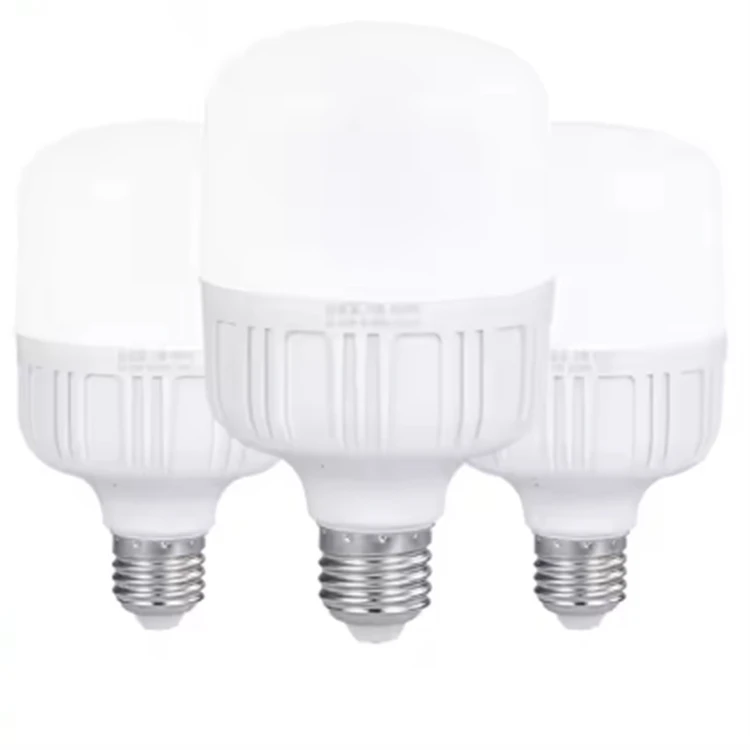
Illuminance Targets and the High-Lumen Imperative
Foot-Candle Requirements Across Warehouse Zones
A warehouse is not a single photometric environment. It is a collection of zones with distinct visual tasks and, consequently, distinct illuminance targets. Bulk storage areas, accessed primarily by forklift, tolerate lower levels: IES guidance places general bulk storage at 10–20 fc. Active storage and general warehousing, where pallets are identified and navigated regularly, commonly target 20–30 fc. Picking and packing zones demand higher levels-30–50 fc-because workers read labels, scan barcodes, and verify SKUs, and higher illuminance reduces pick errors. Shipping and receiving docks require 30–50 fc to manage the transition between interior and exterior light levels.
These targets are not independent of mounting height. A fixture mounted at 25 feet must deliver significantly more raw lumens than a fixture at 15 feet to achieve the same foot-candle level at the work surface. Published lumen output selection tables make this explicit: at 15–20 feet, 10,000–15,000 lumens per fixture may suffice; at 25–30 feet, the requirement rises to 25,000–35,000 lumens; and at heights above 40 feet, 50,000–80,000 lumens per fixture become the design basis. A "high-lumen" bulb is therefore not a marketing superlative in this context. It is a photometric prerequisite for reaching the floor from a warehouse ceiling.
Lumen Delivery vs. Lumen Rating: The Coefficient of Utilization Problem
A lumen rating measured at the lamp does not translate directly into foot-candles on the warehouse floor. A significant fraction of emitted light never reaches the working plane. It is absorbed by the ceiling structure, the tops of racking, dark wall surfaces, and the fixture housing itself. In a 30-foot-ceiling warehouse with racking and concrete floors, roughly 40–60% of light may be lost before it reaches the floor.
Professional lighting design accounts for this through two correction factors: the coefficient of utilization (CU), which captures how much of the fixture's output reaches the work surface given room geometry and surface reflectances, and the light loss factor (LLF), which accounts for lumen depreciation and dirt accumulation over time. Typical warehouse CU values range from 0.45 to 0.55 in open areas and 0.35 to 0.45 in racked aisles; typical LLF values range from 0.75 to 0.85 in clean environments and 0.60 to 0.70 in dusty ones.
The implication for bulb selection is direct: a bulb that produces 15,000 lumens when new but loses 20% of that output within the first two years because of thermal degradation is, in CU-and-LLF terms, a far weaker light source than its initial rating suggests. The "high-lumen" claim must be understood as a claim about maintained lumens, not initial lumens. This is where thermal architecture ceases to be an engineering detail and becomes a photometric specification in its own right.
Why Legacy HID Cannot Close the Gap
Metal halide and high-pressure sodium systems face a structural disadvantage in the high-ceiling warehouse environment. Their luminous efficacy-typically in the range of 60–90 lumens per watt for the lamp alone, before optical and thermal losses-is substantially below that of modern LED systems, which routinely achieve 120–150 lm/W at the fixture level in high-bay configurations. More importantly, HID sources are omni-directional; light emitted upward or sideways must be redirected by a reflector, and that reflection always involves loss.
LED sources, by contrast, are inherently directional. When paired with a well-designed optic-such as the high-transmittance PC lampshade shown on the product-a larger proportion of emitted lumens can be directed toward the working plane. The practical consequence is that a 100W–150W LED bulb can deliver comparable or superior delivered foot-candles to a 400W metal halide lamp, not because the LED is "brighter" in raw output, but because the light is generated and distributed more efficiently. The high-lumen E27 bulb is thus a mechanism for closing the illuminance gap without increasing energy consumption.
Thermal Architecture: The Engineering Behind Sustained High Output
The Junction Temperature Problem
The fundamental constraint on any high-output LED is junction temperature. The LED chip's light output and useful life are both functions of the temperature at the semiconductor junction. A widely used engineering rule of thumb holds that every 10°C increase in LED operating temperature can reduce expected life by approximately half. An LED chip that might last 50,000 hours at a junction temperature of 85°C may last only 25,000 hours at 95°C.
This is not a marginal effect. It is the difference between a lighting installation that amortizes its cost over a decade and one that requires re-lamping within three to four years. In warehouse environments, where ambient temperatures at the ceiling can exceed 40–50°C, and where fixtures are often enclosed or semi-enclosed, the thermal margin available to the LED is narrower than in residential or office applications. A high-lumen E27 bulb without a deliberate thermal design will, in this environment, degrade rapidly-not because the LED chips are defective, but because the heat they generate has nowhere to go.
Aluminum Cooling Fins: Conductive and Convective Heat Transfer
The product's aluminum cooling fins address the first stage of thermal management: moving heat away from the LED board and driver. Aluminum is selected for its high thermal conductivity, allowing heat to spread rapidly from the localized hot spots of the LED array into a larger surface area. The finned geometry then increases the surface area available for convective heat transfer to the surrounding air.
This is the same principle used in specification-grade high-bay luminaires, where die-cast aluminum housings are relied upon to minimize light decay and stabilize chip temperature over a 50,000-hour service life. In a bulb-based retrofit, the constraint is tighter because the available volume is smaller. The finned aluminum section visible between the lampshade and the E27 base is therefore not decorative. It is the primary conductive-convective bridge that determines how much heat can be rejected before the junction temperature rises above its safe operating window.
Built-In Active Cooling: Beyond Passive Heat Sinking
Passive finning alone has a ceiling in compact high-output form factors. As the fin surface area and the thermal resistance of the path from junction to ambient approach their practical limits, the only remaining variable is the convective coefficient on the fin surfaces. A built-in fan changes that coefficient by forcing air across the fins rather than relying on buoyancy-driven natural convection.
The product's high-wattage built-in fan is explicitly described as being included for "higher cooling efficiency." In engineering terms, forced convection can increase the heat-transfer coefficient by a factor of two to five compared with natural convection, depending on airflow velocity and fin geometry. In a warehouse ceiling environment where still-air conditions and elevated ambient temperatures would otherwise erode thermal margin, active cooling is what allows the bulb to sustain a high lumen output without sacrificing junction temperature. Commercial high-output LED bulbs intended for continuous operation in high-temperature environments routinely pair aluminum heat sinks with integrated fans for precisely this reason: the combination is engineered for sustained operation, not intermittent use.
The practical implication is that the fan is a lumen-maintenance component, not an accessory. A fanless high-lumen bulb in the same form factor would either have to be derated in output or accept a shorter service life. The fan buys thermal headroom, and that headroom is what preserves the "high-lumen" claim over time.
IC Constant-Current Driver: Stability Under Thermal Stress
The driver is the second thermally sensitive subsystem in any LED bulb. Electrolytic capacitors and semiconductor components in the driver degrade faster at elevated temperatures, and driver failure is a common mode of premature LED bulb failure even when the LED chips themselves remain functional.
The IC constant-current driver shown in the product's internal architecture serves two functions. First, it maintains a stable drive current to the LED array despite fluctuations in input voltage or forward-voltage variation across chips, which preserves consistent light output and color characteristics. Second, its "anti-interference" design reduces susceptibility to electrical noise on the warehouse mains supply-a non-trivial consideration in facilities with large motors, forklift chargers, and variable-frequency drives on the same distribution circuit. A driver that maintains current stability under thermal stress and electrical noise is a driver that protects the lumen output and the service life of the entire lamp.
High-Transmittance PC Lampshade: Optical Efficiency Without Thermal Penalty
The lampshade material completes the thermal-optical system. Polycarbonate (PC) diffusers with well-controlled diffusion achieve total light transmittance in the range of 85–92%, while converting the harsh point-source emission of the LED array into a softer, more uniform output. The product specifies a "high light transmittance PC lampshade," which places it at the upper end of that range rather than the 80–89% band associated with simpler frosted or low-grade diffusers.
The thermal significance of this choice is often overlooked. A diffuser that achieves soft light by absorbing and re-emitting a large fraction of incident energy converts optical inefficiency into heat inside the lampshade volume. A high-transmittance PC diffuser minimizes that parasitic absorption, reducing the heat load on the LED board and the air volume beneath the shade. In a compact high-output bulb, every percentage point of optical loss that is avoided is also a thermal burden that is avoided. The lampshade is therefore not merely an aesthetic or glare-control element; it is part of the lumen-maintenance strategy.
Matching the Bulb to the Warehouse Environment
Mounting Height and the Need for Directed High Output
Warehouse ceilings commonly range from 20 to 40 feet, with some distribution centers exceeding 40 feet in automated storage and retrieval areas. At these heights, the inverse-square relationship between distance and illuminance is unforgiving: doubling the mounting height quarters the illuminance at the floor for a source of fixed intensity. A bulb intended for a 10-foot residential ceiling is optically and thermally mismatched to a 30-foot warehouse ceiling.
The high-wattage E27 bulb, with its directed output through the PC shade and its active thermal management, is configured for the 20–40 foot band where E27-based high-bay fixtures are typically installed. Its output class-in the range of 10,000 to 25,000 lumens depending on wattage-aligns with the lumen-per-fixture guidance for mounting heights in that range. This is not a general-purpose household lamp repurposed for industrial use. It is a lamp whose wattage, thermal design, and optical distribution are specified for the high-ceiling, high-ambient conditions of warehouse operation.
Ambient Temperature and Continuous-Duty Operation
Warehouse ceilings are thermally stratified. Hot air rises, and in unconditioned or semi-conditioned storage areas, the air temperature at fixture level can be 5–15°C higher than at the floor. Lighting in these spaces also tends to operate for extended hours-often 16 to 24 hours per day in distribution facilities. The combination of elevated ambient temperature and continuous duty is exactly the condition that separates thermally competent high-output bulbs from thermally marginal ones.
Standard LED fixtures in high-ambient environments can suffer rapid lumen degradation and driver failure when internal temperatures exceed the design window. The product's active cooling and finned heat sink are specifically relevant here: they are the mechanisms that extend the thermal margin available to the LED and driver under continuous-duty, high-ambient conditions. In a facility that operates around the clock, a bulb that cannot manage its own heat is a maintenance liability that will present itself within the first year of service.
Vibration, Dust, and Maintenance Frequency
Warehouse environments impose mechanical and particulate stresses that are absent in residential settings. Forklift traffic, dock doors, and conveyor systems generate vibration. Cardboard dust, packaging debris, and ambient particulates accumulate on fixture surfaces and diffusers. The combination of vibration and dust accelerates both optical depreciation and mechanical failure in poorly constructed lamps.
A bulb-based retrofit does not eliminate these stressors, but it changes the maintenance calculus. LED sources are inherently more resistant to vibration than filament-based or arc-based sources, and the absence of a fragile outer glass envelope reduces breakage risk during handling and operation. The PC lampshade contributes impact resistance alongside its optical function. The practical benefit is a longer interval between relamping events-which, at 30 feet, is not merely a materials cost but a labor and equipment-access cost. A high-output bulb that sustains its output is also a bulb that reduces the frequency of scissor-lift or scaffolding deployment, and that maintenance-avoidance value is a significant component of the total economic case.
E27 Compatibility and Retrofit Pathways
The E27 base is the product's interface with the existing infrastructure. In facilities where bulb-based high-bay fixtures are already installed, an E27 retrofit avoids the capital expense and disposal burden of a full fixture replacement. The lamp is screwed into the existing socket, and in ballast-equipped HID fixtures, the ballast must be bypassed or removed so that the LED lamp's integrated driver receives line voltage directly.
This retrofit pathway is not universal. Facilities with integrated LED high-bay luminaires, or with enclosed HID housings that trap heat, may be better served by full fixture replacement. But for the large installed base of E27/E26 bulb-based high-bay fixtures in warehouses, workshops, and storage rooms, the high-output E27 LED bulb is a low-disruption, high-leverage upgrade. It preserves the existing electrical infrastructure while replacing the light source, thermal path, and optical distribution with a system designed for the application.
The Economic Case: Energy, Maintenance, and Payback
Wattage Displacement and Energy Savings
The most direct economic metric in a warehouse lighting retrofit is wattage displacement: the difference between the legacy fixture's power draw and the LED replacement's power draw, multiplied by operating hours and the local electricity rate. Documented high-bay retrofits routinely report energy savings in the range of 70–84% when replacing metal-halide or high-pressure-sodium systems with LED alternatives. A 400W metal halide fixture replaced by a 100W–150W high-output LED bulb, for example, represents a 62–75% reduction in connected lighting load, before any controls-based savings are considered.
The warehouse-specific multiplier is operating hours. A facility operating 16 hours per day, six days per week, runs its lighting for roughly 4,992 hours annually. At that duty cycle, every watt of reduced connected load translates into approximately 5 kWh of annual energy savings. Across dozens or hundreds of fixtures, the aggregate effect is substantial.
Maintenance Cost Avoidance
The maintenance economics of high-ceiling lighting are dominated by access costs, not lamp costs. A relamping event at 30 feet requires either a scissor lift, a scaffolding setup, or a dedicated high-access team. The labor and equipment cost per lamp replacement can easily exceed the cost of the lamp itself by an order of magnitude. Metal halide lamps in warehouse service may require replacement every 10,000–15,000 hours; a thermally well-managed LED bulb can target 50,000 hours or more.
The product's thermal architecture-finned aluminum heat sink, active fan, and stable IC driver-is the mechanism that supports the longer service interval. A bulb that manages its junction temperature is a bulb that does not need to be accessed every two to three years. The maintenance-cost avoidance is therefore not an incidental benefit; it is a direct consequence of the same engineering that sustains lumen output.
Payback Modeling and Documented Retrofit Outcomes
Published case studies provide a realistic frame for payback expectations. A warehouse that replaced 400W metal-halide fixtures with LED high bays reported 73% energy savings, with projected five-year savings of $45,760 in energy costs and $1,215 in maintenance fees. A larger logistics center achieved over 84% energy savings with networked LED high bays and light management, reaching a payback period of 32 months. Another case documented a 13-month project payback with monthly total savings of $5,000.
These figures are not guarantees, and they depend on local electricity rates, operating hours, existing fixture wattage, and whether controls are included. But the directional conclusion is robust: high-efficiency LED replacement in high-ceiling warehouses produces payback periods in the range of one to three years, after which the energy and maintenance savings flow directly to operating margin. The high-output E27 bulb participates in this economics by delivering the required foot-candles at a fraction of the legacy connected load, while its thermal design protects that savings stream against premature lamp failure.
The Cost of Choosing the Wrong High-Lumen Bulb
The economic case has a failure mode that deserves explicit attention. A high-lumen E27 bulb that lacks adequate thermal management will produce its rated output when new, but its junction temperature will rise above the safe window in continuous warehouse duty. The result is accelerated lumen depreciation-the light dims before the lamp fails electrically-followed by driver failure or chip degradation. The facility then faces a second relamping cycle within two to four years, eroding the payback calculation and reintroducing the maintenance burden the retrofit was intended to eliminate.
This is why the thermal specifications matter as much as the lumen rating. The aluminum fins, active fan, and IC driver are the components that convert a short-term brightness claim into a long-term illumination asset. The purchasing decision should be framed accordingly: the objective is not to buy the bulb with the highest initial lumen number, but to buy the bulb whose thermal architecture can sustain its output over the service life the economics assume.
Implementation Checklist for Facility Managers
Verify Socket Type and Ballast Configuration
Before ordering, confirm whether the existing fixtures use E27 or E26 sockets. The two are visually similar and often functionally interchangeable for LED bulbs, but base type should be verified against the fixture documentation. In HID fixtures, determine whether a ballast is present and whether it can be bypassed or must be removed. The LED bulb's integrated driver requires line voltage; operating it on a ballast output will damage the lamp.
Measure Mounting Height and Existing Illuminance
Record the mounting height of the fixtures and take foot-candle readings at the work surface in representative zones-bulk storage, picking aisles, and dock areas. Compare these readings to the IES targets for each zone. This baseline serves two purposes: it quantifies the deficiency the retrofit must close, and it provides the reference against which post-installation performance can be verified.
Confirm Ambient Temperature at Fixture Level
Measure the air temperature at the fixture location during peak operating conditions. Warehouse ceilings can be significantly warmer than floor level. If the ambient at fixture height routinely exceeds 40–45°C, the thermal margin of the selected bulb becomes a critical selection criterion. A bulb with active cooling is not optional in these conditions; it is the specification that separates a viable installation from a recurring maintenance problem.
Calculate Fixture Count and Spacing with CU and LLF
Use the corrected lumen method-(Area × Target fc) / (Lumens per fixture × CU × LLF)-rather than the simple area-times-foot-candle shortcut. Apply CU values appropriate to the space's geometry and racking configuration (0.35–0.45 for racked aisles, 0.45–0.55 for open areas) and an LLF that reflects the facility's cleanliness and maintenance regime. This calculation yields a realistic fixture count that accounts for the light that will actually reach the work surface.
Establish a Post-Installation Verification Protocol
Plan to measure foot-candles at the same locations and under the same conditions as the baseline, ideally after 100 hours of operation to allow for initial stabilization. Verify that the installed bulbs are achieving the design targets in each zone. If controls or dimming are part of the installation, commission them and confirm that the controlled output still meets the task requirements during occupied periods.
Conclusion
The dim warehouse is not an inevitability. It is the predictable outcome of light sources and thermal designs that were never engineered to sustain output in high-ceiling, high-ambient, continuous-duty environments. The high-lumen E27 LED bulb, when built with an integrated active cooling fan, an aluminum fin heat sink, a stable IC constant-current driver, and a high-transmittance PC lampshade, addresses the root cause rather than the symptom. It delivers the lumen output required to reach the warehouse floor, and it manages the heat that would otherwise erode that output within the first years of service.
For facility managers, the purchasing logic is straightforward. The bulb's thermal architecture is the warranty behind its lumen rating. A high initial lumen number without a credible thermal path is a short-term promise. A high-lumen bulb with finned aluminum, forced convection, and a protected driver is a long-term illumination asset-one that supports the foot-candle levels the warehouse actually needs, the maintenance interval the budget actually assumes, and the energy savings the payback model actually projects. The specification to look for is not merely "high lumen." It is high maintained lumen, and that distinction lives in the metal and the airflow, not on the label.

How To Cooperate With Us?
We are happy to have total control over the manufacturing process and the calibre of our products since we have our own facilities. Since we are producers rather than just brokers, we are dedicated to providing our customers with the best pricing. Since we are certain that the price and quality of our products are clear, we invite customers to see our samples first. Our commitment to quality and customer satisfaction drives us to continuously provide top-notch goods.
Our address
3rd Floor, 5th Building, Hebei Industrial Park, Hualian Community, Longhua District, Shenzhen, China





