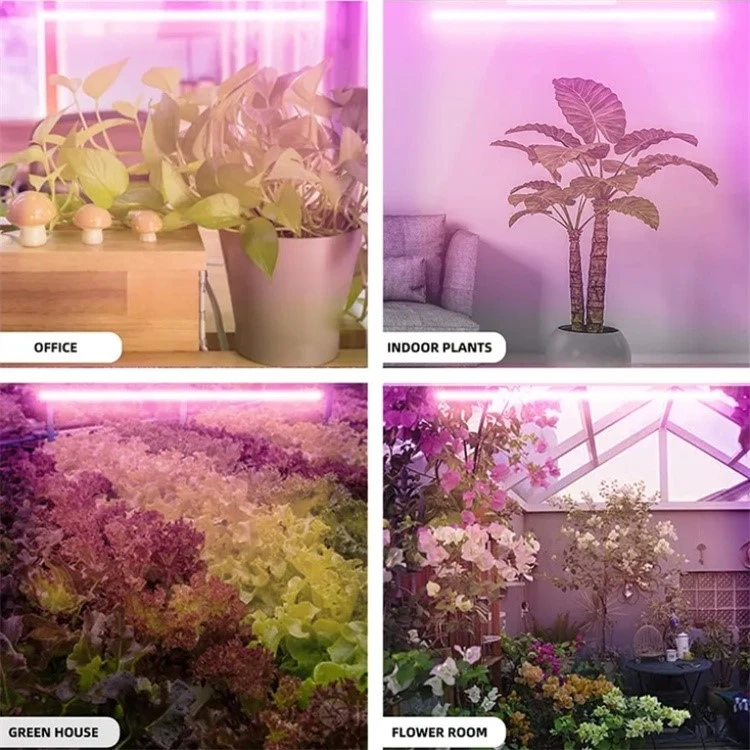
More and more people are taking up indoor gardening-from succulents and herbs on windowsills to leafy greens and seedlings on balconies, or even small-scale commercial growing racks. Yet, they all face the same challenge: a lack of light. Natural light near windows fluctuates in intensity and becomes exceptionally scarce during the winter. Meanwhile, traditional grow lights often suffer from high power consumption, excessive heat generation, or bulky, inconvenient designs. LED grow tube lights are designed specifically for these scenarios. Resembling standard T5 or T8 fluorescent tubes, they are easy to install, feature spectra tailored to plant needs, and are significantly more energy-efficient than older lighting technologies.
What are LED grow tube lights?
LED grow tube lights are artificial supplemental lighting devices that house LED chips within a tubular fixture. They typically come in T5 or T8 specifications, with lengths ranging from 60 cm to 120 cm.
Unlike traditional fluorescent tubes, they contain no mercury and do not shatter into dangerous shards of glass. They are usually constructed with an aluminum alloy housing and a polycarbonate (PC) cover, which ensures superior heat dissipation. Many models also support daisy-chaining, allowing multiple tubes to be connected to a single power source-an ideal feature for multi-tiered growing racks.
Why are they more energy-efficient?
Energy efficiency is the primary reason most people choose LED grow tubes, for three main reasons:
High photoelectric conversion efficiency: For the same light output, LEDs consume significantly less electricity than incandescent or high-pressure sodium (HPS) lamps, with very little energy wasted as heat.
Low heat emission: The tubes can be placed closer to plants without the risk of scorching the leaves, eliminating the need for additional cooling or ventilation equipment.
Long lifespan: High-quality LED tubes can last for tens of thousands of hours. With less frequent replacements required, they prove more cost-effective in the long run.
To put this into perspective: for a growing rack operated for 12 hours a day, the difference in electricity costs between using LED tubes and traditional fluorescent lights becomes substantial over the course of a year-and the more lights you use, the greater the savings.
Choosing the Right Spectrum for Plants
Plants don't care about how "bright" a light is; what matters is the specific light they can "consume." Photosynthesis primarily utilizes red and blue light, making the spectrum the most critical factor when selecting a grow light.
Red-Blue Spectrum: Red light promotes flowering and fruiting, while blue light encourages leaf growth and a compact plant structure. Different ratios are suited for different growth stages.
Full-Spectrum (predominantly white light): This mimics natural light, making it more comfortable for the human eye and easier to observe the condition of your plants-ideal for home or office settings.
Supplemental Far-Red or UV: Some products include these for specific crops, but the average user does not need to seek them out.
For casual indoor gardening, full-spectrum lights are the most convenient choice. If you are growing leafy greens for high yield or starting seeds, consider models with adjustable red-to-blue ratios.
Matching Power with Light Intensity
Many people focus solely on wattage, but wattage does not equate to the light actually available to the plant.
Look at PPFD, not just wattage: PPFD (Photosynthetic Photon Flux Density) measures the amount of photosynthetically active light actually reaching the plant canopy; it is the true metric for determining if the light is "sufficient."
Different plants have different needs: Shade-tolerant ornamental plants have low light requirements, leafy greens and herbs fall in the middle, while flowering and fruiting plants have the highest requirements.
Distance matters: The closer the light is to the plant, the higher the light intensity. You should generally adjust the hanging height based on the plant's growth.
Even without professional equipment, you can gauge the situation through observation: if plants become "leggy" (stretched out) or their leaves turn yellow and sparse, they likely aren't getting enough light. If leaves curl or turn pale/whitish, the plant might be too close to the light source.
Light Fixture Specifications and Installation
Choosing the right specifications will save you a lot of trouble.
Length: Select based on the width of your plant rack. Common lengths include 60cm, 90cm, and 120cm; ideally, the light should be slightly shorter than or equal to the width of the rack.
Connection and Power Supply: Integrated fixtures connect directly to a power source, while modular (separate) units require an external driver.
Before purchasing, ensure compatibility with your existing fixtures or sockets. Installation Methods: Can be ceiling-mounted, suspended, or secured beneath shelving units using brackets. For shelf-based gardening, using hooks or clips is typically the most convenient approach.
Daisy-chaining (Series Connection): Connecting multiple units together reduces the number of power outlets required and keeps wiring neat and organized.
Suitable Plants
Leafy Greens: Lettuce, spinach, arugula, etc. These have short growth cycles and modest spectral requirements, making them ideal for indoor cultivation under grow lights.
Herbs: Basil, mint, cilantro, etc. These require relatively high light intensity; supplemental lighting from nearby grow lights works very effectively.
Seed Starting: Seedlings are sensitive to light; low-heat LED grow lights are an excellent choice, as they won't scorch young plants.
Foliage Plants and Succulents: Succulents require strong light to prevent "leggy" (stretched) growth, while foliage plants generally prefer more moderate light levels.
Fruiting vegetables like tomatoes and peppers can also be grown, but they require higher light intensity. One or two grow lights may not be sufficient; you will need to increase the number of lights (density).
Common Pitfalls When Buying
Exaggerated Wattage: It is not uncommon for the stated wattage to differ from the actual power consumption; it is advisable to request a test report.
Lack of Spectral Data: If a product is labeled "full-spectrum" but the manufacturer cannot provide a spectral graph, it is likely just a standard white-light lamp.
Poor Heat Dissipation: Products with flimsy construction often suffer from rapid light degradation-brightness may drop significantly after just six months of use.
Ignoring Ingress Protection (IP) Ratings: Growing environments are often humid. If there is a risk of exposure to water spray or irrigation, choose a model with an appropriate waterproof and dustproof rating (e.g., IP65).
Focusing Solely on Price: Low-cost products often cut corners on LED chips, drivers, and build quality, which can actually lead to higher long-term costs.
Conclusion
Choosing an energy-efficient LED grow light tube really comes down to a few key factors:
Check the spectrum-prioritize options with an optimal red-to-blue ratio or a high-quality full spectrum.
Look at the PPFD (Photosynthetic Photon Flux Density) rather than just the wattage.
Select the right length and mounting method to allow for future expansion.
Pay attention to heat dissipation, the IP (ingress protection) rating, and the quality of the LED chips.
Match the light intensity to the specific plants you are growing-avoid a "one-size-fits-all" approach.
Choosing the right light ensures healthy plant growth while saving on electricity costs-that is the truly cost-effective way to approach indoor cultivation.
If you are looking for reliable LED grow light tubes for cultivation projects, retail channels, or your own brand, we offer a variety of options in terms of length, wattage, and spectral configurations. We support OEM/ODM customization and can recommend the ideal setup for your specific growing environment. Please leave a message or send us an email detailing your application and requirements; we will promptly provide you with product information, price quotes, and sample options.