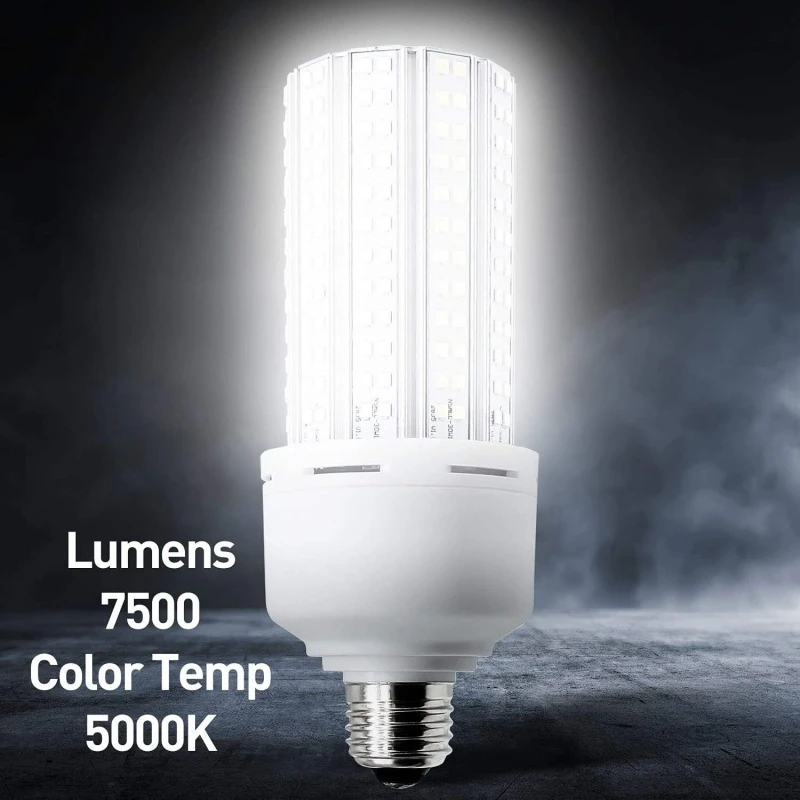
Anyone who has undertaken a lighting retrofit has likely encountered this scenario: old, inefficient fixtures lead to high electricity bills, but the prospect of switching to LED-which might involve removing fixtures, rewiring, and repositioning light points-is daunting. At such moments, someone might suggest: "Why not just swap in an LED 'corn' bulb?"
This suggestion has some merit, though it isn't the right solution for every situation. This article breaks down the advantages and limitations of LED corn bulbs to help you determine whether they are a suitable choice for your project.
What exactly is an LED corn bulb?
The term "corn" refers to the bulb's appearance: it features a cylindrical body covered in densely packed LED chips, arranged in rows that resemble kernels on a corn cob.
This design allows for a light distribution angle approaching 360°. While standard LED bulbs primarily direct light forward, corn bulbs emit light in all directions. When installed in a fixture, they provide an omnidirectional light output similar to that of traditional metal-halide or high-pressure sodium lamps.
They are available in a wide range of wattages-from 5W to 150W-and come with various base types (such as E26/E27, E39/E40, and E14), making them compatible with most sockets, from residential to industrial applications.
Why are they considered "convenient"? The logic of direct replacement
The primary advantage is that there is no need to replace the existing light fixtures.
In most cases, as long as the base type matches, you can simply unscrew the old bulb and screw in the LED corn bulb. There is no need to purchase new fixtures or alter the mounting hardware. For a facility like a warehouse with hundreds of lights, this translates to a shorter retrofit timeline, lower labor costs, and minimal disruption to ongoing operations.
A crucial point to note: if the original fixture includes a ballast, you must verify whether the LED corn bulb is compatible. Some models require the ballast to be bypassed or removed entirely; do not skip this step, as failing to do so could compromise both safety and the lifespan of the bulb.
Which traditional light sources can they replace?
Corn lights are commonly used to replace the following types of light sources:
Metal-halide lamps and high-pressure sodium (HPS) lamps: These are the most common legacy light sources found in high-bay lighting, street lighting, and industrial facilities. Characterized by high power consumption and slow startup times, they are the primary targets for retrofitting.
Compact fluorescent lamps (CFLs): Frequently found in corridors, garages, porches, and similar areas.
Older, high-wattage incandescent or halogen lamps: These are essentially obsolete, offering only the disadvantage of high energy consumption.
In general, corn lights offer significantly higher luminous efficacy than these traditional sources, allowing for substantial power savings while maintaining the same level of brightness. The exact energy-saving ratio depends on the original lamp model and the luminous efficacy of the chosen corn light; it is best to calculate based on actual lumen and wattage figures rather than relying on marketing claims like "equivalent to X watts."
Common application scenarios
Warehouses and industrial facilities: Spaces with moderate ceiling heights, where they can replace legacy high-bay fixtures.
Parking lots and garages: Their omnidirectional light output ensures even illumination across the ground and surrounding areas.
Street and garden lights: Used in conjunction with a fixture housing (luminaire) to replace existing sodium lamps.
Commercial canopies and gas station roofs: These require specific ingress protection (IP) ratings to ensure water resistance.
Decorative lanterns and pillar-top lights: The columnar shape of corn lights complements these types of fixtures.
Limitations to consider before use
While they are often described as the "easiest" solution, they are not without their challenges. Here are some common pitfalls encountered in real-world projects:
Heat dissipation: Corn lights lack a dedicated external heat-dissipation structure, relying instead on their own body to dissipate heat. In enclosed fixtures, heat cannot escape easily, which can shorten the lamp's lifespan. Some high-wattage models feature built-in fans or cooling fins-keep this in mind when selecting a model.
Glare: Because the LED chips are exposed, they can be quite dazzling if looked at directly. In settings without a fixture housing or reflector, careful consideration must be given to installation height and positioning.
Lack of focused light distribution. A 360° light distribution pattern is actually a disadvantage for applications requiring directional lighting (such as accent lighting directed downward from a height), as a portion of the light is wasted in unwanted directions.
Fixture compatibility: Factors such as the base type, ballast, and internal fixture space must all align; any mismatch can prevent proper installation or functionality.
Key Parameters to Consider When Purchasing
Luminous Flux (Lumens) and Luminous Efficacy (lm/W): Do not rely solely on wattage-two 50W bulbs can have vastly different light output levels.
Color Temperature and Color Rendering Index (CRI): Neutral white to cool white is typically preferred for warehouses and workshops, while a higher CRI is recommended for commercial spaces.
Base Type and Dimensions: Measure the socket and the internal space of the fixture before selecting a model.
Ingress Protection (IP) Rating: For outdoor or damp environments, choose models with appropriate waterproof and dustproof ratings.
Driver and Ballast Compatibility: Determine whether the bulb is a "direct-fit" (plug-and-play) type or if it requires rewiring.
Certifications and Warranty: Certification requirements vary by market, and the length of the warranty often reflects the manufacturer's confidence in their product.
Conclusion
If the base type matches, there is sufficient internal space, and precise light distribution is not required, then the answer is generally "yes." This solution avoids the need to replace entire fixtures, allows for quick installation, and entails a lower initial investment-making it particularly well-suited for large-scale retrofitting projects such as warehouses, parking lots, and street lighting.
However, if your fixtures are enclosed, have strict requirements for heat dissipation or light distribution, or involve complex existing ballast configurations, a thorough assessment is necessary-in some cases, dedicated LED fixtures may be a better choice. When the right product is selected for the right environment and with the correct specifications, "corn-style" LED bulbs can be both highly efficient and hassle-free.
Want to learn more? Get in touch with us.
If you are planning a lighting retrofit project but are unsure about the required wattage, base type, or whether your existing fixtures are suitable for a "corn-style" LED upgrade, feel free to send us the model numbers of your current fixtures, the operating environment, and the quantity required. Our team will recommend the best solution for your specific needs and provide samples and price quotes. We also offer OEM/ODM customization and welcome bulk inquiries.