

When purchasing LED floodlights, many buyers focus primarily on wattage, lumens, and IP ratings-only to encounter issues after installation: the lights remain on during the day, stay illuminated in empty corridors, or fail to activate when someone passes by. These problems are rarely due to poor product quality; rather, they usually stem from choosing the wrong type of sensor. There are three common types of sensors for floodlights: photocells, PIR (passive infrared) sensors, and microwave sensors. Each operates on a different principle and is suited to different applications. Below, we break them down to help you make the right choice during your procurement or selection process.
Photocell Sensors: Based on Ambient Light Levels
A photocell sensor uses an internal photoresistor to control the light based on the intensity of ambient light. It automatically turns the light on when it gets dark and off when it gets light, regardless of whether anyone is present.
Pros
Simple design, lowest cost, and low failure rate.
Requires no manual intervention; ideal for areas that need to be illuminated all night.
Can be paired with timers or dimming functions-for example, providing full brightness during the first half of the night and reduced power during the second half.
Limitations
Cannot distinguish between the presence or absence of people, leading to power consumption throughout the entire night.
Installation location must be chosen carefully to avoid interference from other light sources (such as streetlights or vehicle headlights), which could cause the sensor to malfunction and the light to flicker on and off.
Ideal for: Courtyards, perimeter walls, billboards, parking lots, and other areas requiring stable, long-duration illumination.
PIR (Passive Infrared) Sensors: Detecting Human Body Heat
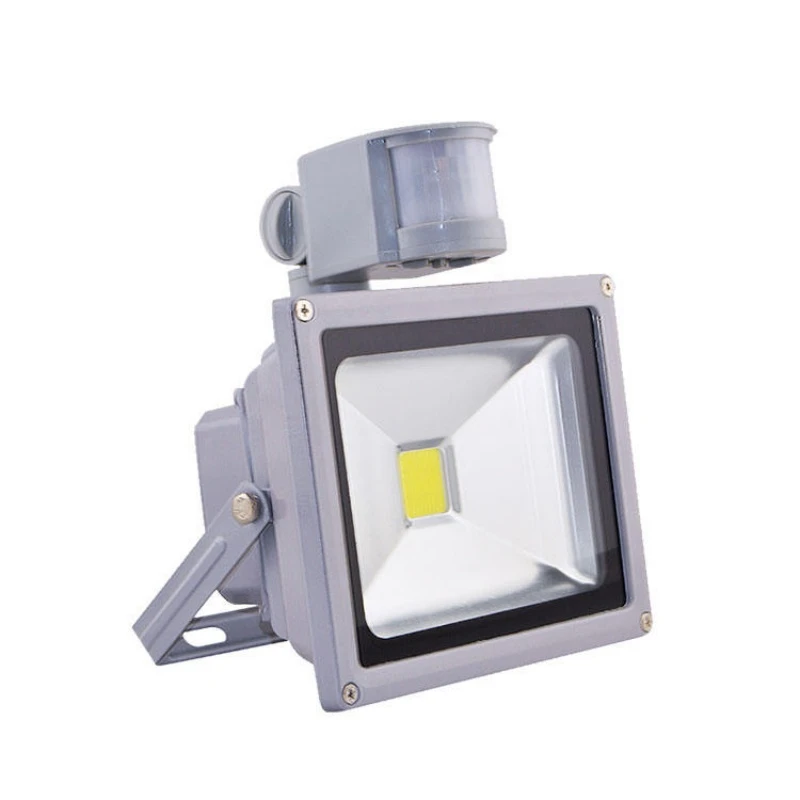
PIR (passive infrared) sensors are triggered by detecting the temperature difference between a human body and the surrounding environment. When a person enters the detection range, the light turns on; after the person leaves, the light remains on for a set duration before automatically switching off.
Pros
Illuminates only when someone is present, offering significant energy savings.
Less prone to false triggers; less sensitive to swaying foliage or small animals compared to microwave sensors.
Moderately priced with high market acceptance.
Limitations
More sensitive to lateral (side-to-side) movement than to direct approach; installation angle is critical.
Sensitivity decreases in summer when ambient temperatures approach human body temperature.
Cannot penetrate obstacles such as glass or walls.
Detection range is typically limited to 6–12 meters.
Suitable for: Residential garage entrances, side doors, walkways, backyards, and other areas where lighting is only needed when someone is present.
Microwave Sensing: Detecting Movement via Electromagnetic Waves
Microwave sensors actively emit high-frequency electromagnetic waves and detect movement by analyzing frequency shifts in the reflected waves. They do not rely on temperature, responding instead to the motion itself.
Pros
Large detection range, high sensitivity, and a wide, adjustable detection area.
Unaffected by ambient temperature; functions reliably even in hot weather.
Can penetrate glass, wood, and thin walls, allowing for discreet installation.
Limitations
Highly sensitive; can be triggered by swaying tree branches, raindrops, or passing vehicles.
High penetration can be a double-edged sword-movement on the other side of a wall may also trigger the light.
Generally more expensive than PIR sensors.
Suitable for: Large warehouses, factory perimeters, open parking lots, and industrial settings requiring wide-area coverage.
Choosing Based on Application Scenario
For all-night illumination: Use light-controlled (dusk-to-dawn) sensors-stable and hassle-free.
For lighting only when someone is present (in smaller areas): Use PIR sensors-the best value for money.
For large, open spaces requiring wide-area coverage: Use microwave sensors (ensure sensitivity is adjusted to an appropriate level).
For basic nighttime illumination that brightens further when someone is present: Use a combination of light-controlled and PIR sensors, or a sensor-equipped light with dimming capabilities.
In environments with frequent movement from wind-blown foliage or small animals: Prefer PIR sensors; microwave sensors are not recommended.
If the light is installed behind glass or thin panels: Microwave sensors are required for detection. When making a purchase, consider a few additional factors: whether the sensing distance and angle are adjustable, if the time delay can be configured, and whether the unit features both light-sensing and motion-sensing modes. These details often have a greater impact on the user experience than the type of sensor itself.
Summary
Light sensors control operation based on time, PIR (passive infrared) sensors respond to the presence of people, and microwave sensors detect motion. No single sensor type is objectively the "best"; the right choice depends entirely on your specific environment. Use light sensors for all-night illumination, PIR sensors for corridors and residential areas, and microwave sensors for large spaces or industrial settings. If your requirements are more complex, opt for a combination model that integrates multiple sensing modes, allowing a single light to provide both energy efficiency and security.
Need selection advice or a customized solution?
We offer LED floodlights equipped with light-sensing, PIR, microwave, or multi-mode sensing technologies. These are available in various power ratings, color temperatures, and IP (ingress protection) ratings. We can also tailor sensing parameters, time delays, and physical design to meet the specific requirements of your project. Please leave a message or send us an email describing your intended application; our engineers will recommend the ideal solution and provide a quote along with samples.
Our address
No. 5-3 Niujiao Road, Yanchuan Community, Yanluo Subdistrict, Bao'an District, Shenzhen
bwzm18@ledbenweilighting.com






