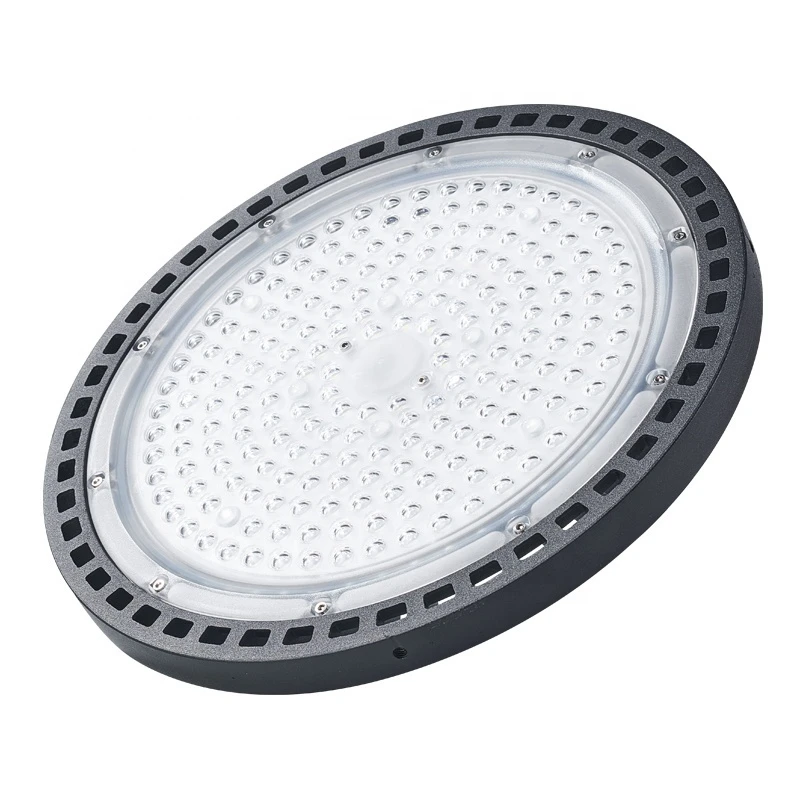
When upgrading warehouse lighting, many buyers and contractors face a common dilemma: for high-bay fixtures, should you choose an SMD or a COB light source? While the lumen ratings on spec sheets may appear similar, the actual brightness in warehouse aisles, the uniformity of light on the floor, and visual comfort can vary significantly once the fixtures are installed. The key factor determining these differences is "light distribution." This article examines the structural differences between these two types of light sources and compares their performance in a warehouse environment to help you decide which is best for your project.
Understanding "Light Distribution"
Light distribution refers to how light emitted by a fixture is spread throughout a space. In a warehouse context, three main metrics are considered:
Beam Angle: Common options include 60°, 90°, and 120°. Narrower angles concentrate light, making them suitable for high ceilings, while wider angles cover larger areas, making them better for lower ceilings.
Illuminance Uniformity: The difference between the brightest and darkest points on the floor or the faces of storage racks. Greater uniformity ensures a more comfortable working environment and reduces the risk of missing labels.
Glare Control: Whether the light source causes discomfort or "dazzle" when viewed by forklift operators or warehouse staff.
Many people focus solely on lumen output; however, lumens only indicate the "total amount of light emitted"-they do not specify "where that light actually lands."
Light Distribution Characteristics of SMD High-Bay Fixtures
In an SMD (Surface-Mounted Device) configuration, multiple low-power LED chips are distributed across a circuit board, typically paired with secondary lenses.
Naturally Uniform Light: With dozens to hundreds of individual LED chips spread out-each covering a specific, small area-the resulting illumination on the floor is smooth and consistent.
Versatile Beam Options: Because each LED chip can be equipped with its own lens, these fixtures can achieve various beam angles (such as 60°, 90°, or 120°) and even asymmetrical light distribution, which is ideal for illuminating aisles.
Softer, Less Intense Glare: Since the brightness of any single chip is relatively low, the light does not strike the eye with the same intensity as a concentrated, high-brightness point source. Large heat dissipation area: With LED chips distributed over a wider area, heat is not concentrated.
This makes light depreciation easier to control and ensures that the light distribution remains stable over long-term use, preventing distortion caused by the aging of individual chips.
It is worth noting that if the number of LED chips is low or the lens quality is poor, issues like multiple light spots and shadows can occur; therefore, one should not simply assume that "SMD" automatically guarantees uniform light distribution.
Light distribution characteristics of COB high-bay lights
COB (Chip-on-Board) technology involves packaging multiple LED chips directly onto a single light-emitting surface, creating a concentrated, high-intensity luminous area.
High brightness from a single point: The light-emitting surface is small yet powerful, producing a concentrated beam. When paired with a reflector or lens, it can achieve a very narrow beam angle, allowing for long-range, precise illumination.
Well-defined light spot boundaries: Ideal for applications where light needs to be "projected" over a long distance, such as in warehouses with high ceilings.
Higher risk of glare: Due to the high brightness of the light-emitting surface, it can be dazzling when viewed directly; therefore, deep-profile reflectors or anti-glare shields are required.
Relatively fixed light distribution angles: Finished fixtures typically offer angles around 90° or 120°, with limited flexibility for creating asymmetrical or complex light distribution patterns.
Simpler structure and lower cost: With fewer individual LED chips and a straightforward assembly process, some COB products offer a price advantage.
Other key factors affecting light distribution
The type of light source is not the only variable; the following factors are often equally important:
Quality of lenses and reflectors: The material and optical design directly determine the actual light distribution. Even when using the same COB technology, the performance can vary significantly depending on the manufacturer's reflector design.
Mounting height and spacing: As a general rule, the spacing between fixtures should not exceed 1 to 1.5 times the mounting height; otherwise, dark zones may appear between them.
Rack layout: The height of the storage racks and the width of the aisles determine whether the priority should be horizontal (floor) illuminance or vertical (rack-face) illuminance.
Color Rendering Index (CRI) and color temperature: For warehouses, a color temperature of 4000K–5000K and a CRI (Ra) of ≥80 are commonly used, as they help in identifying labels and the colors of goods.
Light depreciation and thermal management: Even with a high-quality light source, poor thermal management will lead to a decline in luminous flux after a year or two of use, which in turn alters the light distribution.
Selection Recommendations and Summary
Key Takeaways:
For general applications requiring uniform, comfortable, and wide-area illumination, SMD high-bay lights are the preferred choice for most standard warehouses.
For facilities with very high ceilings that require long-distance, concentrated light projection, COB high-bay lights-ideally paired with anti-glare features-are a suitable option.
Regardless of the light source, always evaluate the light distribution design, mounting height, and spacing in tandem; do not base your decision solely on lumen output or price.
For significant projects, we recommend conducting a DIALux lighting simulation before placing an order. This allows for data-driven validation rather than relying on guesswork or past experience.
Need a customized lighting solution for your warehouse?
Every warehouse has unique ceiling heights, racking layouts, and operational demands. Choosing the wrong light source can lead to costly retrofitting later-an expense far greater than the time invested in proper planning upfront.
If you are currently planning your warehouse lighting, please share your warehouse dimensions, mounting heights, and racking layout with us to receive a tailored solution and a formal quote.