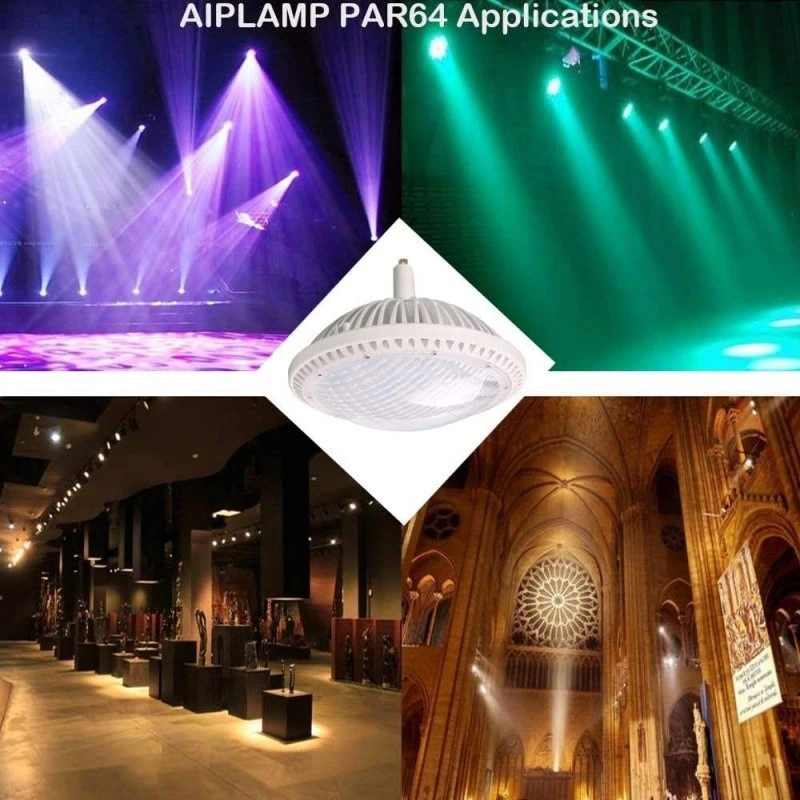
If you are involved in purchasing lighting for stages, churches, or architectural projects, the term "PAR64" will likely be familiar to you. These fixtures are substantial in size and produce a concentrated beam of light. While they have been in use for decades, LED versions have now largely replaced the traditional halogen models. This article outlines the definition, types, applications, and key selection criteria for PAR64 LED fixtures, providing you with the essential background knowledge needed before requesting quotes or making purchasing decisions.
What does "PAR64" mean?
"PAR" stands for "Parabolic Aluminized Reflector." The fixture contains a parabolic-shaped reflector that gathers light and directs it forward, creating a focused beam.
The number "64" refers to the diameter of the fixture, measured in units of 1/8 inch. Thus, 64 ÷ 8 = 8 inches (approximately 203 mm). Similarly, a "PAR38" fixture has a diameter of 4.75 inches. Consequently, the PAR64 is a large-format fixture within the PAR series, commonly used in professional lighting applications.
How do LED versions differ from traditional halogen models?
Traditional PAR64 fixtures typically utilize 500W or 1000W halogen lamps. While they are certainly bright, they also come with significant drawbacks. LED versions offer several improvements:
Lower power consumption: LED PAR64 fixtures generally operate between 30W and 200W, yet can achieve brightness levels comparable to traditional halogen lamps that consume hundreds of watts.
Reduced heat output: Halogen lamps reach very high surface temperatures. While LED fixtures still require heat dissipation, they generate significantly less heat, resulting in lower ambient temperatures and reduced strain on air conditioning systems.
Longer lifespan: LED light sources are typically rated for tens of thousands of hours of operation, eliminating the need for frequent replacements-a major advantage for fixtures installed in hard-to-reach, high-ceiling locations.
Dimmability and color versatility: Models equipped with RGB or RGBW technology can be controlled via DMX, allowing a single fixture to produce a wide range of colors without the need for external color gels.
Common Types of PAR64 LED Fixtures
Single-color or White-light Models: Available in warm white, neutral white, or cool white. These are ideal for settings that require consistent white light, such as television studios and exhibition halls.
RGB / RGBW / RGBWA Full-color Models: These utilize multi-colored LED chips to produce a wide spectrum of colors; they are most frequently used for stage lighting and atmospheric effects.
Waterproof Models: Typically rated at IP65 or higher, these are designed for outdoor use-perfect for architectural wall-washing and landscape illumination.
Adjustable Beam Angle Models: Some versions feature interchangeable lenses, allowing for beam angles ranging from narrow (approx. 10°–15°) to wide (over 40°).
Key Application Scenarios
Stage and Performance: Used in concerts, theatrical productions, and weddings for front lighting, side lighting, and background color washes.
Television and Studios: Require stable color rendering and flicker-free performance; high-CRI (Color Rendering Index) white-light models are best suited for these environments.
Churches and Event Venues: With high ceilings and long throw distances, the low heat output and long lifespan of LED fixtures offer significant practical advantages.
Building Facades and Landscapes: Waterproof models are used to illuminate building exteriors, bridges, trees, and sculptures.
Bars, Nightclubs, and Themed Venues: Utilize color transitions and dynamic effects to create a specific atmosphere.
Conclusion
The PAR64 is an 8-inch diameter parabolic reflector fixture, characterized by its concentrated beam and high brightness. LED versions retain these core strengths while offering lower power consumption, reduced heat generation, a longer lifespan, and flexible color-changing capabilities. They are widely used in stage productions, television studios, churches, event venues, architectural lighting, and entertainment spaces. When selecting a fixture, focus on key specifications such as power (wattage) and lumen output, beam angle, color rendering index (CRI), control methods, and ingress protection (IP) ratings-choosing the right parameters ensures a reliable and hassle-free lighting experience.
If you are looking for PAR64 LED fixtures for a project, or if you would like to inquire about customization options-such as specific power ratings, beam angles, color configurations, or IP ratings-please feel free to contact us. Tell us about your use case and the required quantity, and we will recommend the appropriate model, provide a price quote, and offer sample support.