In emergency scenarios such as fires and sudden power outages, emergency lights are the "invisible guardians" protecting life-saving passageways. They come in various types and have different uses. Choosing the right emergency light not only meets fire safety compliance requirements but also provides crucial support for evacuation and rescue in times of crisis. Many purchasers easily confuse the functions of different types of emergency lights and are unclear about which type is suitable for different scenarios. Today, we'll outline the core classifications of emergency lights, combined with the latest industry standards, to help you quickly clarify your selection process and avoid purchasing pitfalls.
Classification by Power Supply Method
The power supply method is the most basic classification of emergency lights, directly determining their installation complexity and maintenance costs. The core types are self-contained power supply and centralized power supply, adapting to different building sizes and needs.
Self-Contained Power Supply Emergency Lights
This type of emergency light is currently the most common. The light fixture has an internal battery. Under normal circumstances, it is powered by mains electricity, which also charges the battery. When the mains power is interrupted (such as during a power outage or fire), the battery automatically starts to power the light fixture. Its advantages lie in its flexible installation, requiring no additional centralized power supply, the ability of a single lamp to operate independently, and easier maintenance, requiring only periodic battery checks.
According to the new national standard GB 17945-2024, self-powered emergency lights are mostly Type A lamps (DC power supply, rated voltage not exceeding 48V), which can use compliant lead-acid batteries and are widely used in small shops, office buildings, residential buildings, and other small to medium-sized buildings.
Centralized Power Supply Emergency Lights
Unlike self-powered types, these emergency lights do not contain batteries and rely on a dedicated centralized emergency lighting power supply. All lamps are connected to the centralized power supply via wiring, which provides emergency power to the lamps. Its advantages include convenient centralized management, real-time monitoring of the operating status of all lamps, and rapid fault location. It is suitable for large buildings, shopping malls, subway stations, and other scenarios with a large number of lamps and complex layouts.
Classification by Control Method
The control method determines the level of intelligence of the emergency light, mainly divided into centralized control and non-centralized control. The core difference lies in whether unified management and intelligent linkage can be achieved.
Centralized Control Emergency Lights
These emergency lights require an emergency lighting controller. The controller centrally controls the starting, stopping, and fault monitoring of all lights, and can also link with fire alarm systems to achieve dynamic evacuation guidance. For example, in the event of a fire, the controller can automatically adjust the direction of evacuation signs based on the location of the fire, guiding people away from dangerous areas and significantly improving evacuation efficiency.
Their communication methods are primarily RS485 and Ethernet wired transmission, with Bluetooth used only as an auxiliary means. They are suitable for large public buildings, medical buildings, and high-rise buildings with high fire safety requirements.
Non-Centralized Control Emergency Lights
Non-centralized control emergency lights do not require a controller. They are independently controlled by the emergency lighting central power supply or emergency lighting distribution box, automatically starting when the mains power is interrupted. They cannot achieve unified management and intelligent linkage. Their simple structure and low cost make them suitable for small buildings, warehouses, and ordinary shops where high levels of intelligence are not required, meeting only basic emergency lighting needs.
Classification by Purpose
Classifying by purpose is the most practical approach. Emergency lights with different purposes fulfill different safety missions and must be precisely matched according to the needs of the scenario.
Emergency Lighting Fixtures
Their core function is to provide emergency lighting, illuminating critical areas such as evacuation routes, stairwells, and fire control rooms in emergencies to ensure personnel can clearly identify escape routes and conduct rescue operations. Common types include double-headed wall-mounted emergency lights and ceiling-mounted emergency lights. Illuminance must comply with GB 55037-2022 standards: ≥3.0 lx illuminance on the floor of evacuation corridors and ≥5.0 lx illuminance on the floor of stairwells.
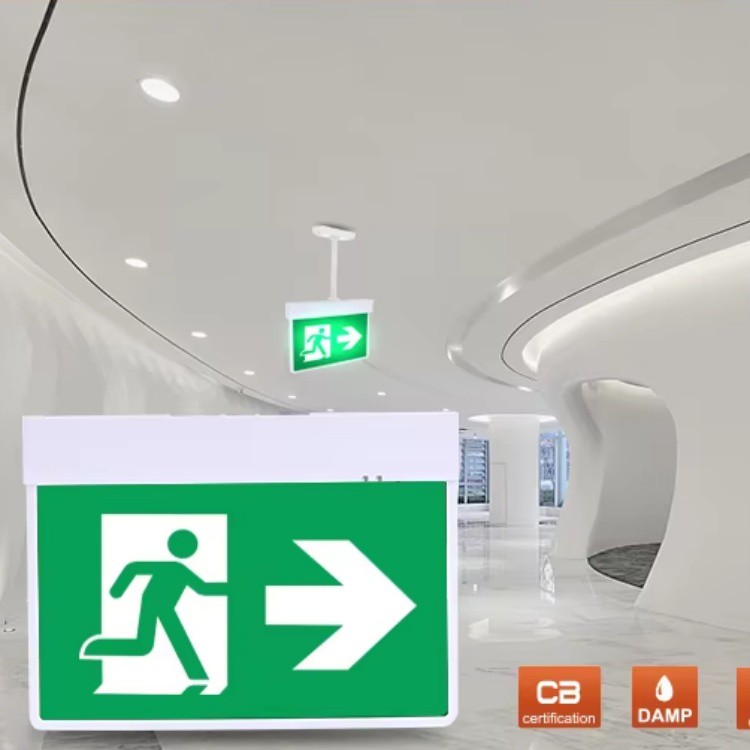
Emergency Evacuation Signage Fixtures
These primarily use graphics and text to indicate safety exits, evacuation directions, floors, etc. They are divided into variable and fixed types. For example, green arrow signs indicate evacuation directions, and safety exit signs mark the location of escape exits. They are often installed on corridor walls or above exits, with a spacing of no more than 20 meters to ensure rapid identification in the dark.
Emergency Lighting and Signage Composite Fixtures
These combine emergency lighting and evacuation guidance functions, integrating the advantages of both. They eliminate the need for separate fixtures, saving installation space and cost. Suitable for narrow passageways and limited installation space, such as underground garages and small corridors.
Classification by Installation Method
The installation method should be selected based on the building structure and usage scenario. Different installation methods for emergency lights have different focuses in terms of lighting range and applicable scenarios. Common types are as follows:
Wall-Mounted Emergency Lights
The most common installation method, often featuring a double-headed design, fixed high on the wall (no less than 2 meters from the ground). Suitable for corridors, stairwells, and passageways. Simple to install, providing a wide field of vision, and effectively illuminating evacuation routes.
Ceiling-Mounted Emergency Lights
Installed on the ceiling, these do not occupy wall space and offer a wider lighting range. Suitable for large shopping malls, conference rooms, exhibition halls, and other open spaces, providing uniform emergency lighting and avoiding blind spots.
In-ground Emergency Lights
Recessed in the ground, these are primarily used in scenarios with heavy smoke (smoke rises). Ground-level indicators are unaffected by smoke, clearly guiding evacuation. Suitable for subway stations, tunnels, underground parking garages, etc.
Recessed Emergency Lights
Embedded in the ceiling or wall, these have a clean appearance and do not disrupt the overall architectural style. Suitable for places with high aesthetic requirements, such as hotels, office buildings, and high-end shopping malls. Care should be taken to avoid deeply recessed lights that may trap smoke, affecting lighting performance.
Summary of Emergency Light Types
The above are the four core categories of emergency lights. Different types of emergency lights have their advantages and are suitable for different scenarios: Small buildings can prioritize wall-mounted or ceiling-mounted lighting fixtures with built-in power supplies and non-centralized control; large public buildings are advised to use centralized power supplies and centralized control types, combined with signage or composite lighting fixtures to meet fire safety compliance and intelligent evacuation requirements; in high-risk scenarios and areas with heavy smoke, in-ground indicator lights can be used to improve evacuation safety. Whether you need to purchase emergency lights for shops, office buildings, large shopping malls, or special locations, please contact us!
Our address
No. 5-3 Niujiao Road, Yanchuan Community, Yanluo Subdistrict, Bao'an District, Shenzhen
benwei10@benweilighting.com