

Introduction to Wall Washer Lighting System Engineering Application
Functional Characteristics and Application Scope of Wall Washer Lights
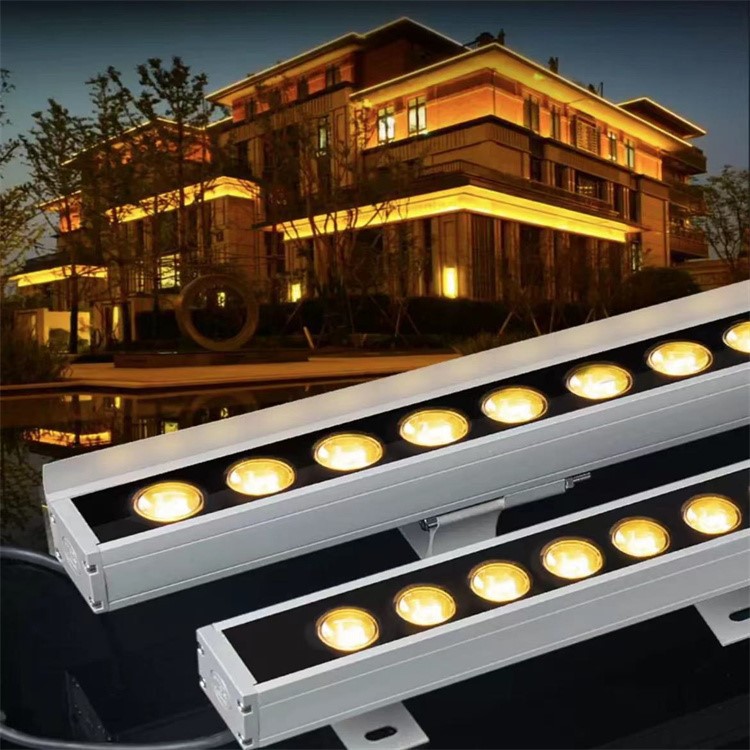
Wall washer lights belong to professional architectural auxiliary lighting fixtures with asymmetric wide-angle light distribution, which form uniform and continuous light coverage on building wall surfaces through optimized optical lens design and irradiation angle control. Different from ordinary point light sources, wall washer lights eliminate local highlight spots and uneven light and dark layering, realizing the overall brightening, texture rendering and contour beautification of building facades. With diversified structural designs and adaptable optical parameters, wall washer lights are widely applicable to commercial building exterior wall lighting, indoor space atmosphere rendering, residential villa facade decoration and large public venue wall lighting renovation, possessing high practical value and artistic expression in modern architectural lighting engineering.
Core Influence of Standardized Installation on Lighting Effect
The final wall rendering effect, luminous uniformity and long-term operational stability of wall washer lights depend entirely on standardized pre-selection matching and scientific construction installation technology. Non-standard parameter configuration such as mismatched voltage and wattage will lead to insufficient illumination or excessive light pollution; unreasonable installation position and angle will cause local dark areas and distorted wall texture presentation; unstandardized fixing construction will induce equipment loosening, light deflection and potential electrical safety hazards. Therefore, systematic installation specification constraints and standardized construction management are essential prerequisites to ensure the functional performance and decorative value of wall washer lighting systems.
Research Objectives and Technical System Framework
This paper systematically sorts out the pre-construction parameter selection specifications, core installation prerequisites, mainstream construction process technologies and safety compliance standards of wall washer lights. It conducts in-depth analysis on the applicability, advantages and construction difficulties of recessed installation and surface-mounted installation, two mainstream installation processes, forming a complete set of standardized installation technical systems. The research aims to provide scientific theoretical basis and operable construction guidelines for architectural lighting engineering construction and wall washer lamp application layout.
Pre-Installation Preparation and Standard Parameter Matching Requirements
Electrical Parameter Selection and Matching Specifications
Electrical parameter matching is the basic premise to ensure the safe operation and stable performance of wall washer lights. All parameter selection work must be based on the official technical specifications released by the equipment manufacturer to avoid blind matching affecting lighting efficiency and service life. The mainstream working voltage of civil and commercial wall washer lighting systems is standardized at 120V alternating voltage, which matches the conventional low-voltage power supply system of architectural lighting. In terms of power configuration, the adjustable wattage range of wall washer lights is 50W to 500W, forming differentiated power gradient adaptation to different spatial scales.
In practical engineering selection, the spatial area, wall height, wall material light reflectivity and expected illumination effect should be comprehensively considered to calibrate the optimal wattage parameter. Low-power wall washer lights within 50W-150W are suitable for small-area indoor wall rendering and short-distance local atmosphere lighting; medium-power products of 150W-300W adapt to conventional residential exterior walls and commercial indoor large-area wall lighting; high-power equipment of 300W-500W is applied to high-altitude large-scale building facade overall brightening projects. Excessively low power will lead to insufficient wall illumination and weak rendering effect, while excessively high power will cause light overflow, glare pollution and invalid energy consumption.
Classification Selection and Performance Adaptability of Light Source Types
According to different luminous core components, wall washer light sources are mainly divided into three categories: LED light sources, halogen light sources and incandescent light sources, with significant differences in energy efficiency, brightness performance and service life.
LED wall washer lights are the mainstream optimized products in the current market, with outstanding advantages of high photoelectric conversion efficiency, low power consumption, long service life and stable luminous performance. The energy-saving rate is significantly higher than that of traditional light sources, and the light color is uniform without stroboscopic phenomenon, which is suitable for long-term continuous operation of indoor and outdoor fixed lighting projects.
Halogen wall washer lights have high luminous intensity and strong light penetrating power, which can form high-saturation wall light rendering effect and highlight building texture and three-dimensional sense. Such light sources are mostly used for key local accent lighting scenarios requiring high brightness and high color restoration, but they have the defects of high heat generation and relatively high energy consumption.
Incandescent wall washer lights are gradually phased out in modern lighting engineering due to low luminous efficiency, large power loss, short service life and poor stability, and are only retained in a small number of old building renovation projects with fixed style matching requirements.
Professional Skill and Safety Preparatory Requirements
Wall washer light installation involves low-voltage circuit wiring, equipment fixing and electrical debugging, which belongs to professional electrical construction work. Construction personnel must master basic low-voltage electrical operation knowledge, standardized wiring specifications and electrical safety protection skills. Non-professional personnel are prohibited from blind construction, so as to avoid electrical faults such as virtual wiring connection, short circuit and electric leakage caused by irregular operation, which threaten personal safety and equipment operational stability. For complex large-scale engineering installation, professional licensed electricians should be employed for construction and debugging.
Installation Positioning Specifications and Adaptable Surface Requirements
Scientific Positioning and Irradiation Angle Design
The installation height and horizontal spacing of wall washer lights directly determine the uniformity of wall light distribution. The standardized installation principle is that the lamp body is fixed above the illuminated wall area and higher than the target lighting object. Through reasonable height difference setting and downward inclined optical irradiation angle design, the light beam realizes gradual uniform coverage from top to bottom on the wall surface, effectively eliminating local highlight spots and bottom dark areas, and forming soft and hierarchical overall wall lighting effect.
In the positioning design, the wall height and horizontal span should be matched to adjust the lamp spacing and inclination angle. High walls are equipped with high-position installation and large-angle irradiation, while low short walls adopt dense low-position layout to ensure seamless light splicing and no dead lighting corners.
Adaptability Analysis of Different Installation Base Surfaces
Wall washer lights have strong adaptability to building base surfaces, and can be stably installed on common architectural substrates such as brick wall, concrete wall and gypsum drywall. For hard and dense brick and concrete base surfaces, impact drilling and expansion bolt fixing processes are adopted to ensure stable load-bearing performance; for relatively loose drywall substrates, special load-bearing fixing brackets are matched to increase the stress area, so as to prevent the lamp body from loosening, tilting and falling off caused by long-term vibration and gravity action.
Overall Fixing Stability Requirements
No matter what kind of installation process and base surface, the core installation standard is to ensure the long-term firmness and stability of the lamp body. After installation, the equipment should have no shaking, displacement and angle deviation, avoiding light beam deflection and uneven lighting effect caused by loose fixing. Regular stability inspection should be reserved in the later maintenance link to eliminate potential safety hazards of equipment falling.
Mainstream Installation Process Technology and Construction Difficulty Analysis
Recessed Embedded Installation Process and Technical Points
Recessed embedded installation is a high-grade integrated installation process for wall washer lights, which embeds the whole lamp body into the wall interior structure, realizing flush fitting between the lamp panel and the wall surface. This installation mode has the advantages of ultra-high integration, simple and modern visual effect, no protruding structure and strong overall decoration, which is suitable for high-standard indoor decoration and high-end commercial space lighting projects.
The construction of recessed installation has high pre-planning requirements and complex process steps. The overall construction must be completed in the early stage of wall decoration, and the embedded grooving and lamp position reserved hole construction should be completed before the drywall sealing and surface decoration process. It is necessary to accurately calibrate the grooving size, depth and spacing according to the lamp body parameters, reserve wiring pipelines in advance, and conduct pre-embedding fixing and sealing debugging. The construction cycle is long, and the error tolerance rate is low, requiring high-precision construction operation.
Surface-Mounted Exposed Installation Process and Technical Points
Surface-mounted installation is a conventional and efficient wall washer light construction process, which directly fixes the lamp body on the outer surface of the finished wall through supporting brackets and hardware accessories. This process has the characteristics of simple operation, short construction cycle and low technical threshold, and is suitable for old building lighting renovation, uneven wall base surface and temporary lighting layout projects.
The construction steps of surface-mounted installation are simplified and flexible. After confirming the installation positioning, fix the special mounting bracket on the drywall or building base surface through drilling and locking screws, then dock and fix the lamp body with the bracket, and complete circuit wiring and power-on debugging. The whole process will not damage the overall wall structure, and the later maintenance, replacement and position adjustment are convenient, with strong engineering practicability.
Comparative Analysis of Two Installation Processes
In terms of appearance effect, recessed installation is more integrated and beautiful, suitable for high-standard fixed decoration scenes; surface-mounted installation has exposed lamp body, with slightly weaker overall sense, but stronger practicability. In terms of construction difficulty, recessed installation requires early reservation and high-precision construction, with high difficulty; surface-mounted installation has simple process and low construction threshold. In terms of later maintenance, surface-mounted equipment is convenient for disassembly and maintenance, while recessed equipment has high maintenance cost and difficult operation.
Construction Safety and Standardized Acceptance Specifications
Electrical Construction Safety Compliance Requirements
All wall washer light installation and wiring operations must comply with national low-voltage electrical construction codes and local lighting engineering safety regulations. The construction must be carried out under power-off state, with standardized wire docking, reliable grounding protection and complete insulating sealing measures. It is forbidden to connect wires in disorder and overload the circuit to ensure the electrical safety of the lighting system.
Post-Construction Debugging and Effect Acceptance Standards
After the completion of equipment installation, full power-on debugging and lighting effect inspection must be carried out. Check whether the lamp body operates stably without flickering and abnormal heating, verify the uniformity of wall light coverage and the rationality of irradiation angle, and adjust the position and angle in time for unqualified lighting effects to ensure that the actual rendering effect meets the design expectations.
Professional Construction Assistance Principles
For large-scale commercial wall washer lighting projects and complex embedded construction scenes, professional electricians and lighting engineering construction teams should be entrusted for operation. Relying on professional construction experience and standardized operation specifications, the construction quality and long-term stable operation of the lighting system are guaranteed.
Conclusion
Core Research Summary
The standardized installation of wall washer lights is a systematic project integrating parameter matching, position calibration, process construction and safety debugging. Pre-construction work includes scientific matching of voltage and wattage parameters, classified selection of light source types and professional skill preparation; on-site construction covers accurate installation positioning, stable base surface fixing and standardized implementation of recessed and surface-mounted two major processes. Different installation processes have differentiated applicability in terms of appearance effect, construction difficulty and maintenance performance, and need to be selected according to actual project conditions.
Engineering Application Suggestions
In architectural lighting engineering practice, construction personnel should take manufacturer parameter specifications and electrical safety codes as the core basis, combine spatial scale, wall characteristics and decorative style to select targeted installation schemes and light source matching strategies. Strictly implement full-process standardized construction and post-installation debugging acceptance, so as to give full play to the wall texture rendering and space beautification functions of wall washer lights, and realize safe, efficient and high-quality operation of architectural lighting systems.

How To Cooperate With Us?
Having its own factory gives our firm complete control over the production process and the quality of our goods, which we take great pride in. We are manufacturers, not only brokers, committed to offering our clients the lowest costs. We invite consumers to evaluate our samples first since we are certain that the cost and quality of our items are evident. Our dedication to excellence and client happiness motivates us to consistently provide superior products.
Our address
3rd Floor, 5th Building, Hebei Industrial Park, Hualian Community, Longhua District, Shenzhen, China





