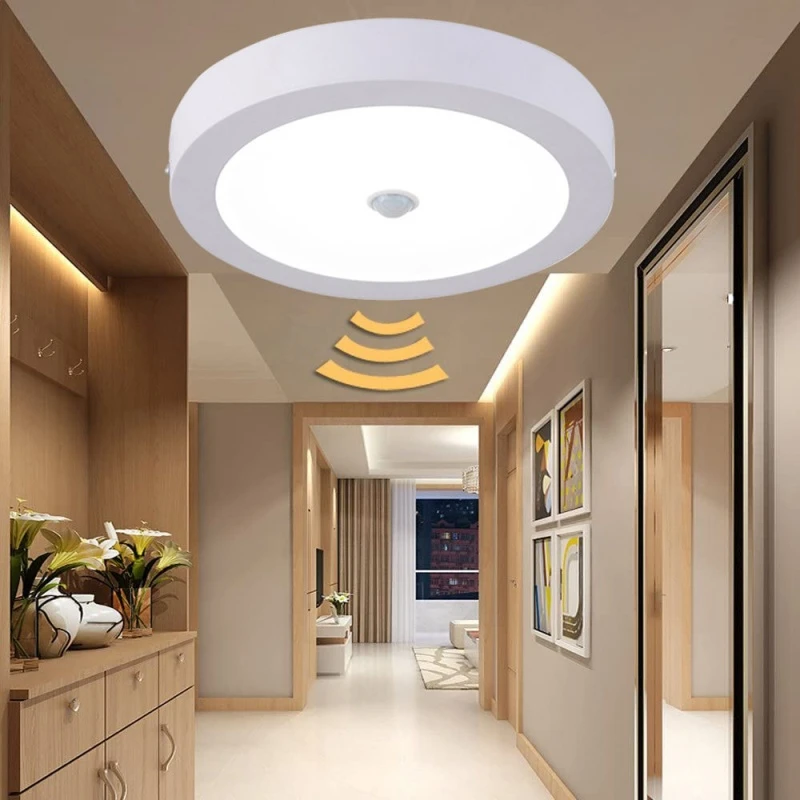
When many clients reach out for a quote, their first question is often: "I'm looking for a round LED panel light that turns on when someone approaches and off when they leave-where exactly should I install it?"
That's a very practical question. With their clean, minimalist design, easy installation, and built-in motion-sensing capabilities, these lights can save energy and simplify maintenance-but only if placed correctly. If installed in the wrong spot, they might trigger accidentally or fail to turn on when needed. This article explores common use cases to help you determine the best (and worst) places for these lights, along with key factors to consider when choosing the right model.
How Sensor-Equipped Round LED Panel Lights Work
These fixtures are essentially standard round LED panel lights with an integrated sensor module. There are two common types:
Passive Infrared (PIR) Sensors: These detect the heat emitted by the human body. Their advantage is that they are less likely to be triggered by irrelevant objects; their drawback is that they typically require noticeable movement from a person within the detection range.
Microwave Radar Sensors: These emit low-power, high-frequency signals and detect movement by analyzing changes in the reflected signals. They are highly sensitive and can even detect motion through materials like glass or thin partitions-though this also makes them more prone to being triggered by movement in adjacent rooms or outside a door.
When someone enters the detection range, the light turns on automatically. After the person leaves and a set time delay has elapsed, the light turns off. Many models also include a daylight sensor, ensuring the light remains off when ambient light is sufficient and only activates when it gets dark.
6 Ideal Use Cases
① Corridors and Hallways
Corridors in office buildings, apartment complexes, and hotels are the most common application. Since people only pass through these areas briefly, keeping lights on constantly is both a waste of energy and an unnecessary maintenance burden. Installing sensor-activated lights ensures they are only on when needed, leading to significant energy savings over time.
② Stairwells and Fire Exits
Stairwells see irregular foot traffic-sometimes remaining empty for hours at a time. When mounted on the ceiling, round panel lights provide uniform illumination, helping to eliminate dark corners on the steps. If the space also requires emergency lighting, it is advisable to choose a model that includes an integrated emergency function.
③ Bathrooms and Restrooms
In these spaces, people often have their hands occupied, making it inconvenient to operate light switches. Sensor-activated lights solve this problem while also being more hygienic. For such environments, it is advisable to check the moisture-resistance rating of the fixtures to ensure that prolonged exposure to humidity does not shorten their lifespan.
④ Underground Garages and Parking Entrances
Given the large area of a garage and the irregular movement of people and vehicles, keeping all lights on constantly is not cost-effective. Installing sensor-activated lights in specific zones-so that they only illuminate when a person or vehicle passes by-can lead to significant energy savings. For garages, microwave radar sensors are recommended, as they offer more reliable detection for larger objects like vehicles.
⑤ Storage Rooms, Warehouses, and Archives
These areas are visited infrequently and for short durations, yet people often enter while carrying items, leaving their hands unavailable to flip a switch. Sensor-activated lights provide immediate illumination upon entry, preventing accidental bumps or trips, and eliminating the risk of forgetting to turn the lights off when leaving.
⑥ Hotel Room Entryways and Home Foyers
Entryways experience frequent foot traffic, though stays in these areas are typically brief. Installing a circular sensor-activated panel light ensures that one doesn't have to fumble for a switch in the dark-a feature that enhances the experience for hotel guests, as well as for elderly family members and children at home.
Scenarios Where Sensor-Activated Lights Are Less Suitable
Sensor-activated lights are not a universal solution; caution should be exercised in the following types of settings:
Spaces where people remain seated for long periods, such as office workstations or conference rooms. Infrared sensors are often insensitive to stationary individuals, meaning the lights might turn off while someone is still present-a poor user experience.
Areas requiring continuous, stable lighting, such as precision workstations in manufacturing facilities or operating rooms, where a sudden loss of light could pose safety risks or compromise quality.
Areas with extremely high, near-constant foot traffic. In such places, the lights would remain on continuously, rendering the sensor function pointless; standard panel lights would be more economical.
Five Key Parameters to Consider When Purchasing
Sensor Type: Infrared sensors are suitable for corridors and restrooms; microwave radar sensors are better for garages, large spaces, or locations where the signal needs to penetrate partitions.
Detection Range and Angle: These must be matched to the installation height. If the ceiling is high, an insufficient detection range may result in the light failing to turn on when someone approaches.
Time-delay (duration): Typically adjustable from a few seconds to several minutes. A shorter duration is suitable for stairwells, while a longer duration is recommended for warehouses or restrooms.
Light-sensing control: For areas with ample natural daylight, models with built-in light sensors are recommended to further save energy.
Dimensions and installation: Round panel lights are available in recessed (flush-mount) or surface-mount versions. Be sure to verify the required cutout dimensions based on your ceiling structure to ensure a proper fit upon arrival.
Summary
Sensor-equipped round LED panel lights are ideal for spaces with intermittent occupancy or irregular usage patterns, such as corridors, stairwells, restrooms, garages, storage rooms, and entryways. In these areas, they provide on-demand lighting while reducing energy consumption and maintenance costs. They are not recommended for spaces where people remain stationary for long periods or where continuous, stable lighting is required.
When selecting a product, follow this approach: first, consider the environment; next, determine the appropriate sensing technology; and finally, match the detection range, time-delay settings, and installation dimensions. This process will help ensure you choose the right product.
Would you like to learn more or require a customized solution?
We offer a wide range of sensor-equipped round LED panel lights, available in various wattages, sizes, and color temperatures. We support both infrared (PIR) and microwave radar sensing technologies. Additionally, we can tailor detection ranges, time-delay parameters, and packaging to meet the specific requirements of your project. Please leave a message on this page or send us an email with details about your application scenario and the quantity required; we will recommend the most suitable models and provide a formal quote and samples.