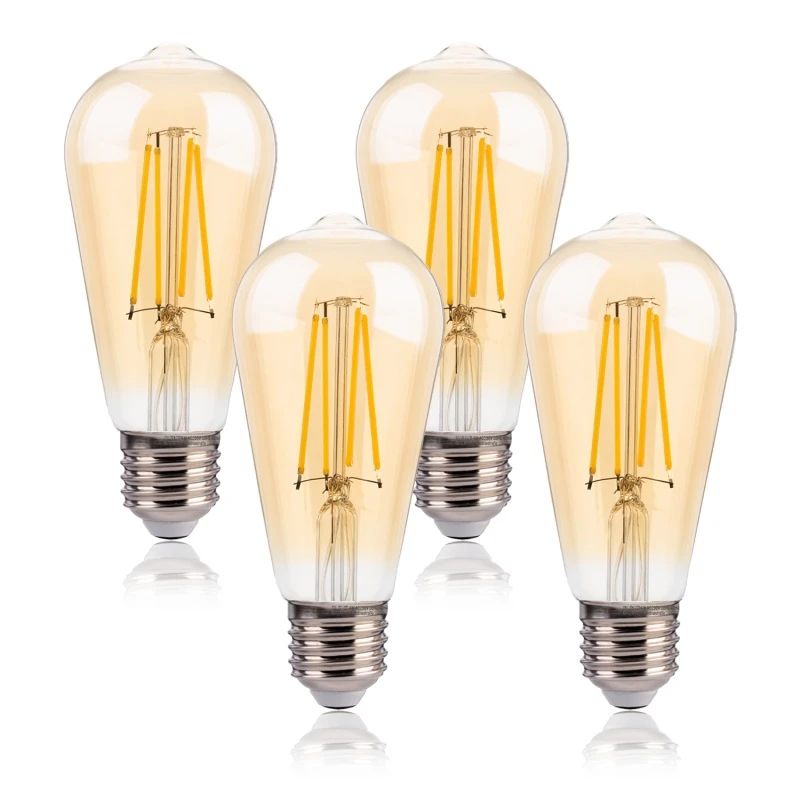
Step into a lighting store, and you will find two types of LED bulbs on the shelves: one resembles a traditional incandescent bulb, with glowing filaments visible inside a clear glass envelope; the other features the familiar frosted or milky-white finish, concealing its internal structure. The former are known as LED filament bulbs, while the latter are what we typically refer to as standard LED bulbs.
Both types offer energy savings and a longer lifespan compared to incandescent bulbs, yet they differ significantly in terms of light emission, heat dissipation, appearance, and intended application. For lighting procurement professionals, brand owners, or project managers, choosing the wrong type can impact product positioning, customer experience, and even after-sales costs. Let's break down the differences point by point.
Differences in Light-Emitting Structure
This is the most fundamental distinction between the two.
The light source in an LED filament bulb consists of filaments-typically a series of low-power LED chips mounted on a transparent or translucent substrate (made of glass, sapphire, or ceramic) and coated with a phosphor layer. A single bulb may contain one or several such filaments, which glow along their entire length when powered on.
In contrast, standard LED bulbs generally utilize SMD (Surface-Mounted Device) light sources. Here, LED chips are soldered onto an aluminum or PCB substrate-usually positioned at the base or center of the bulb-from which light is emitted and then diffused through the outer bulb cover.
In short: filament bulbs provide "linear" light emission, whereas standard LED bulbs provide "planar" or "point-source" light emission.
Differences in Design and Appearance
The primary selling point of a filament bulb is its aesthetic appeal. With a clear glass envelope housing gold-toned or warm-hued filaments, these bulbs exude a strong vintage charm-serving as decorative pieces even when switched off. Common shapes include A60, ST64, G95, and T45, with additional options available in candle, globe, and tubular styles. Standard LED bulbs prioritize utility; they typically feature a frosted or milky-white cover that conceals the internal components. Their design is highly standardized, often incorporating a base made of plastic and aluminum for heat dissipation, giving them a more "industrial" appearance.
For applications where the bulb remains exposed-such as in pendant lights, wall sconces, or fixtures with clear glass shades-filament-style LED bulbs offer a distinct aesthetic advantage.
Differences in Light Distribution and Luminous Efficiency
In filament-style bulbs, the filaments are positioned centrally, allowing for a beam angle approaching 360°. This creates an omnidirectional light distribution, mimicking the effect of traditional incandescent bulbs and minimizing dark spots or shadows behind the bulb.
In standard LED bulbs, the light source is fixed in a specific position, directing light primarily forward. The beam angle typically ranges from 200° to 270°, with the bulb cover used to diffuse the light and compensate for the limited angle.
Regarding luminous efficiency, filament-style bulbs can often achieve higher levels because the chips are encased directly in a transparent medium, resulting in minimal light loss. In contrast, light from standard LED bulbs must pass through multiple layers-such as the cover and the heat-dissipating housing-which can reduce overall light output efficiency. However, exact figures depend on chip quality and the specific design, so this can vary from product to product.
Differences in Heat Dissipation
Standard LED bulbs rely on an aluminum housing to conduct heat away from the chips, which necessitates a sufficient volume within the bulb's structure for heat dissipation.
Filament-style bulbs lack a metal heat-dissipating housing. Instead, heat is transferred via an inert gas (typically helium) inside the bulb to the glass envelope, from where it dissipates into the surrounding air. Consequently, there is a practical limit to the wattage of filament-style bulbs; they are most commonly found in the 2W to 8W range, with high-wattage versions being relatively rare.
This also means that when using filament-style bulbs in enclosed fixtures, careful attention must be paid to the available space for heat dissipation; otherwise, the bulb's lifespan may be significantly shortened.
Differences in Color Rendering and Light Tone
Filament-style LED bulbs typically feature a warm yellow light with a color temperature ranging from 2200K to 2700K. While versions at 4000K and 6500K also exist, the market is dominated by bulbs that provide a warm, atmospheric glow. Their Color Rendering Index (CRI) generally reaches 80 or higher, with some products achieving 90.
Standard LED bulbs offer a broader range of color temperatures-from warm white to cool white-and are better suited for functional lighting in spaces like offices, kitchens, or garages, where bright, clear illumination is required.
In short: choose filament-style bulbs to create a cozy atmosphere, and opt for standard LED bulbs when you need bright, practical lighting.
Differences in Lifespan and Reliability
Both types of bulbs have a rated lifespan of 15,000 to 25,000 hours, though the factors affecting their longevity differ.
For filament-style bulbs, the primary risk lies in the delicate nature of the filaments themselves; they may break or suffer from poor solder joints if subjected to intense vibration or impact during transport. Additionally, inadequate heat dissipation can accelerate lumen depreciation (a decline in brightness over time).
For standard LED bulbs, the risks are primarily associated with the driver circuitry and electrolytic capacitors. If the power supply is of poor quality, the bulb will often fail long before the LED chip itself does.
Therefore, when purchasing, pay close attention to the filament construction and the shock-resistance of the packaging for filament-style bulbs, while focusing on the driver design and the quality of the electronic components for standard LED bulbs.
Different Use Cases
Filament LED bulbs are better suited for:
Commercial spaces that prioritize ambiance, such as cafés, restaurants, and bars.
Exposed-bulb pendant lights, vintage-style wall sconces, and crystal chandeliers.
Boutique accommodations (homestays/guesthouses), hotel guest rooms, and decorative home lighting.
Standard LED bulbs are better suited for:
Environments requiring broad, high-intensity illumination, such as offices, schools, and warehouses.
Downlights, desk lamps, and general primary lighting for homes.
Large-scale projects where budget sensitivity is a key factor.
Cost and Procurement Considerations
Filament LED bulbs typically carry a higher unit price than standard LED bulbs of equivalent lumen output. This is due to more complex manufacturing processes-involving filament production, glass encapsulation, and gas-filling-which also make maintaining high yield rates more challenging.
However, from another perspective, the decorative appeal of filament bulbs allows for higher retail pricing and better profit margins. For brands that emphasize product value-add, they offer an excellent opportunity for differentiation.
The supply chain for standard LED bulbs is highly mature with transparent pricing; these are better suited for high-volume sales, where profitability relies heavily on economies of scale and rigorous cost control.
When sourcing, consider the potential for customization: filament bulbs offer a wider range of options regarding bulb shape, filament configuration, and glass tint (e.g., clear, amber, or smoke-grey), making it easier to develop a unique, brand-specific product line.
Conclusion
There is no absolute "better" or "worse"-it all depends on your target customers and the intended application. If the focus is on ambiance and aesthetics, choose filament bulbs; if the priority is brightness and cost-effectiveness, opt for standard LED bulbs.
Need LED filament bulbs? Get in touch with us.
Leave a comment or send us an email detailing your target market, budget, and application requirements. Our team will respond within 24 hours with a tailored product solution and a formal quote.