

Introduction: The Wholesale Decision Is a Different Game
Buying a single LED panel light for one room is simple: pick something bright, reasonably priced, and it goes in. Buying LED panel lights wholesale - for a warehouse, an office campus, a retail chain, a hotel, or a resale inventory - is a completely different discipline. The stakes multiply, the decision criteria shift, and the cost of a wrong choice compounds across hundreds or thousands of fixtures.
This guide is written for the professional buyer: the facility manager, contractor, electrician, importer, distributor, or procurement lead who is specifying, purchasing, or reselling commercial LED panel lights in volume. Our focus is a specific combination that matters more in commercial settings than almost any other: cost-effectiveness over the life of the fixture, and genuine bug-proof / insect-resistant construction - because a commercial ceiling grid is, in practice, a network of warm, inviting, open traps for insects.
We will cover the four pillars of a sound wholesale purchase - total cost of ownership, build quality and sealing, optical and electrical performance, and supply-chain reliability - and give you a concrete checklist you can apply to any quote or sample. By the end, you will be able to evaluate a wholesale offer not by its sticker price, but by the number that actually determines your profitability: what each fixture costs you per year, per lumen, per square meter - over its full lifetime.
The Real Metric: Total Cost of Ownership, Not Unit Price
The most common mistake in wholesale purchasing is comparing unit prices. "This panel is $6, this one is $8 - the cheaper one wins." On a single fixture, the difference is trivial. On 500 fixtures, it is $1,000 - which sounds significant. But it is almost always the wrong comparison.
The TCO Equation
The honest cost of a fixture is its total cost of ownership (TCO) over its service life. Every LED panel carries four cost components:
TCO = Purchase Price + Energy Cost over Lifetime + Replacement & Labor Cost + Maintenance Cost
Purchase price - what you pay today (the only number most buyers see).
Energy cost - power draw × operating hours × electricity rate, compounded over the fixture's life. For a fixture running 10–16 hours a day in a commercial setting, this dwarfs the purchase price within a few years.
Replacement and labor - every premature failure means a new fixture plus an electrician. Labor alone often costs more than the fixture.
Maintenance - cleaning, inspection, and servicing; a poorly sealed fixture demands far more.
When you add these up, a "cheap" fixture that draws more watts and dies sooner is almost always more expensive than a "premium" fixture that runs efficient and lasts. The wholesale buyer who optimizes TCO - not sticker price - wins on every line of the ledger.
A Worked TCO Comparison
Let us compare two commercial panels, both delivering equivalent light, running 12 hours/day, 365 days/year, at a commercial rate of $0.12/kWh, over a 10-year horizon:
| Fixture A ("cheap") | Fixture B ("cost-effective") | |
|---|---|---|
| Unit price | $8 | $12 |
| Power draw | 48 W | 30 W |
| Annual energy cost | 48W×12×365/1000 ×$0.12 ≈ **$25.2** | 30W×12×365/1000 ×$0.12 ≈ **$15.8** |
| 10-year energy cost | ≈ $252 | ≈ $158 |
| Lifetime | ~25,000 h → replace ~twice in 10 yr | ~50,000 h → no replacement |
| Replacement + labor (10 yr) | ≈ $20+ (extra) | $0 |
| Total 10-year cost | ≈ $280 | ≈ $170 |
The "cheap" fixture costs ~$110 more** over ten years per fixture. On a 500-fixture order, that is **$55,000 - an amount that makes the $4-per-unit price difference look absurdly small. This is why the TCO mindset is not optional for a wholesale buyer; it is the entire game.
Efficacy: The Number That Drives TCO
The lever that controls the energy component of TCO is luminous efficacy - lumens per watt (lm/W). It tells you how much useful light you get for each watt of electricity.
Low-grade panels: 80–100 lm/W.
Quality high-brightness panels: 120–160+ lm/W.
To deliver the same luminous flux, the higher-efficacy fixture draws measurably fewer watts - which, per the table above, is the single largest line item in ten-year cost. When you compare wholesale offers, demand the efficacy figure, not just the wattage or brightness. A fixture that lists a lower wattage but also fewer lumens is not necessarily efficient; check lm/W to be sure.
The Bug-Proof Requirement: Why Insects Are a Commercial Problem, Not a Nuisance
"Bug-proof" sounds like a small selling point. In commercial reality, it is a reliability and maintenance issue that quietly costs facilities real money. Here is why insects matter more than most buyers realize.
Why Insects Are Attracted to Ceiling Lights
Insects are strongly drawn to ceiling fixtures for three reasons:
Heat - LED drivers and housings run warm; insects seek warmth;
Light - many species are phototactic, flying toward illumination;
Shelter - a ceiling fixture offers a protected cavity.
A ceiling grid across a warehouse or retail space is, effectively, an array of warm, lit, sheltered cavities. In warm climates - and especially in tropical and subtropical regions - this makes unsealed fixtures into magnets and traps.
What Insects Do Inside a Fixture
Once inside, insects cause four types of damage:
Electrical short circuits - dead insects can bridge contacts and cause faults;
Overheating - bodies and debris block airflow and trap heat against the driver and chips;
Light loss - debris on optics reduces output and creates dark spots;
Corrosion and contamination - insect waste accelerates degradation of components.
Each of these shortens lifespan and, more importantly, triggers the failures and service calls that dominate commercial maintenance budgets.
The Cost of Insect-Related Failure in Commercial Settings
In a commercial facility, an insect-related failure is not a single broken bulb. It is:
A service ticket and an electrician visit;
Downtime - a section of the facility or a guest room without proper lighting;
Reputation risk - in hotels, restaurants, and retail, visible dead fixtures or bug-trapped lights look unprofessional.
A sealed, bug-proof fixture eliminates this entire cost category. The "bug-proof" feature is, in commercial terms, a maintenance-cost reduction and a reliability guarantee - not a novelty.
What "Bug-Proof" Actually Requires
Genuine bug-proof construction comes from integrated sealing - the same engineering that protects against moisture and grease. A fixture is only bug-proof if every seam, junction, and wiring entry is sealed so that insects physically cannot get inside. Key signals:
Sealed seams between housing and diffuser;
Protected wiring entry points;
No open cavities where insects can shelter.
If a fixture has open gaps anywhere, it is not bug-proof regardless of the label. Verify the seal, not the claim.
Build Quality: What Separates a Ten-Year Fixture from a Two-Year Fixture
Beyond efficiency and sealing, a wholesale fixture must be built to survive commercial duty - long operating hours, continuous cycling, and demanding environments. Build quality determines the replacement-and-maintenance half of TCO.
Thermal Management: The Lifespan Decider
LED chips and drivers degrade with heat. The hotter they run, the faster they lose brightness and the sooner they fail. Good fixtures manage heat through:
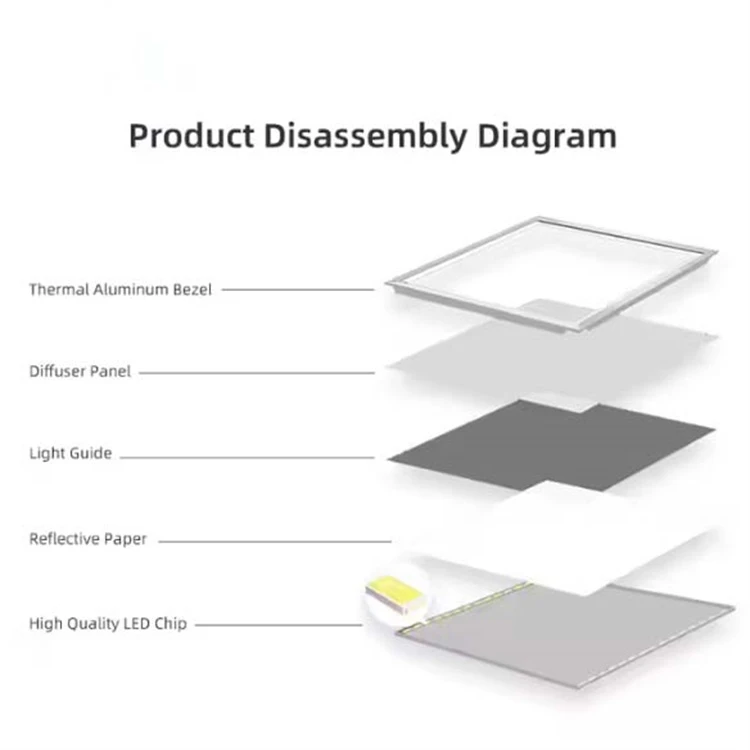
Thermal aluminum bezels / heat-sinking frames that draw heat away from the chip array;
Efficient driver design that generates less waste heat;
Ventilation or thermal paths that keep components within safe temperature ranges.
A substantial, well-constructed frame is not "heavier for no reason" - it is thermal engineering, and it is the difference between a 25,000-hour fixture and a 50,000-hour fixture.
Optical Quality: Getting the Light Out
A high-brightness chip is wasted behind a poor optical system. Quality panels layer:
Reflective paper - bouncing lost light forward;
Light guide plate - distributing point sources into an even field;
Diffuser panel - softening output into glare-free, uniform light.
The result is soft, even, uniform illumination - no hotspots, no harsh shadows - which matters in offices, classrooms, clinics, and retail, where comfortable, consistent light is a functional requirement, not a luxury.
Moisture, Grease, and Easy Cleaning
In bathrooms, kitchens, and food or hospitality environments, sealing also protects against moisture and grease-laden vapor. A sealed, smooth-surfaced fixture is easy to clean - wipe it down without forcing moisture inside - and does not accumulate grime that blocks light. For commercial operators, easy cleaning is lower labor cost; for hygiene-critical environments, it is a requirement.
Verify What You Cannot See
Build quality is not always visible in a photo. When evaluating a wholesale offer, ask for specifications, request samples, and inspect the seams, the frame construction, the optical layers, and the certification documentation (e.g., CE and supporting compliance data). A fixture that looks identical in a catalog can be fundamentally different in a warehouse.
Color Temperature and Versatility: One Product, Many Spaces
A key advantage of modern commercial LED panels is flexibility in color temperature, allowing a single product line to serve an entire building. This matters for wholesale buyers because it standardizes inventory and simplifies installation across multiple zone types.
The Three Standard Temperatures
Quality panels commonly offer:
Warm - 3,500K - for lounges, restaurants, hospitality, and relaxation areas where calm, welcoming light is desired;
Neutral - 4,000K - for offices, classrooms, and general workspaces, balancing comfort with clarity;
Cool - 5,000K - for warehouses, workshops, and precision tasks requiring crisp, alert, high-contrast light.
Why This Matters for Wholesale
For a buyer specifying an entire facility - or stocking a resale line - having multiple color temperature options in one product family means:
One SKU family covers offices, hospitality, retail, and industrial zones;
Standardized fixtures simplify installation, spares, and maintenance;
Zone-level tuning - each area gets the temperature that fits its function without introducing a second product line.
A fixture family that offers selectable color temperatures is not just more versatile; it is more cost-effective to buy, stock, and maintain in volume.
Supply-Chain Reliability: The Hidden Half of "Cost-Effective"
A fixture is only cost-effective if you can get it, on time, at the quoted quality, consistently. For a wholesale buyer, the supplier is half the product. Neglect supply-chain reliability and the lowest unit price in the world becomes the most expensive choice you make.
Quality Consistency Across Batches
Wholesale purchasing is a bet on consistency. The fixture you approve in the sample must be the fixture that arrives in the 5,000-unit container - not a lower-grade version that shipped because the price was renegotiated downward. A reliable supplier maintains consistent components, tolerances, and quality control across every batch. Ask how quality is verified from batch to batch, and request a QC report.
Lead Times and Capacity
A wholesale order is tied to a project schedule or a sales season. Confirm:
Lead times - how long from order to shipment;
Production capacity - whether the supplier can actually fill your volume;
Scaling - whether they can grow with your order sizes over time.
A supplier that promises low prices but cannot deliver on schedule turns a "cheap" fixture into a costly delay.
Communication, Documentation, and After-Sales Support
Professional wholesale relationships rest on:
Clear documentation - specifications, certifications, and QC records;
Responsive communication - especially across time zones and languages;
After-sales support - a warranty and a point of contact for issues.
A supplier who disappears after payment leaves you holding a container of unsupported fixtures. Cost-effectiveness includes the reliability of the person you buy from - verify the supplier as carefully as you verify the fixture.
The Relationship Between Price and Risk
Here is the professional buyer's truth: an unusually low price is not a bargain; it is a risk signal. It usually means lower-grade chips, thinner frames, missing seals, or inconsistent QC - all of which surface later as energy waste, early failures, and service calls that erase the initial saving. In wholesale, you are buying the supplier's discipline as much as the fixture. A fair price from a reliable supplier is cheaper than a low price from an unreliable one.
A Complete Wholesale Buying Checklist
Use the following as your evaluation sheet for any commercial LED panel light offer - for a project, a facility, or a resale line.
Technical Performance
Luminous efficacy (lm/W) - 120 lm/W or higher signals genuine efficiency; demand the figure.
Power draw (W) and lumen output (lm) - always together, so you can verify efficacy.
Rated lifetime (hours) - 30,000–50,000+ hours signals quality engineering.
Color temperature options - 3,500K / 4,000K / 5,000K availability for application flexibility.
Build Quality and Protection
Integrated sealing - verify sealed seams, protected wiring entries, no open cavities (this is the bug-proof / moisture-proof guarantee).
Thermal construction - substantial heat-sinking frame for longevity.
Optical layers - diffuser, light guide, and reflective paper present and layered correctly.
Easy-to-clean surface - smooth, sealed exterior for low-maintenance hygiene.
Certification - recognized compliance marks (e.g., CE) with supporting documentation.
Supply Chain
QC consistency - verified across batches, with QC reports available.
Lead time and capacity - confirmed against your project or sales schedule.
Documentation - complete specs, certifications, and records.
After-sales support - warranty and a reliable point of contact.
The Decision Rule
When comparing offers, do not compare unit price. Compare 10-year TCO per fixture, and add a risk factor for any offer that is suspiciously cheap. The fixture that wins is the one with:
High efficacy (lower energy per lumen),
Long rated life (fewer replacements),
Integrated sealing (bug-proof, moisture-proof, low maintenance),
A reliable supplier (consistent quality, on-time delivery, real support).
That combination - not the lowest price - is what "cost-effective" actually means in wholesale.
Conclusion: Buy the Whole Cost, Not Just the Price
Wholesale purchasing of commercial LED panel lights is a numbers game, but not the one most buyers think it is. The number that matters is not the unit price on the quote. It is the total cost of ownership - energy, replacements, labor, and maintenance - compounded across hundreds of fixtures and a decade of operation. And the number that protects that cost is the fixture's build quality, its integrated sealing, and the reliability of its supplier.
A truly cost-effective commercial LED panel light delivers three things at once:
High luminous efficacy - so it draws fewer watts for the same light, and the energy component of TCO stays low;
Long life and sealed, bug-proof construction - so it does not fail early, does not attract maintenance trouble, and stays clean and efficient for years;
A dependable supply chain - so the fixtures you approve are the fixtures you receive, on time and consistent.
How To Cooperate With Us?
We are happy to have total control over the manufacturing process and the calibre of our products since we have our own facilities. Since we are producers rather than just brokers, we are dedicated to providing our customers with the best pricing. Since we are certain that the price and quality of our products are clear, we invite customers to see our samples first. Our commitment to quality and customer satisfaction drives us to continuously provide top-notch goods.
Our address
3rd Floor, 5th Building, Hebei Industrial Park, Hualian Community, Longhua District, Shenzhen, China





