

What Is an Emergency Light Tower?
An emergency light tower is a portable, battery-powered lighting system built on a telescopic pole. A bright LED head sits at the top, so light spreads over a wide area from above instead of shining flat from the ground. That height reduces glare and shadows and lights up much more space than a handheld flashlight or a small lantern.
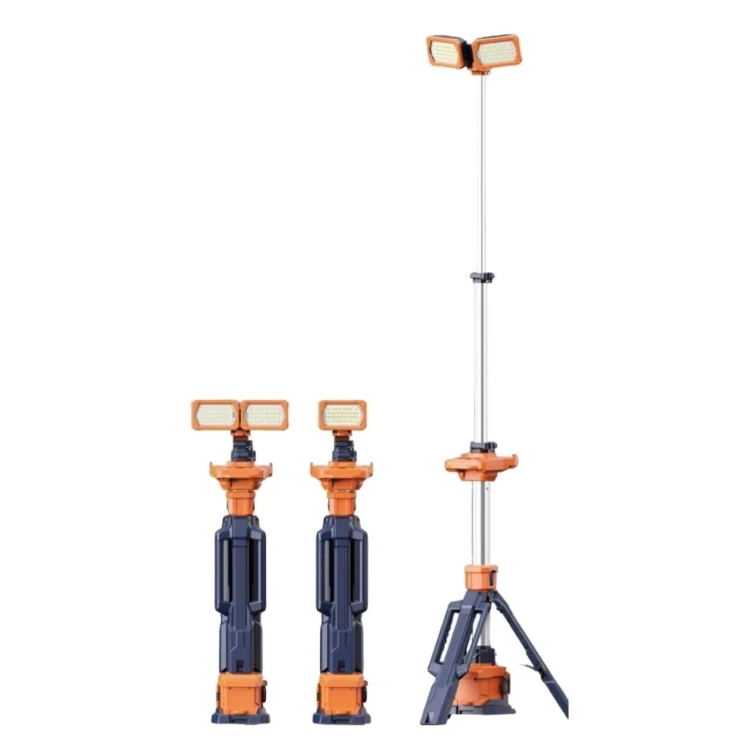
The tower in the photo has a dual-panel LED head, a telescopic mast and a folding tripod base with the battery body at the bottom. On the left it is shown collapsed for carrying and storage, and on the right it is fully extended for use.
What Does IP65 Waterproof Mean?
IP65 is a protection rating with two parts:
| Code | Meaning | What it means for you |
|---|---|---|
| 6 (first digit) | Fully dust-tight | Dust, sand and dirt cannot get inside |
| 5 (second digit) | Protected against water jets from any direction | Handles heavy rain, splashes and hose spray |
Important: IP65 does not mean submersible. Don't leave the tower in standing water or flooding. Keep charging ports and covers closed, and don't charge the unit while it is wet.
Why Choose a Rechargeable Light Tower?
Traditional work lights depend on power cords or noisy gasoline generators. A rechargeable tower solves several problems:
| Feature | Rechargeable light tower | Corded work light | Generator light tower |
|---|---|---|---|
| Needs a power outlet | No | Yes | No |
| Noise | Silent | Silent | Loud |
| Exhaust fumes | None | None | Yes |
| Fuel needed | No | No | Yes |
| Easy to carry | Yes | Medium | Hard |
| Works in a power outage | Yes | No | Yes |
| Running cost | Very low | Low | High |
What Are the Key Features to Look For?
| Feature | What to check | Why it matters |
|---|---|---|
| Power and brightness | Wattage and lumens [e.g., 150W / ___ lumens] | Decides how large an area you can light |
| Battery | Capacity and run time [e.g., ___ mAh / ___ hours] | Decides how long you can work without recharging |
| Telescopic height | Minimum and maximum height [e.g., ___ m] | Higher mounting gives wider, more even light |
| Light head | Dual panels, tilt and rotation angle | Lets you aim light where you need it |
| Waterproof rating | IP65 or higher | Protects against rain and dust |
| Stability | Tripod design, weight and wind resistance | Prevents tipping on uneven ground |
| Charging | Input type and charge time | Affects how quickly you can get back to work |
| Modes | High, low, strobe, SOS | Gives flexibility and emergency signaling |
| Portability | Weight, folded size and handle | Affects transport and storage |
Replace the bracketed values with your product's tested specifications before publishing.
Where Can You Use an Emergency Light Tower Outdoors?
| Use case | How a light tower helps |
|---|---|
| Power outages | Lights a room, porch or yard when the grid is down |
| Roadside breakdowns | Raises light above the vehicle for safer repairs, with strobe or SOS for visibility |
| Construction and repair work | Provides wide, shadow-free light for night jobs |
| Camping and RV trips | Lights a campsite or cooking area from above |
| Outdoor events and markets | Lights stalls, parking areas and stages |
| Search and rescue | Lights a wide area quickly in the dark |
| Farms and workshops | Lights barns, gates and equipment yards |
| Storm and disaster preparedness | Stays ready in a garage or emergency kit |
How Do You Set Up a Light Tower?
Choose a flat, stable spot. Open the tripod legs fully and make sure each leg sits firmly on the ground.
Raise the mast. Extend the telescopic pole one section at a time and lock each clamp.
Aim the light head. Tilt and rotate the two panels to cover the work area.
Select a mode. Use high for wide coverage, low to save battery.
Secure it in wind. Add sandbags or stakes if the ground is soft or the wind is strong.
Pack away safely. Lower the mast, fold the head, and store it dry.
How Long Will the Battery Last?
Run time depends on brightness. The table below is an example of how mode affects battery life. Replace it with your real test results:
| Brightness mode | Example output | Example run time |
|---|---|---|
| High | 100% | [e.g., 4-6 hours] |
| Medium | 50% | [e.g., 8-12 hours] |
| Low | 20% | [e.g., 20+ hours] |
| Strobe / SOS | Flashing | [e.g., 30+ hours] |
Tip: Use the lowest brightness that does the job. Halving the output often more than doubles the run time.
How Do You Maintain Your Light Tower?
| Task | How often |
|---|---|
| Fully charge before first use | Once |
| Recharge during storage | Every 2-3 months |
| Wipe the lens and body with a damp cloth | After each outdoor use |
| Check charging port cover and seals | Before each use |
| Inspect mast locks and tripod legs | Monthly |
| Store in a cool, dry place | Always |
What Are Common Mistakes to Avoid?
Using it in standing water. IP65 handles rain and splashes, not submersion.
Charging while wet. Dry the unit and port first.
Skipping stabilization. A tall mast tips easily in wind without sandbags or stakes.
Running on high all the time. It drains the battery quickly.
Storing with an empty battery. This shortens battery life.
Buying by wattage alone. Check lumens, run time and light spread too.





