

Introduction: Why L70 Standard Matters for Industrial Flood Lighting
The Defect of Traditional Lighting Lifespan Evaluation
Traditional industrial lighting products such as high-pressure sodium lamps, metal halide lamps, and halogen lamps adopt a "sudden failure" lifespan model. After reaching the rated service hours, the light source will burn out completely and stop working, with zero luminous flux output. Therefore, the industry used to simply define lifespan as the total working hours before lamp burnout. However, this evaluation method is completely inapplicable to modern LED industrial floodlights. As a solid-state lighting device, LED chips have no filament burnout risk, and their failure mode is dominated by gradual luminous attenuation rather than sudden shutdown .
In actual industrial scenarios, most LED floodlights can still work normally after tens of thousands of hours, but their luminous brightness drops significantly, failing to meet the minimum illumination requirements of engineering design standards. For large-scale industrial projects, insufficient late illumination will lead to hidden safety hazards, failed project acceptance, and increased secondary renovation costs. This makes the traditional single lifespan data unable to truly reflect the long-term usability of LED floodlights, and the L70 standard has become the only authoritative evaluation index for industrial LED lighting lifespan and light decay performance .
Pain Points of Industrial Lighting in Practical Application
Industrial outdoor lighting faces extreme operating conditions that civil lighting does not encounter. Long-term high-temperature exposure, rainy and humid weather, coastal salt spray corrosion, and frequent voltage fluctuations will all accelerate LED light decay and aging. Many low-cost LED floodlights on the market boast a nominal lifespan of 50,000 hours, but their luminous flux drops below 60% after 20,000 hours of actual operation, completely losing industrial use value. For engineering contractors and project owners, unqualified light decay performance means frequent lamp replacement, high labor and material maintenance costs, and unstable on-site lighting effects, which directly affects project operation efficiency and economic benefits.
Against this background, mastering the L70 standard and selecting L70-certified industrial floodlights is the core key to ensuring long-term stable operation of lighting projects, controlling overall project costs, and improving engineering quality.
Core Definition and Professional Principle of L70 Standard
Official Definition of L70 Lumen Maintenance Standard
The L70 standard is an authoritative lumen maintenance and lifespan evaluation standard formulated by the Illuminating Engineering Society of North America (IESNA) and widely adopted by global lighting industries and international certification institutions . Its core definition is: under standard laboratory test conditions and rated operating parameters, when the luminous flux of LED lighting products attenuates to 70% of the initial factory luminous flux, the cumulative working hours at this time is the L70 rated lifespan of the product .
Different from nominal lifespan data, L70 is a functional lifespan evaluation standard based on effective illumination availability. The 30% luminous flux attenuation is defined as the acceptable attenuation threshold for industrial lighting. When the luminous retention rate is higher than 70%, the lighting brightness, uniformity, and visibility of the floodlight can fully meet national and international industrial lighting engineering specifications; when lower than 70%, the illumination fails to meet the design standard, and the product is judged to have reached the end of its effective service life .
Core Concepts of Lumen Maintenance and Light Decay
Lumen maintenance refers to the ratio of the real-time luminous flux of an LED light source to the initial luminous flux after a specific period of operation, which intuitively reflects the light decay resistance of the product . Light decay is the irreversible gradual attenuation of LED luminous flux caused by chip aging, driving attenuation, lens aging, and thermal resistance accumulation during long-term operation .
The light decay curve of high-quality industrial LED floodlights conforms to the exponential attenuation model recognized by the industry. The attenuation rate is slow and stable in the early and middle service periods, and no sharp brightness drop occurs. Inferior products have a fast initial light decay rate, with luminous flux dropping rapidly in the first 1–2 years of use, resulting in extremely poor long-term usability. The L70 standard effectively screens such inferior products and provides unified quantitative evaluation dimensions for industrial lighting product quality.
Difference Between L70, L80 and L90 Standards
To accurately understand industrial lighting selection, it is necessary to distinguish different lumen maintenance standards. The L90 standard means the luminous flux retains 90% of the initial value, corresponding to low-attenuation early performance; the L80 standard means 80% luminous retention, suitable for high-precision commercial lighting scenarios; the L70 standard is the most scientific and applicable evaluation index forindustrial flood lighting .
Industrial floodlights focus on long-term continuous operation and cost performance. Excessively high luminous retention standards will greatly increase product costs, while standards lower than L70 cannot guarantee lighting safety. Therefore, L70 has become the universal industry benchmark for stadiums, bridges, construction sites, and port lighting projects, balancing performance, lifespan, and economic benefits perfectly.
Root Causes of LED Light Decay in Industrial Scenarios
Chip Aging and Thermal Accumulation Damage
The core cause of LED light decay is chip thermal aging. LED chips will generate heat energy during electro-optical conversion. The electro-optical conversion efficiency of industrial high-power floodlights is about 85%, and the remaining 15% of electric energy is converted into heat. If the heat cannot be dissipated in time, long-term high-temperature accumulation will cause internal crystal lattice damage of the chip, reduce luminous efficiency, and form irreversible light decay .
In high-temperature outdoor industrial environments, the ambient temperature can reach above 55°C in summer. Inferior floodlights with simple heat dissipation structures cannot export heat efficiently, resulting in long-term high-temperature operation of chips and accelerated aging. This is the main reason why many low-priced floodlights fail to meet L70 standard in actual use despite passing laboratory tests.
Driver Performance Attenuation and Voltage Fluctuation Interference
The LED constant-current driver is the core component to ensure stable luminous output. Industrial power grids have frequent voltage fluctuations and surge interference. Inferior drivers have low power factors and poor anti-interference ability. Long-term unstable current output will cause frequent overload operation of LED chips, accelerate luminous attenuation, and even cause local chip burnout .
In addition, the internal electronic components of ordinary drivers are prone to aging under high temperature and humid conditions, resulting in reduced output accuracy, further aggravating light decay and shortening the effective service life of floodlights.
External Environmental Corrosion and Lens Aging
Outdoor industrial scenarios are accompanied by acid rain erosion, coastal salt spray, ultraviolet radiation, and dust accumulation. Ordinary plastic lenses are prone to yellowing, scratch and light transmission attenuation after long-term UV exposure; unqualified shell sealing structures will cause moisture and dust to enter the lamp cavity, corrode chips and circuits, and increase light decay rate . These environmental factors are important external reasons for the failure of industrial floodlights to reach L70 standard lifespan.
Product Technical Advantages: Achieving Premium L70 Light Decay Performance
Optimized Thermal Dissipation System to Suppress Chip Aging
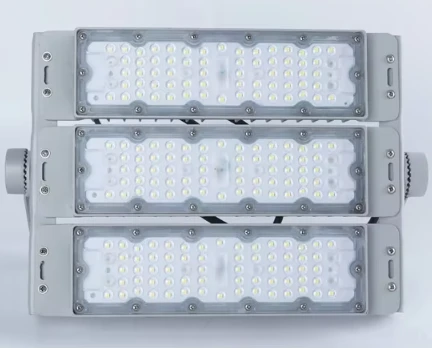
This high-performance modular LED floodlight adopts an industry-upgraded fin-type die-cast aluminum heat dissipation structure, which builds an efficient three-dimensional thermal conduction and dissipation path. The thickened aluminum alloy shell integrates heat conduction and heat dissipation functions, realizing rapid heat exchange between the lamp body and the external environment, effectively solving the heat accumulation problem of high-power LED chips .
The product supports a wide working temperature range of -25°C to +55°C. Even in extreme high-temperature industrial environments, it can keep the chip working temperature within the safe threshold, greatly reduce the thermal aging rate of the chip, and maintain ultra-stable luminous attenuation performance. After professional accelerated aging tests, the product still maintainsmore than 70% luminous flux retention after 50,000 hours of continuous operation, fully meeting and exceeding the L70 industrial standard .
High-Stability Constant-Current Driver to Ensure Long-Term Luminous Consistency
Equipped with high-quality industrial-grade constant-current driver (optional Philips power supply), the product achieves a power factor higher than 0.95, with ultra-stable current and voltage output. It has excellent surge resistance and voltage fluctuation resistance, adapting to unstable industrial grid environments . It avoids chip overload operation caused by power supply fluctuation, fundamentally reduces luminous attenuation caused by driver aging, and ensures that the luminous efficiency of the floodlight does not decay sharply in the whole service cycle.
Different from ordinary low-power drivers, this industrial-grade driver has strong anti-electromagnetic interference ability, will not be affected by on-site industrial equipment operation, and maintains long-term stable working state, providing reliable guarantee for L70-level long-term performance.
IP66 Full Protection Design to Resist Environmental Light Decay
The product adopts IP66 highest industrial protection grade, with fully sealed lamp cavity and waterproof cable gland structure, realizing dust-tight and high-pressure water jet resistance . It can effectively block external dust, rainwater, salt spray and humid air from entering the lamp body, prevent circuit corrosion and lens contamination, and avoid light decay acceleration caused by environmental erosion.
Matched with high-transmittance tempered optical lens, it has UV resistance, anti-yellowing, anti-scratch and impact resistance properties. Long-term outdoor exposure will not cause lens light transmission attenuation, ensuring stable and consistent light output throughout the product life cycle, and perfectly supporting L70 long-term lumen maintenance performance .
Modular Split Structure to Reduce Overall Maintenance Attenuation
The innovative modular detachable design is a major advantage of this product in light decay control and life extension. Traditional integrated floodlights need to be replaced as a whole once local modules age and decay, resulting in overall performance degradation. This modular product can replace individual aging light modules separately without replacing the whole lamp .
This design ensures that the overall luminous performance of the floodlight is always maintained at L70 qualified level in the long-term operation process. It avoids the overall brightness drop caused by partial module aging, greatly extends the actual service life of the equipment, and reduces the comprehensive light decay rate of the whole lamp.
Industrial Value and Procurement Advantages of L70-Compliant Floodlights
Reduce Long-Term Project Operation Costs
For industrial lighting projects, the initial procurement cost only accounts for a small part of the total life cycle cost, while the later maintenance and replacement costs are the main expenditure. L70-standard floodlights have an effective service life of up to 50,000–80,000 hours, which is 3–5 times that of traditional lighting products . Under 24-hour continuous working conditions, they can operate stably for more than 5 years without overall replacement.
Low light decay performance avoids frequent lamp replacement and on-site maintenance work, saves a lot of labor costs, material costs and project downtime losses for enterprise users and engineering contractors, and significantly improves the return on investment (ROI) of lighting projects.
Ensure Project Lighting Safety and Acceptance Qualification
All industrial lighting projects have clear illumination standard acceptance specifications. Floodlights with unqualified L70 light decay performance will have insufficient late illumination, resulting in project acceptance failure, reformation and economic losses. This product strictly complies with L70 lumen maintenance standards, with stable luminous performance in the whole life cycle, ensuring that the project always meets the national and international industrial lighting design standards .
Whether it is stadium venue lighting, road and bridge engineering lighting, construction site temporary lighting, or port terminal lighting, it can provide continuous, uniform and high-brightness lighting guarantee, eliminate safety hazards caused by insufficient light, and improve project operation safety and standardization.
Improve Environmental Adaptability and Equipment Durability
Combined with IP66 high protection, high-efficiency heat dissipation and high-stability drive system, the L70-level light decay performance of the product can be stably exerted in various harsh industrial environments. It can resist high temperature, low temperature, rain, salt spray, dust and ultraviolet radiation, and maintain ultra-low light decay attenuation in complex scenarios .
Compared with ordinary floodlights that are prone to brightness attenuation and failure in 1–2 years of outdoor use, this product has excellent long-term durability, reduces equipment failure rate, and is the most cost-effective and reliable lighting solution for long-term operation of industrial projects.
How to Select Industrial Floodlights Based on L70 Standard
Distinguish Nominal Lifespan and L70 Effective Lifespan
Many inferior products on the market falsely advertise high lifespan data, but their nominal lifespan is only the theoretical maximum working hours without considering light decay. When selecting products, buyers must focus on L70 certified effective lifespan data rather than nominal lifespan. Only L70-standard lifespan can represent the actual usable time of industrial floodlights with qualified illumination performance .
Focus on Comprehensive Matching of Light Decay and Environmental Performance
Excellent L70 performance cannot be separated from the support of heat dissipation structure, protection grade and driver quality. When purchasing, it is necessary to comprehensively verify whether the product has die-cast aluminum heat dissipation, IP66 protection, industrial-grade constant-current drive and other configurations. Only products with full-process high-quality configuration can achieve stable L70 light decay performance in actual industrial scenarios .
Prioritize Modular Design for Long-Term Cost Control
Modular L70-compliant floodlights have obvious advantages in later maintenance and performance maintenance. The separable module replacement function can always maintain the overall luminous performance of the equipment at the L70 qualified level, avoid overall equipment elimination caused by partial aging, and maximize the long-term economic benefits of the project .
Conclusion
The L70 lumen maintenance standard is the core scientific basis for evaluating the long-term performance and effective service life of industrial LED floodlights, and it is also an indispensable selection index for modern industrial lighting engineering procurement. Different from the superficial nominal lifespan data, L70 standard focuses on the effective lighting capability in the whole life cycle, accurately solving the industry pain point that traditional evaluation methods cannot identify light decay performance .
This high-performance modular IP66 LED floodlight relies on efficient heat dissipation system, high-stability drive configuration, full-level environmental protection design and innovative modular structure to achieve industry-leading L70-level ultra-low light decay performance. It maintains more than 70% luminous flux retention after long-term industrial operation, effectively solving the problems of fast light decay, short effective service life and high maintenance cost of traditional floodlights .
For engineering contractors, project owners and industrial purchasers, selecting L70-standard industrial floodlights is not only a guarantee of project lighting quality and safety, but also a key strategy to reduce long-term operation costs and improve project comprehensive benefits. In the field of industrial outdoor lighting, products that truly pass L70 standard certification are the most reliable, cost-effective and durable long-term lighting solutions.

How To Cooperate With Us?
Because we have our own facilities, we are pleased to have complete control over the production process and the quality of our goods. We are committed to giving our clients the finest prices since we are manufacturers rather than just brokers. We encourage clients to look at our samples first since we are certain that the cost and quality of our items are transparent. Our dedication to excellence and client happiness motivates us to consistently provide superior products.
Our address
3rd Floor, 5th Building, Hebei Industrial Park, Hualian Community, Longhua District, Shenzhen, China





