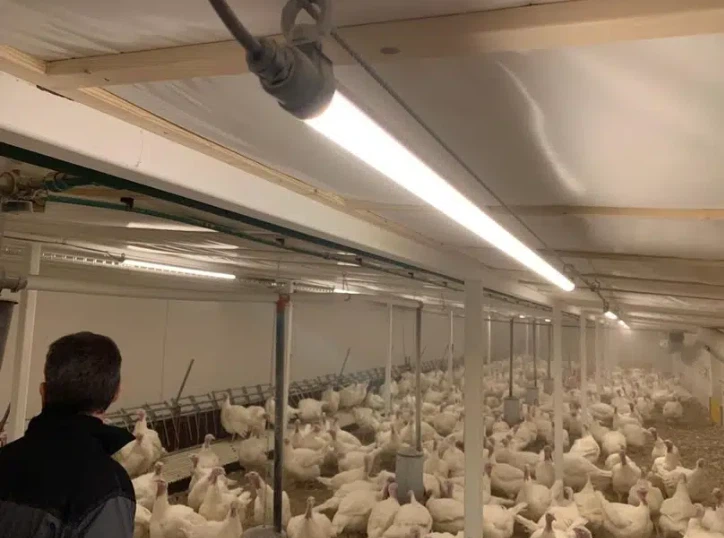
Lighting is one of the most essential environmental factors in poultry farming, directly affecting chicken health, growth status and egg production efficiency. Scientific and reasonable lighting conditions can stabilize the laying cycle of hens, promote normal chicken activity and growth, and effectively avoid common poultry health problems. In contrast, unreasonable light spectrum, intensity or lighting time will lead to reduced egg production, poor chicken growth and abnormal behavioral problems. For many farmers and poultry breeders, figuring out the standard and optimal lighting solution for coops is the key to improving farming benefits. This article will elaborate on the core standards of poultry lighting, key parameter settings and standardized installation specifications to help you create a scientific breeding lighting environment.
Basic Lighting Duration Standard for Poultry Breeding
Stable and sufficient lighting hours are the foundation of maintaining continuous egg production and healthy growth of poultry. For laying hens and breeding chickens, the daily effective lighting duration must be guaranteed between 14 and 16 hours. This fixed light cycle can fully meet the physiological needs of poultry's laying cycle and avoid production decline caused by insufficient light time. It is worth noting that besides the total lighting hours, the rational matching of light intensity and lighting timing is also indispensable to achieve optimal breeding effects.
Core Lighting Requirements: Spectrum, Intensity and Timing Rules
The optimal poultry lighting system is composed of three core elements: scientific full-spectrum light source, graded light intensity and standardized light and dark cycle. Each parameter directly determines the growth and production state of poultry.
Full-Spectrum Light Spectrum Selection
It is recommended to adopt full-spectrum lamps for poultry coop lighting. The light source of full-spectrum lamps covers multiple wavelengths close to natural sunlight, which can effectively simulate natural daylight conditions. This helps stabilize the circadian rhythm of poultry, regulate their physiological metabolism, and comprehensively improve the physical health and growth state of chickens, avoiding stress responses caused by single-spectrum light.
Graded Light Intensity Standards
Light intensity needs to be adjusted in stages according to the growth cycle of poultry. Too dim light will restrict growth and egg production, while excessive brightness will easily cause bad behaviors such as feather pecking and cannibalism among flocks. In the first two weeks of brooding, the light intensity should be controlled at 10 to 20 lux to adapt to the fragile state of young chickens. Starting from the third week, the light intensity can be gradually increased to 50 to 70 lux to meet the growth and activity needs of growing poultry.
Standardized Light and Dark Cycle Timing
Maintaining a regular light and dark cycle consistent with natural laws is crucial for poultry physiological balance. Breeders need to formulate a fixed lighting schedule: gradually increase the light intensity in the morning to simulate sunrise and wake up the flock, and turn off the lights on time every night to ensure stable dark rest time. A consistent cycle can effectively protect the circadian rhythm of poultry and avoid health and production fluctuations caused by irregular lighting.
Standard Light Placement and Intelligent Control Suggestions
Scientific Lamp Placement
The installation height and position of coop lights directly affect the uniformity of light irradiation. The light source should be installed at a reasonable height, which can prevent chickens from directly staring at the light source to avoid eye damage, and also ensure that the light can evenly cover every corner of the breeding area, eliminating dark light areas and ensuring consistent lighting conditions for the whole flock.
Intelligent Timing Control
It is highly recommended to equip lighting equipment with automatic control systems or timers. Manual lighting switching is prone to time errors and irregular light changes, which will negatively affect poultry health and production performance. Intelligent timing equipment can achieve fixed-time switching and gradual brightness adjustment, maintain long-term stable lighting conditions, and reduce human operation errors.
Comprehensive Summary of Optimal Poultry Lighting Solutions
In conclusion, the optimal poultry lighting solution takes full-spectrum light sources as the core, and matches staged light intensity standards, fixed light and dark cycles and scientific installation layout. Adhering to 14-16 hours of daily lighting, adopting graded intensity adjustment according to poultry growth stages, cooperating with standardized installation and intelligent control, can fully optimize the living and production environment of poultry. This set of scientific lighting schemes can effectively improve chicken health, stabilize and increase egg production, improve egg quality, and ultimately bring higher economic benefits to poultry farms.
If you need customized poultry full-spectrum grow light selection, parameter matching and installation scheme according to your coop size and breeding cycle, welcome to contact our professional team. We provide one-stop breeding lighting solutions to help you reduce costs and increase farm productivity!