

When planning lighting solutions for warehouses, workshops, offices, or retail spaces, many clients ask the same question: for ceiling heights under 6 meters, should I choose "low-bay" lights or flat-panel lights? While both can effectively "illuminate a room," they differ significantly in terms of performance, cost, and maintenance. Choosing the wrong type can lead to issues ranging from glare and dark corners to the need for costly replacements or rework later on. This article breaks down the core differences between the two, helping you make an informed decision before you even start requesting quotes.
Structure and Appearance: Suspended vs. Surface-Mounted
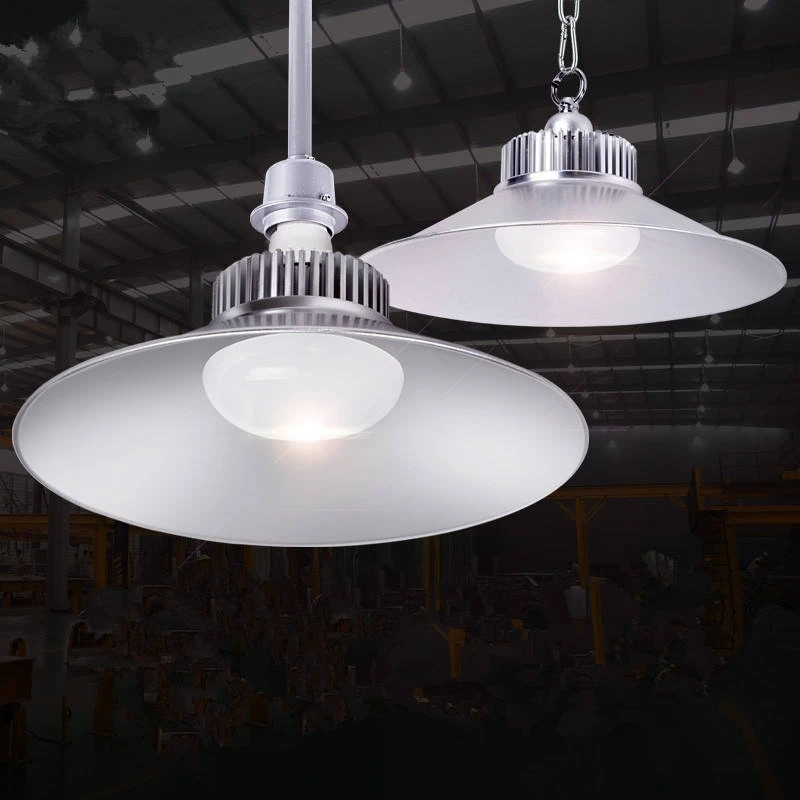
Low-bay lights are typically industrial-grade fixtures-often round or linear in shape-housed in aluminum alloy casings with integrated cooling fins. They are usually installed via chains, rods, or direct ceiling mounts. Their defining characteristics are robustness, excellent heat dissipation, and focused light output.
Flat-panel lights, by contrast, are slim, square, or rectangular panels-usually only a few centimeters thick. Common dimensions include 600×600, 300×1200, and 600×1200 mm. They are designed to be recessed into suspended ceilings or surface-mounted directly onto the ceiling. They are characterized by their thin, lightweight profile and clean, unobtrusive appearance.
In short, a low-bay light functions more like a piece of "industrial equipment," while a flat-panel light acts more like an "interior design element."
Beam Angle and Light Distribution: Focused Illumination vs. Uniform Diffusion
This is the most fundamental difference between the two.
Low-bay lights typically utilize lenses or reflectors to achieve specific beam angles-commonly 60°, 90°, or 120°. This creates a more concentrated beam, effectively "delivering" brightness down to the floor or onto shelving units.
Flat-panel lights employ a design featuring a light-guide plate and a diffuser. This produces a uniform, diffused downward glow across the entire surface, with no distinct "hot spots" or glare-creating an effect that closely mimics natural, ambient light emanating from the ceiling itself.
Therefore, low-bay lights are advantageous when specific areas (such as shelving aisles or workstations) require focused illumination, whereas flat-panel lights are better suited for providing soft, uniform ambient lighting throughout a space.
Applicable Height: Performance Below 6 Meters
Both types of fixtures can be used in spaces with ceilings below 6 meters, though each has its own "comfort zone":
Below 3 meters: Flat-panel lights are more common. In low-ceiling environments, high light penetration is unnecessary, and uniform, soft lighting offers greater visual comfort.
3–4.5 meters: Both types are suitable, depending on the application. Offices and retail spaces typically favor flat-panel lights, while warehouses and workshops lean toward low-bay lights.
4.5–6 meters: The advantages of low-bay lights become more apparent here. The diffused light from flat-panel fixtures tends to attenuate more rapidly at greater heights, often resulting in insufficient illuminance at floor level.
If the ceiling height is close to 6 meters and a high level of floor-level illuminance is required, low-bay lights are the preferred choice. Alternatively, one could opt for higher-wattage flat-panel lights and increase the total number of fixtures.
Glare and Visual Comfort
Individuals who work under artificial lighting for extended periods are often highly sensitive to glare.
Flat-panel lights feature a large light-emitting surface, which disperses brightness and typically results in a lower UGR (Unified Glare Rating). This makes them less likely to cause discomfort, making them ideal for offices, classrooms, and conference rooms where prolonged visual tasks are performed.
Low-bay lights have more concentrated light sources; without anti-glare covers or deep-reflector designs, they can produce noticeable, intense bright spots when viewed from below. Fortunately, many low-bay models offer optional lenses or reflectors specifically designed to reduce glare.
Power and Luminous Efficacy
The power ranges for these two types of fixtures differ:
Flat-panel lights: Typically range from 18W to 72W, which is sufficient for most indoor spaces with lower ceilings.
Low-bay lights: Typically range from 50W to 200W (or higher), capable of meeting more demanding lighting requirements.
In terms of luminous efficacy, most mainstream LED products achieve 100–160 lm/W. Variations in performance are primarily determined by the brand, the LED chip, and the quality of the driver, rather than the fixture type itself. When selecting lighting, consider both the lumen output and the actual illuminance requirements, rather than focusing solely on wattage.
Installation Methods and Site Conditions
The structure of the ceiling at your site will largely dictate your options:
For spaces with suspended ceilings (such as offices or shopping malls), flat-panel lights can be recessed directly; this allows for quick installation and a clean, streamlined appearance.
For spaces with exposed ceilings (such as warehouses or factories), "low-bay" (or industrial-style) lights are more practical, as they can be suspended via chains or rods without relying on a ceiling grid.
If you wish to use flat-panel lights on an exposed ceiling, you must choose a surface-mount version and include a compatible mounting frame.
Verifying the ceiling type and its load-bearing capacity before installation will save you a great deal of trouble.
Ingress Protection (IP) Ratings and Operating Environment
Different environments impose different requirements for fixture protection:
Flat-panel lights are typically designed for clean, dry indoor environments, generally carrying an IP rating between IP20 and IP40.
Low-bay lights are frequently used in industrial settings and offer superior protection against dust and moisture. Many models are rated at IP65, and some are even designed to withstand environments with high levels of dust, humidity, or mild corrosive elements.
If your space is subject to dust, oil mist, or moisture, low-bay lights are generally the more reliable choice.
Price and Long-Term Maintenance Costs
In terms of unit price, flat-panel lights-particularly the standard 600×600 mm size-are often slightly more affordable, making them highly cost-effective for bulk purchases. Low-bay lights, which require more robust heat-dissipation structures and heavier-duty housing materials, typically carry a higher unit price.
However, total cost should not be judged by the purchase price alone:
Low-bay lights feature a rugged design, ensuring a more stable lifespan even in harsh conditions.
While flat-panel lights perform well in clean environments, they are not suited for damp or dusty areas; using them in such settings can lead to issues like yellowing, water ingress, or driver failure.
Choosing the right fixture for the specific environment is the most effective way to save money in the long run.
Summary
Setting Recommended Fixture Type Primary Reason
Offices, conference rooms, classrooms Flat-panel lights Uniform light distribution, low glare, clean aesthetic
Shopping malls, supermarkets, retail stores Primarily flat-panel lights; low-bay lights can be added for key display areas Balances overall brightness with product presentation
Warehouses, logistics centers Low-bay lights Focused light output; improves illumination for shelving and aisles
Workshops, production lines Low-bay lights High ingress protection (IP) rating, durable, and suited for industrial environments
Spaces with higher ceilings (approaching 6 meters) Low-bay lights More concentrated light output; ensures better illumination at floor level
In short: Choose flat-panel lights if you prioritize comfort and aesthetics; choose low-bay lights if you prioritize high brightness and durability. The final decision should be based on a comprehensive assessment of your ceiling height, ceiling structure, operating environment, and specific illumination requirements.
Need help developing a lighting plan?
If you are working on a lighting project for a warehouse, factory, office, or commercial space and are unsure whether to choose low-bay lights or flat-panel lights, please feel free to contact us. Our team will recommend the appropriate models, wattage, and quantities based on your specific needs, and we can provide price quotes and samples. We also offer OEM/ODM customization services-send us your inquiry, and we will get back to you promptly.
Our address
No. 5-3 Niujiao Road, Yanchuan Community, Yanluo Subdistrict, Bao'an District, Shenzhen
bwzm18@ledbenweilighting.com






