

Before energy-efficient lighting became popular, selecting a light bulb was quite simple. Does the 40-watt bulb not provide enough light? Choose a 60-watt to obtain extra light. Simple and simple!
LED technology has opened up a wide range of possibilities in terms of performance and features, and while this may be viewed as a step forward in terms of environmental technologies and industrial or commercial applications, it complicates things significantly for the average consumer who simply wants to buy a few light bulbs.
With so many colour and light terminology, deciding which bulb to buy may be daunting and stressful. We're here today to assist you understand and differentiate between two difficult phrases that are often confused: CCT (correlated colour temperature) and CRI (colour rendering index).
What is CCT (Correlated Colour Temperature)?
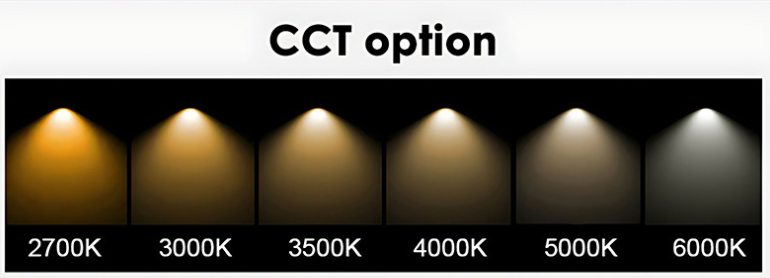
CCT is a value measured in degrees Kelvin that describes a light source's relative warmth or coolness. Most light bulbs vary in colour temperature from 2700K (warm, incandescent) to 5000K or more (sharp, white daylight).
For most residential applications, 2700K and 3000K are the chosen colour temperature selections since they both provide a pleasant, warm look that produces an appealing and restful atmosphere.
For retail or commercial applications, 4000K is a common colour choice because it produces a cleaner, more vibrant white. For industrial or task-oriented applications, 5000K or even 6500K is the optimum colour temperature since it closely matches natural sunshine.
What is CRI (Colour Rendering Index)?
The CRI rating of a light source indicates how well it highlights the colours of an item. It is rated on a scale, with 100 being the best. Standard bulbs typically have a CRI rating of 80, while high CRI bulbs have a CRI value of 90 or above
For example, a painting seen under a 70 CRI light source may have colours that may not seem proper or true. When seen under a 95 CRI light source, the painting's colours are likely to seem true and natural.
What distinguishes CRI from CCT
As previously stated, CCT and CRI assess two separate characteristics of colour. CCT indicates the colour of the light output by the light bulb and is easily apparent to the casual observer when gazing straight at the light source.
On the other hand, the CRI rating does not indicate the colour of the light itself. Rather, it describes the colour look of things under the light source (the light source "renders" an object's colours, thus the word). The CRI rating of a light bulb cannot be determined just by looking at it. Instead, a light bulb's CRI can only be evaluated with the naked eye by examining the colours of an item lit by the light bulb. This notion is shown by photographers and painters using a "colour checker," which employs a palette of standardised colours to determine colour rendering quality.
The only method to determine a light source's CRI is to use specialised spectral measuring instruments. Lighting manufacturers use data from these devices to publish and guarantee colour rendering measurements.
The connection between CCT and CRI
Although CCT and CRI address separate elements of light colour, their computations are closely connected. As previously stated, CRI may be seen as a measure of a light source's accuracy. To identify "accurate," we must first establish what the reference point for this "accuracy" should be. For example, how can we determine what a painting's colour appearance should be? In other words, what is the reference standard?
When discussing light accuracy, we must first ascertain the colour temperature of a light source to provide a correct reference point. Each colour temperature has a "reference standard" that is thought to be the most realistic, or natural, light source. For example, 2700K has a reference standard that is roughly equivalent to an incandescent lightbulb. In contrast, the reference standard for 6500K is about equivalent to natural sunshine (around noon on a midsummer day near the equator).
To continue with the painting example, suppose we had a light bulb with a colour temperature of 2700K. We would compare the look of colours to that of an incandescent bulb. We wouldn't compare them to natural sunshine since the colour temperature of 2700K shows that this is a warm, yellowish light source that isn't really similar.
On the other hand, if a light bulb's colour temperature is measured at 6500K, we would compare its colour look to that of natural sunshine.
Why is CCT more essential and vital than CRI?
The above explanation should have made it apparent that CRI needs a colour temperature value to establish what we are comparing colour appearance to.
CRI is a useful statistic for explaining colour quality, however it is almost useless when used without a colour temperature value. Given a light bulb's 95 CRI rating, you may be pleased and believe it must be quite accurate. But accurate in comparison to what? Colour of light from an incandescent bulb (2700K), natural sunshine (5000K), or natural daylight (6500K)?
Consider your application's colour temperature needs first, followed by CRI. Do you want to recreate the illumination of natural daylight? Choose a high colour temperature (5000K or above) first, followed by the CRI value. Even with a high CRI rating, a 2700K light bulb with 95 CRI cannot replicate natural daylight owing to its significantly different colour temperature.
In your effort to imitate natural lighting, suppose you locate a 6500K bulb with a low CRI. In this instance, the colour of light output by the bulb may seem to be the same as natural daylight (because to the colour temperature value), but when the light falls on any coloured surface, the colours may not appear to be the same as in natural daylight (thanks to the low CRI value).





