

In large spaces such as industrial plants, logistics warehouses, and large stadiums, ordinary lighting fixtures often fail to meet the needs for uniform brightness and wide coverage. They either produce weak light leading to blurred vision, or have limited illumination range creating blind spots, affecting work efficiency and potentially posing safety hazards. High bay lights were developed to address this pain point. As professional lighting equipment specifically designed for high-ceiling environments, their unique structural design and performance advantages have made them a core choice for lighting large spaces. They are widely used in various industrial, commercial, and public high-ceiling areas, serving as key equipment for ensuring spatial lighting quality and improving operational efficiency.
Core Definition and Design Intent of High Bay Lights
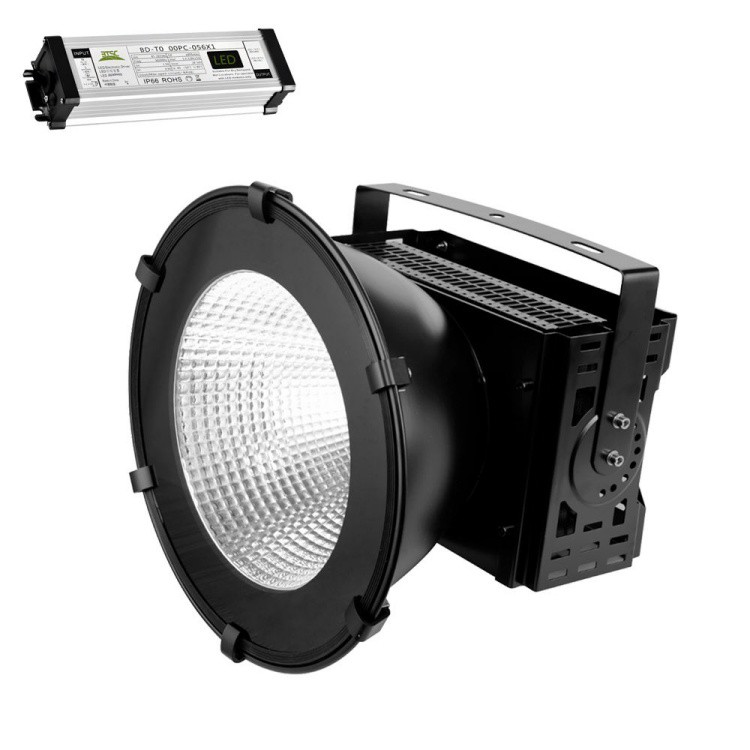
High bay lights are high-intensity lighting fixtures specifically designed for large spaces with ceiling heights typically 6-12 meters and above. Compared to ordinary indoor lights and low bay lights, their core design intent is to solve the core pain points of "insufficient light penetration, limited coverage, and difficulty in achieving standard brightness" in high-space lighting. By optimizing light source power, beam angle, and heat dissipation structure, it ensures that light is evenly projected onto the ground and work area even at high suspension heights, avoiding dark areas and shadows. It also considers energy saving and durability, adapting to complex environments in large spaces and meeting the lighting needs of various scenarios.
Core Uses of High-Door Lights
The uses of high-door lights revolve around "uniform lighting in large spaces." Different scenarios have different focuses, and they can be specifically divided into the following categories:
Industrial Production Scenarios: Primarily used in factory workshops, manufacturing plants, etc., providing sufficient and uniform light for production line operations, machinery maintenance, parts assembly, etc. The light must be flicker-free and have good color rendering (Ra≥80) to avoid operational errors and safety accidents caused by insufficient light. It is also suitable for the high-temperature and dusty environments of workshops, ensuring stable operation of the lights.
Logistics and Warehousing Scenarios: Suitable for large warehouses, logistics distribution centers, etc. The core purpose is to illuminate high-level shelves, aisles, and work areas to facilitate goods storage, retrieval, inventory, and forklift operations. It requires complete light coverage without blind spots and clear identification of goods labels. Some scenarios can be equipped with sensors to automatically turn lights on when people are present and off when they leave, reducing energy consumption.
Public Leisure and Sports Scenarios: Used in stadiums, gyms, badminton halls, etc. It needs to meet the requirements for large-area uniform lighting, with sufficient brightness (some sports scenarios require over 500 lux), no glare, and no shadows, ensuring the performance of athletes and the viewing experience of spectators. It also needs to be compatible with the high ceilings of the venues to avoid direct sunlight affecting visibility.
Commercial and Public Transportation Scenarios: Suitable for large supermarkets, convention centers, airport waiting halls, ports, and other high-ceilinged spaces. The purpose is to create a bright and comfortable environment. In supermarkets, it can highlight product displays, while in convention centers and transportation hubs, it needs to ensure smooth flow of people and goods, improving the overall operational experience. Some outdoor scenarios require waterproof and dustproof performance.
Special Environmental Scenarios: For special locations such as cold storage facilities, refrigerated rooms, chemical plants, and oil depots, high-domed lights are used to provide stable illumination in extreme environments. They must possess characteristics such as low-temperature resistance, explosion-proof, and corrosion resistance to prevent damage to the lights due to environmental factors and ensure the safe operation of special tasks.
Key Performance Advantages of High-Door Lights
The performance design of high-domed lights revolves around their core purpose, ensuring suitability for use in large spaces. Key advantages include:
High Brightness and Uniformity: Utilizing a high-lumen output light source (typically 15,000-40,000 lumens) with an optimized beam angle of 60°-150°, the light can be adjusted for focused or diffused lighting effects according to the scene, ensuring uniform light coverage at high suspension heights, with no dark areas or glare, meeting the brightness requirements of different scenarios.
Energy Efficient: Most mainstream high-ceiling lights utilize LED technology, saving 50%-70% more energy than traditional metal halide and fluorescent lamps. This significantly reduces energy consumption in large spaces. LED light sources have a lifespan of 50,000-100,000 hours, reducing replacement frequency and maintenance costs, making them suitable for long-term operation scenarios such as industrial and warehousing environments.
Durable and Easy to Maintain: The housings are often made of aerospace-grade aluminum or stainless steel, with a protection rating of IP65 or higher. They are dustproof, waterproof, corrosion-resistant, and impact-resistant, adaptable to complex environments such as industrial workshops and outdoor ports. Some models feature a compact design for easy installation, adapting to different ceiling heights via hanging chains or brackets, and simplifying maintenance.
Highly Adaptable: Models with different power, beam angles, and installation methods can be selected to meet various scenario requirements. They also support intelligent control (such as sensors and dimming), flexibly adapting to various large spaces including industrial, commercial, and sports venues. Existing lighting fixtures can even be upgraded using Retrofit kits, reducing upgrade costs.
Common Types and Applicable Scenarios of High Dome Lights
To better adapt to different scenarios, high dome lights are divided into several types, each with its own specific application focus, as follows:
UFO-type High Dome Light: With a compact, round design, excellent heat dissipation, concentrated and even brightness, suitable for large open spaces such as factory workshops, stadiums, and airport hangars. Easy to install, but less suitable for narrow aisles or areas with dense shelving.
Linear High Dome Light: With a long rectangular design, the light is distributed in a rectangular pattern. Suitable for structured spaces such as warehouses with dense shelving, supermarket aisles, and production lines. It can precisely cover aisles and work areas and can be installed aligned with shelves and production lines to improve targeted lighting.
Retrofit High Dome Light Kit: Designed for upgrading old lighting fixtures, it eliminates the need to replace the entire fixture. It can directly replace existing metal halide lamps and fluorescent lamps, suitable for small workshops, garages, and small warehouses with limited budgets that require quick lighting upgrades. It offers high cost-effectiveness.
Explosion-proof/Low-Temperature Resistant High Dome Lights: Building upon the basic model, these lights feature explosion-proof and low-temperature resistant structures, making them suitable for special environments such as chemical plants, oil depots, and cold storage facilities. Their core function is to meet the safety lighting needs in extreme environments, ensuring operational safety.
In summary, the core purpose of high dome lights is to provide uniform, sufficient, and stable lighting for spaces 6 meters and above, addressing the pain points of ordinary lighting fixtures in high-space environments. Essentially, they "adapt to high spaces, ensure lighting quality, and improve operational efficiency." Whether in industrial production, logistics warehousing, sports, or commercial settings, high dome lights, with their high brightness, energy efficiency, durability, and strong adaptability, ensure operational safety and user experience while reducing operating and maintenance costs, making them an indispensable core product for high-space lighting. With the development of LED technology and intelligent control, high dome lights are evolving towards greater energy efficiency, intelligence, and adaptability to specific scenarios, further meeting the personalized lighting needs of different industries, helping them improve operational efficiency and reduce energy costs, while aligning with the global trend of improving energy efficiency.
If you have needs for purchasing and selecting high-ceiling lights, whether for industrial workshops, warehouses, stadiums, or special environments, we can recommend suitable models and solutions based on your site height, lighting requirements, and budget, and provide professional product consultation and technical support. Feel free to contact us anytime to discuss cooperation, obtain detailed quotes, and work together to solve lighting challenges in high spaces and improve the quality of spatial lighting!
www.benweilighting.com/professional-lighting/led-highbay-light/ip65-outdoor-led-high-bay-light.html
Our address
No. 5-3 Niujiao Road, Yanchuan Community, Yanluo Subdistrict, Bao'an District, Shenzhen
benwei10@benweilighting.com






