If you've ever wondered why nearly every LED street light on the market today comes housed in aluminum rather than steel, plastic, or cast iron, the answer isn't just tradition - it's physics, economics, and decades of field experience all pointing to the same material. Below, we break down the specific properties that make aluminum alloy the go-to choice for street light manufacturers and project buyers alike.
Superior Thermal Conductivity for Heat Dissipation
LED chips are efficient, but they still generate heat - and heat is the number one enemy of LED lifespan. Every 10°C rise in junction temperature can cut an LED's usable life significantly. Aluminum alloys such as 6063 and 6061-T6 conduct heat at roughly 150–200 W/m·K, which is why most fixture housings double as passive heatsinks. The heat generated at the LED board transfers quickly through the aluminum body and dissipates into the surrounding air, keeping the driver and chips within a safe operating range without needing fans or liquid cooling.
Lightweight Yet Structurally Strong
Street lights are typically mounted 6-12 meters up on poles that also have to withstand wind load, vibration, and their own weight over time. Aluminum weighs about one-third as much as steel for a comparable structural strength. That weight saving matters twice: it reduces the load on the pole and mounting arm, and it makes transportation and installation noticeably easier for crews working at height - fewer people needed, less equipment strain, faster project turnaround.
Natural Corrosion and Weather Resistance
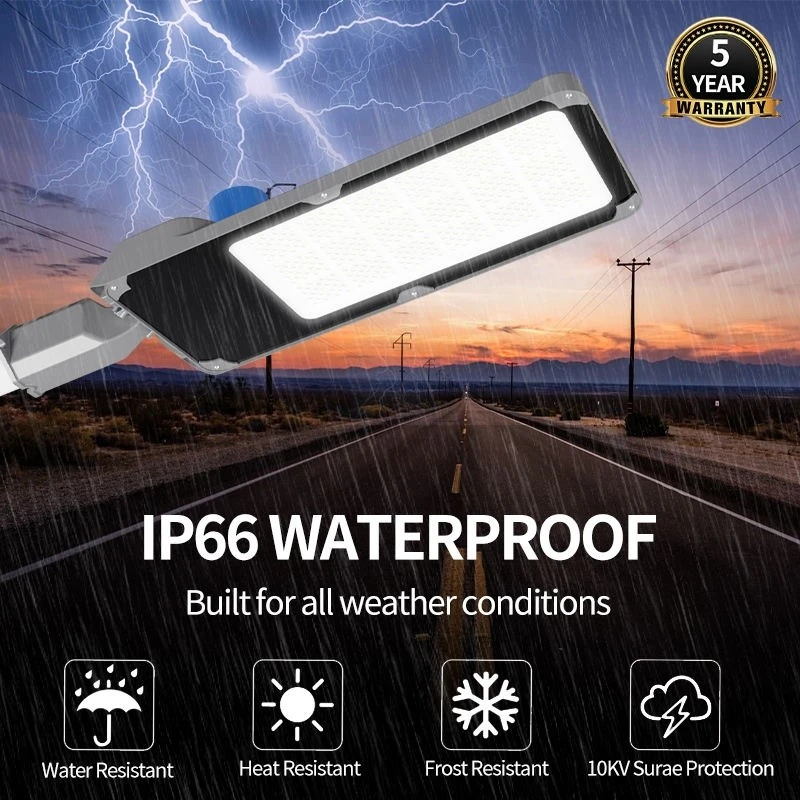
Street lights sit outdoors permanently, exposed to rain, UV radiation, humidity, and in coastal or industrial areas, salt spray or airborne pollutants. Aluminum naturally forms a thin oxide layer on its surface that protects the metal underneath from further oxidation. When combined with additional surface treatments - anodizing or powder coating, for example - this resistance extends further, allowing fixtures to hold up in demanding environments like coastal highways or industrial parks without rusting or degrading structurally.
Design Flexibility for Complex Housings
Aluminum is well suited to die-casting and extrusion, two manufacturing processes that allow for detailed heatsink fin patterns, streamlined housing shapes, and integrated mounting brackets in a single piece. This matters for street lights specifically because fin geometry directly affects how much surface area is available for heat dissipation. Manufacturers can fine-tune fin spacing, depth, and orientation to match a fixture's wattage and expected ambient temperature, something far harder to achieve economically with steel or plastic tooling.
Long Service Life and Low Maintenance
Municipal and commercial buyers generally expect street lights to last 10 years or more with minimal upkeep, since replacing fixtures on tall poles is labor-intensive and costly. Because aluminum resists corrosion and doesn't fatigue the way some metals do under thermal cycling, housings tend to keep their structural integrity and appearance over that entire service window. This translates into fewer maintenance callouts and a lower total cost of ownership across the life of a lighting project.
Cost-Effective Over the Product Lifecycle
Aluminum's upfront material cost is often comparable to or even lower than alternatives like copper (used in some heatsinks) once you factor in weight-related savings on poles, brackets, and shipping. It's also close to 100% recyclable without loss of material properties, which appeals to municipalities running sustainability-focused procurement programs. When you add up manufacturing efficiency, reduced installation labor, and minimal maintenance, aluminum alloy consistently comes out ahead on lifecycle cost, not just sticker price.
Summary
Taken together, thermal performance, weight, weather resistance, manufacturability, and long-term cost all point in the same direction - which is why aluminum alloy remains the standard housing material across the LED street lighting industry rather than a passing trend. Choosing the right alloy grade and fin design, though, still depends on your specific project conditions - wattage, climate, and mounting height all play a role.
If you're sourcing LED street lights and want guidance on which aluminum housing design fits your project, feel free to reach out to our team for a tailored recommendation and quote.
Our address
No. 5-3 Niujiao Road, Yanchuan Community, Yanluo Subdistrict, Bao'an District, Shenzhen
bwzm18@ledbenweilighting.com