

Picking an RGB downlight sounds simple until you're staring at a spec sheet full of numbers you didn't know you needed to care about - CRI, beam angle, IP rating, DMX vs. Zigbee. If you've ever installed a "smart" downlight only to find it flickers on dimmers or can't sync with the rest of your lighting system, you already know the stakes. This guide breaks down the factors that actually matter, so whether you're a lighting designer, a contractor sourcing for a project, or a distributor building out a product line, you can match the right downlight to the right room without guesswork.
Understand What "RGB Downlight" Actually Means
Not every colored downlight on the market is built the same way. Some units mix red, green, and blue LEDs to produce color but struggle to render a clean, neutral white. Others pair RGB chips with a dedicated white LED (RGBW) or a tunable white channel (RGB+CCT), which matters a lot once the "party mode" is over and you just want normal task lighting. Before comparing prices, it helps to know which category you're actually looking at, because the downstream specs - CRI, dimming behavior, control protocol - all depend on it.
Color Quality: RGB, RGBW, or RGB+CCT?
If the downlight will ever be used for anything besides mood lighting - a living room, a retail display, a hotel corridor - color rendering index (CRI) becomes important. Pure RGB mixing tends to produce a white that looks slightly purple or greenish under scrutiny, with CRI often sitting in the 70s. RGBW and RGB+CCT fixtures use a separate white LED channel, which usually pushes CRI above 90 and gives a much truer white for everyday use. As a rule of thumb: pure RGB is fine for accent or theatrical effects; RGBW/RGB+CCT is the safer choice for any space where people will also read, cook, or work.
Beam Angle and Room Layout
Beam angle decides whether a downlight washes color evenly across a wall or creates a tight, dramatic spotlight. Narrow beams (15–24°) suit feature walls, artwork, or small display niches where you want a punch of color in one spot. Wider beams (60–120°) are better for general ambient lighting in living rooms or open ceilings, since they blend adjacent fixtures into a continuous wash of color rather than a row of separate circles. Getting this wrong is one of the most common installation mistakes - a narrow-beam downlight in a large room just leaves visible gaps between fixtures.
Brightness and Wattage Requirements
RGB downlights are usually rated in both lumens (for the white channel) and watts, but the two don't map onto white-light downlights the same way. Colored light is inherently less efficient at producing perceived brightness than white light, so a 9W RGB downlight will not feel as bright in color mode as a 9W white downlight. For general room lighting, most residential ceilings do well with 7–12W per fixture spaced roughly 1–1.2 meters apart, but this varies with ceiling height and desired ambiance - a bedroom accent setup needs far less output than a living room used for daily activity.
Control Compatibility (DALI, DMX, Zigbee, RF, WiFi)
This is where a lot of buyers get tripped up after installation. An RGB downlight is only as good as the system it talks to. RF remotes and WiFi apps work fine for single rooms or small residential projects, but they don't scale well and often can't sync precisely across many fixtures. Zigbee and Bluetooth mesh are better for whole-home smart lighting because they don't rely on a single hub-to-bulb radio link. For commercial or architectural projects - hotels, retail, entertainment venues - DMX or DALI-2 is usually the standard, since it allows precise scene control across dozens or hundreds of fixtures from a central controller. Before ordering, confirm the downlight's protocol matches (or can bridge to) whatever system is already installed, because mixing protocols usually means buying an extra gateway.
IP Rating for the Installation Environment
Not every RGB downlight is meant for the same environment. A standard IP20 fixture is fine for a dry living room ceiling, but it has no business going into a bathroom, kitchen splash zone, or outdoor soffit. IP44 handles occasional moisture (like a bathroom outside the direct shower zone), while IP65 or higher is needed for exposed outdoor use or areas with direct water contact. It's worth double-checking this spec specifically for RGB units, since some manufacturers focus their sealing efforts on the driver housing but leave the lens gasket underrated for the advertised IP class.
Cutout Size and Mounting Constraints
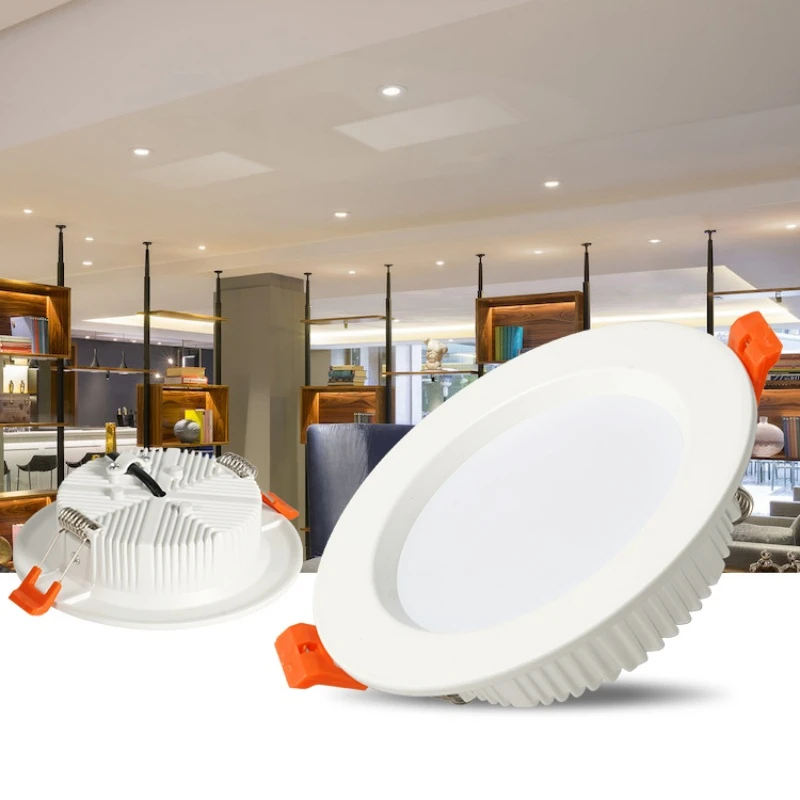
Ceiling cutout diameter is a detail that's easy to overlook until the fixture arrives and doesn't fit the existing hole from a previous installation. RGB downlights commonly come in 75mm, 100mm, and 125mm cutout sizes, though this varies by manufacturer. If you're retrofitting an existing ceiling, measure the current cutout first - resizing a plaster or drywall opening adds cost and time that's easy to avoid by matching sizes upfront. Also check the minimum ceiling void depth required for the driver and heat sink, especially in retrofit projects with shallow ceiling cavities.
Driver Quality and Dimming Performance
The driver is the part of the downlight most buyers never think about, but it's usually the first thing to fail and the main source of flickering or buzzing on dimmers. A well-built RGB downlight driver should support smooth 0–100% dimming without visible stepping, and if it needs to work with existing wall dimmers (leading-edge or trailing-edge), that compatibility should be confirmed before bulk ordering - not discovered after installation. For smart-control setups, some drivers integrate the receiver directly, while others require a separate controller module; knowing which one you're getting affects both the installation labor and the total component cost.
Certifications to Check Before Buying
Depending on the target market, certain certifications aren't optional. CE and RoHS are typically expected for the EU market, UL or ETL for North America, and SAA for Australia. For commercial projects, some clients or building codes also require specific fire-rating certifications (like fire-rated downlight housings for use in fire-separated ceilings). Asking a supplier for test reports rather than just a certification logo on the packaging is a reasonable step, especially for larger orders where non-compliant fixtures can cause real problems at customs or during building inspection.
Summary
There's no single "best" RGB downlight - the right choice depends on what the room needs to do. A tight-beam, high-CRI RGBW fixture suits a feature wall in a living room; a DALI-compatible, IP65-rated unit is the better call for an outdoor hotel walkway; a simple RF-controlled downlight is often enough for a single bedroom accent setup. The main things worth checking every time are color quality (RGB vs. RGBW vs. RGB+CCT), beam angle relative to room size, control protocol compatibility with existing systems, IP rating for the installation environment, and driver/dimming quality. Getting these five right avoids most of the common complaints - mismatched white tones, patchy coverage, flickering, or fixtures that simply won't sync with the rest of the system.
If you're sourcing RGB downlights for a project - residential, hospitality, or retail - and want help matching specs to your specific ceiling layout, control system, or environment, feel free to reach out to our team with your project details. We're happy to recommend the right configuration and provide samples or test reports before you commit to a bulk order.
Our address
No. 5-3 Niujiao Road, Yanchuan Community, Yanluo Subdistrict, Bao'an District, Shenzhen
bwzm18@ledbenweilighting.com






