

We often encounter clients who specify the wrong model in their inquiries-mistaking C7 for C9, or confusing Mini LED bulbs with standard decorative light strings. Although these three types of bulbs look similar, their applications differ vastly; choosing the wrong one not only compromises the decorative effect but can also necessitate costly re-installation. This article clarifies the differences between them to help you avoid pitfalls when selecting products, preparing quotes, or discussing specifications with clients.
What is a C7 bulb?
C7 is a long-standing specification in the US decorative lighting industry. The "C" stands for "Cone" (referring to the bulb shape), and the number 7 indicates a maximum diameter of approximately 7/8 of an inch. Traditional C7 bulbs use an E12 screw base (commonly known as a candelabra base) and feature a compact body; they are frequently used to outline windows and railings or to decorate small shrubs.
Old-fashioned incandescent C7 bulbs typically had a wattage of around 5 watts, but they have largely been replaced by LED versions in today's market. LED C7 bulbs of the same size consume only about 0.4–0.5 watts and often feature PC or acrylic housings, offering much better shatter resistance than glass bulbs. Their compact size makes them ideal for close-range viewing, such as on door frames or windowsills.
Characteristics of C9 bulbs
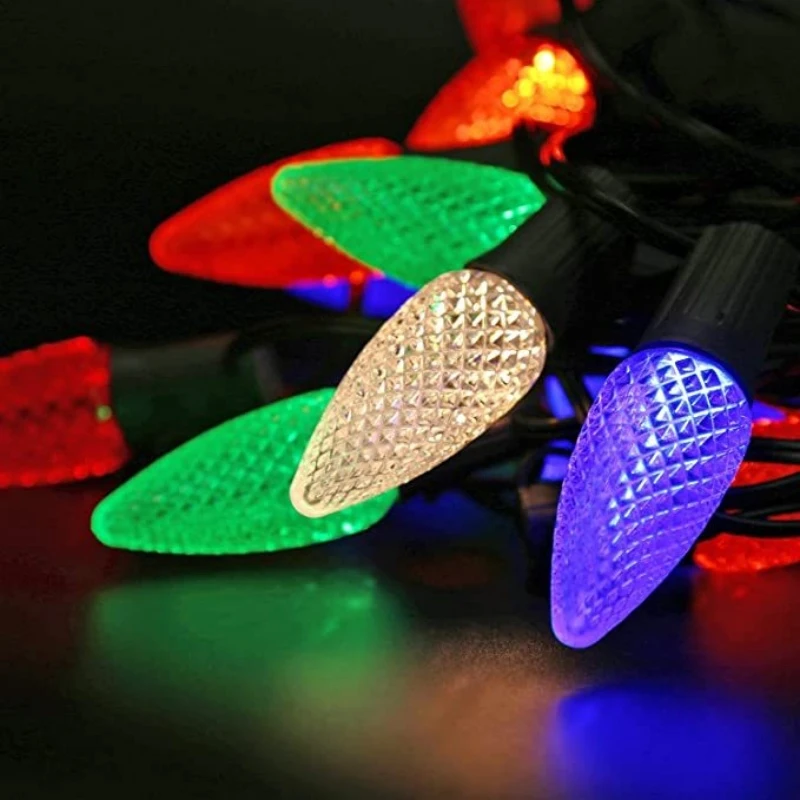
C9 and C7 are "sibling models" that share the same naming convention; the number 9 indicates a maximum diameter of approximately 9/8 of an inch-making them slightly larger than C7s. Like the C7, the C9 uses an E12 screw base, but the bulb itself is larger and brighter, making it the standard choice for outlining rooflines, eaves, and large commercial buildings.
Due to their larger size, C9 bulbs offer a more "eye-catching" lighting effect suitable for long-distance viewing-perfect for villa rooftops, shopping mall facades, and municipal holiday displays. LED C9 bulbs consume roughly 0.5–0.7 watts and are significantly brighter than C7s. In fact, when North American clients place wholesale orders-particularly for commercial lighting projects-C9 volumes often exceed those of C7s.
Understanding Mini LED bulbs
Mini LED bulbs belong to a completely different category than the first two types. C7 and C9 lights are "bulb-shaped" decorative lights, whereas "Mini LED" typically refers to the tiny, closely spaced bulbs found on light strings-commonly seen in products like Christmas tree lights, icicle lights, and curtain lights.
Mini LED bulbs generally lack individual screw bases; instead, they are soldered or clipped directly onto the wire. Their individual power consumption is extremely low-usually between 0.03 and 0.08 watts-allowing hundreds of bulbs to be densely arranged on a single string without excessive power draw. This is precisely why Christmas tree lights almost exclusively use Mini LEDs: they provide a multitude of dense light points while keeping overall power consumption manageable.
Key Differences: A Comparison
Summarizing the information above, the main differences lie in the following dimensions:
Size: C9 > C7 > Mini LED; C9 is the largest, while Mini LED bulbs are roughly the size of a grain of rice.
Installation: C7 and C9 are screw-base bulbs that can be replaced individually; Mini LEDs are usually permanently soldered, meaning a broken bulb often requires replacing the entire string or repairing specific bulbs.
Applications: C7 is suitable for detailed, close-up decoration; C9 is ideal for large-scale outline lighting; Mini LEDs are best for dense lighting effects (such as tree wraps, curtains, or icicle designs).
Brightness and Power Consumption: Individually, C9 is the brightest and consumes the most power; however, because Mini LEDs are used in large numbers, the total power consumption of a string depends on the bulb density.
Visual Effect: C7/C9 produce "intense point-source light" with distinct spacing; Mini LEDs create a "dense, soft glow," resembling a starry sky.
Taken together, there is no single "best" option-only the choice of which is most suitable for the specific project at hand.
Choosing Bulbs Based on the Scenario
For large-scale commercial lighting projects-such as outlining rooflines or eaves-C9 bulbs are usually the top choice; they offer sufficient brightness and uniform spacing, creating a great visual impact from a distance. If the client desires refined decoration for window frames or porches, C7 bulbs offer a more balanced look without appearing overly obtrusive. For orders requiring lighting effects that cover a "surface" or create a sense of "volume"-such as for Christmas trees, topiary shapes, or curtain lights-Mini LEDs are the go-to choice. They offer high density and low power consumption, while also supporting dynamic effects like gradients and twinkling patterns.
In fact, many wholesale clients stock all three types simultaneously; since downstream project requirements vary, a single product category rarely covers every order.
Summary
While C7, C9, and Mini LED bulbs may all look like "decorative bulbs," they differ significantly in terms of bulb size, base type, and application. C7s are compact and ideal for close-up viewing of details; C9s are larger and better suited for highlighting outlines from a distance; and Mini LEDs specialize in creating dense, point-source lighting effects. Understanding these distinctions simplifies everything from product selection and inventory management to discussing specifications with clients.
If you are sourcing C7, C9, or Mini LED bulbs for the Christmas season or outdoor decoration projects, please contact our team. We offer customization options for wattage, string length, and IP waterproof ratings, as well as OEM/ODM packaging solutions. We provide samples for testing and welcome bulk inquiries. We look forward to learning about your specific project needs and recommending the ideal bulb solution for you.
Our address
No. 5-3 Niujiao Road, Yanchuan Community, Yanluo Subdistrict, Bao'an District, Shenzhen
bwzm18@ledbenweilighting.com






