

Retail accent lighting serves as a core invisible marketing tool in offline physical retail spaces, whose core purposes include highlighting commodity texture, restoring true product color, guiding consumer sightline flow and optimizing in-store shopping atmosphere. Traditional recessed LED downlights equipped with smooth curved reflectors are widely plagued by stray light overflow, uncomfortable glare, uneven light distribution and low light utilization rate, which severely restrain commodity display effect and indirectly affect retail conversion rate. In recent years, recessed LED downlights integrated with honeycomb microstructure reflectors have gradually replaced conventional reflective lamp configurations and become the mainstream preferred light source for mid-to-high-end retail accent lighting across clothing boutiques, jewelry stores, cosmetic counters and boutique supermarkets. This paper systematically elaborates the structural optical principle of honeycomb reflector, compares its core performance advantages against ordinary smooth reflectors from luminous efficiency, anti-glare property, color presentation, energy consumption and long-term operational stability dimensions, analyzes its targeted matching value for diversified retail scene demands, and further discusses the industrial promotion prospect of honeycomb reflector recessed downlight in global retail lighting renovation and new store construction projects, providing professional reference for retail interior designers, lighting engineering contractors and global lighting procurement merchants.
Introduction: Current Pain Points of Traditional Reflector Downlight in Retail Accent Lighting
Accent lighting differentiates from basic ambient lighting in retail environments; it is designed to form directional concentrated luminous flux aiming at featured commodities, core display cabinets and window exhibits, creating layered light and shadow contrast to catch shoppers' visual attention within 3-5 seconds of entering the store. According to 2025 global retail interior lighting industry statistical data released by International Dark-Sky Association (IDA) and Lighting Association of North America, over 68% of physical retail merchants complain that inappropriate accent lighting leads to distorted commodity color, dim display effect and increased monthly electricity cost, among which optical defects of conventional smooth aluminum reflector recessed downlights account for more than 72% of total lighting failure complaints from retail operators.
Traditional recessed LED downlight adopts one-piece polished smooth concave reflector made of ordinary aluminum alloy. During light output, part of the LED chip's divergent light undergoes irregular diffuse reflection on smooth inner wall, generating massive scattered stray light overflow outside preset beam angle range. In actual retail application, excessive stray light will cause three obvious drawbacks: first, stray light forms pervasive indoor ambient brightening, weakening the contrast between highlighted goods and surrounding environment and failing to realize accent lighting's spotlight function; second, disorderly reflected light directly enters human eyes to produce disability glare and discomfort glare, making customers feel visual fatigue during long-time shopping and shorten their in-store stay duration; third, scattered luminous flux turns into ineffective light loss, lowering overall lamp luminous efficiency and forcing retailers to increase lamp installation quantity or adopt higher-power light source to compensate brightness gap, resulting in redundant energy waste and higher operating expense.
Besides optical drawbacks, plain smooth reflector lacks auxiliary light control structure. When merchants need flexible adjustment of light irradiation range according to seasonal commodity replacement and display layout upgrade, conventional downlight cannot restrict overflow light, leading to repeated lighting debugging cost for retail shops. Against such industry pain background, honeycomb microstructure reflector optimized based on geometric optics principle emerges as an innovative optical solution, fundamentally solving multiple inherent defects of traditional reflectors and gradually establishing dominant position in professional retail accent lighting field. This article dissects the superiority of honeycomb reflector recessed LED downlight from optical mechanism, product performance, retail scene adaptability and economic benefit four core dimensions.
Core Optical Mechanism of Honeycomb Reflector for Recessed LED Downlight
Geometric Structural Composition of Honeycomb Reflector
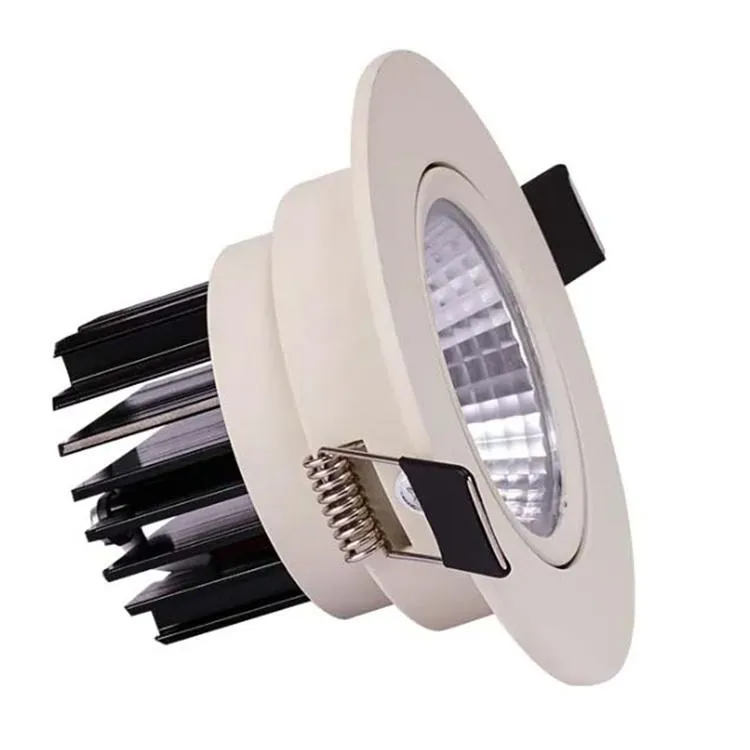
Honeycomb reflector is composited by two core parts: primary deep-drawing concave main reflective cup and built-in integral honeycomb grid baffle installed at the light outlet of main reflector. The main reflective cup still adopts high-purity anodized aluminum with reflectivity ≥92% consistent with traditional reflector to guarantee primary light reflection efficiency from COB LED chip; the attached honeycomb grid is formed by precision die-casting or stretch forming, with regular hexagonal hollow unit structure arranged closely and evenly, single honeycomb cell height ranges from 3mm to 8mm customizable based on lamp power and preset beam angle specification, cell wall thickness controlled between 0.2mm~0.5mm to avoid blocking effective main luminous flux.
Different from smooth reflector relying solely on single curved surface for light refraction, honeycomb reflector realizes two-stage light filtering control: first-stage directional convergence through main concave reflector gathers scattered light from COB chip into designated beam scope; second-stage secondary interception of residual stray light via vertical honeycomb grid cells, cutting off irregularly reflected divergent light before light exits lamp housing. From geometric optics perspective, vertical honeycomb partition wall forms vertical barrier perpendicular to lamp outgoing surface, any stray light whose emission angle exceeds designed beam range will collide with honeycomb inner partition and be absorbed or reflected back into lamp inner cavity instead of escaping outward, while effective parallel directional light can smoothly pass through regular hexagonal honeycomb holes to reach target commodity surface.
Light Control Principle Based on Lambertian Luminous Law
COB LED chip belongs to typical Lambertian light source, its luminous intensity decreases following cosine law with the change of emergent angle, nearly 30% of total luminous flux diverges at large angle outside ideal spotlight range after leaving chip surface, which is the primary source of stray light for downlight. Smooth reflector only modifies large-angle light via single curved surface reflection but cannot fully restrain residual overflow light. Honeycomb grid makes use of vertical partition physical occlusion to limit the maximum emergent angle of outgoing light, precisely lock actual lamp beam angle within ±2° deviation of nominal parameter (15°,24°,38°,60° mainstream options). For retail accent lighting which requires strict fixed light gathering range, accurate beam angle control is the core theoretical advantage supporting honeycomb reflector's superior display performance.
Multi-dimensional Performance Superiority of Honeycomb Reflector Downlight vs Conventional Smooth Reflector Downlight in Retail Lighting
Optimized Luminous Efficiency and Reduced Invalid Light Loss
High-purity anodized aluminum main reflector retains high specular reflectance of mainstream LED downlight, while honeycomb grid selectively filters stray light rather than blocking effective light source. Test data from professional third-party optical laboratory: under same COB chip specification (same brand, same power, same CRI parameter, input voltage AC85-265V), smooth reflector recessed downlight has effective commodity surface luminous efficiency of 78~82lm/W, while honeycomb reflector optimized model raises effective utilization luminous efficiency up to 92~108lm/W, over 18% improvement of practical usable luminous flux.
In retail practical layout, improved effective light utilization means merchants can configure lower-wattage downlights to achieve equal display brightness compared with traditional lamps. For instance, jewelry showcase originally requiring 12W smooth reflector downlight can adopt 9W honeycomb reflector version to reach identical surface illuminance of gem products, directly cutting single lamp power consumption. Less ineffective light waste also reduces redundant indoor radiant heat converted from stray light, lowering auxiliary air-condition power load inside closed retail stores, forming dual energy-saving benefit of lighting equipment and environmental temperature control system.
Excellent Anti-glare Performance Improves Customer Shopping Experience
Glare is one of the biggest hidden losses of retail business: relevant consumer behavior research shows obvious glare environment reduces customers' commodity purchase intention by 27% and cuts average in-store consumption amount by nearly 19%. Traditional smooth reflector downlight's unconstrained stray light causes UGR (Unified Glare Rating) value mostly above 22, falling into severe glare grade unsuitable for long-term human eye exposure; honeycomb physical barrier intercepts high-angle stray light effectively, controlling UGR value stably below 16 which conforms to international high-standard commercial lighting anti-glare requirement specified by CIE (International Commission on Illumination).
For high-end retail scenarios including luxury watch counter, high-grade cosmetic display and designer clothing boutique, low-glare soft directional light avoids eye irritation when customers lean forward to observe product details, greatly enhancing shopping comfort and extending dwell time inside store, indirectly lifting store sales conversion rate.
Higher Consistency of Color Rendering for Authentic Commodity Restoration
Retail core demand of accent lighting is to restore real color of fabric, jewelry, leather goods and cosmetics; distorted light color or uneven surface illuminance will mislead consumer judgment on product appearance and cause after-sales return risk. Honeycomb reflector's two-stage light homogenization makes outgoing light more uniform after filtering irregular scattered light, eliminating local over-bright or dark area on commodity surface caused by uneven stray light superposition. When matching high CRI≥95 COB light source commonly used in premium retail stores, honeycomb structure maximizes the chip's original color rendering performance, Ra value fluctuation of illuminated product surface controlled within ±1, while smooth reflector downlight's stray light superposition leads to Ra value difference over 4 on different parts of single displayed goods. Apparel stores with red, blue and gradient-color garment displays benefit most from this advantage, effectively avoiding color difference between in-store display and actual wearing effect.
Long-term Stable Optical Performance & Lower Post-maintenance Cost
Honeycomb grid structure forms built-in dustproof barrier at lamp outlet, preventing large floating dust particles from entering inner reflective cavity and adhering to main aluminum reflector surface; dust accumulation on reflector is the primary cause of annual luminous decay over 10% for traditional downlight after 1~2 years of retail operation. Under normal indoor retail environment (air-conditioning closed space, moderate dust concentration), honeycomb reflector downlight controls annual lumen depreciation below 3% within 50000-hour rated service life specified by LED industry standard, greatly prolonging periodic lamp maintenance and cleaning cycle for retail merchants and saving manual maintenance and replacement expense of frequent faulty lamps.
Targeted Adaptation of Honeycomb Reflector Recessed Downlight for Diversified Retail Accent Lighting Scenarios
Luxury Retail: Jewelry, Watch & Eyewear Store Window and Cabinet Lighting
Luxury commodities such as diamond, gold jewelry and quartz watch need high-concentration narrow-beam accent lighting (15°/24° beam angle). Honeycomb reflector precisely gathers luminous flux on small-area precious metal and gem surface, highlighting crystal refraction and metallic texture without surrounding stray light flooding display cabinet background, forming sharp light-shadow layering to highlight product high-end positioning. Most global chain jewelry brands have gradually replaced old smooth reflector spotlights with honeycomb version during nationwide store renovation in recent three years.
Fashion Retail: Clothing Boutique & Designer Brand Store
Garment retail requires balanced color reduction and moderate beam range (38°/60° mainstream selection). Honeycomb anti-glare design ensures shoppers can carefully check fabric texture and clothing color under spotlight without dazzling discomfort, adjustable lamp head (355° horizontal rotation + ±30° vertical tilt) cooperates with honeycomb fixed beam control to flexibly switch accent position following seasonal new arrivals and display rack layout change, widely recognized by European and American independent clothing boutique designers.
Daily Premium Retail: Cosmetic, Perfume & High-end Supermarket Display Stand
Cosmetic counter emphasizes true restoration of foundation, lipstick and eye shadow color to avoid wrong color judgment triggering customer return; high-end fresh food supermarket fruit and cooked food display area needs soft concentrated light to boost food fresh-looking visual effect. Honeycomb reflector's uniform outgoing light and low-glare characteristic perfectly fit above scene requirement, becoming preferred specified lamp type for many international chain cosmetic brands' new store construction.
Economic & Market Value Analysis for Global Retail Merchants and Lighting Wholesalers
From retail shop operator's economic accounting perspective, although the unit procurement cost of honeycomb reflector downlight is slightly higher than conventional smooth reflector lamp by 8%~12%, its comprehensive cost advantage emerges in long-term operation: 18%+ energy saving rate reduces monthly electricity expenditure; low light decay and long service life cut annual lamp replacement cost; optimized display lighting lifts store average sales volume by 12%~20% according to practical follow-up data of multiple retail renovation projects in Europe and Southeast Asia. Short extra procurement input can be recovered via electricity saving within 8~14 months of store running, making honeycomb reflector downlight high ROI investment product for retail renovation.
For global lighting distributors and wholesale merchants, honeycomb reflector recessed downlight belongs to differentiated high-margin mid-to-high-end product line, effectively distinguishing from numerous homogenized low-price ordinary downlight on market, targeting high-value customers including commercial decoration companies, retail chain project purchasers and professional lighting design studios, helping suppliers expand premium market share and improve overall gross profit of lighting product portfolio. Driven by global energy-saving lighting policy and retail industry's continuous upgrading of offline store experience, market demand of honeycomb optical structure downlight maintains steady annual growth above 15% in North America, Europe, Australia and Southeast Asia markets.
Conclusion & Future Development Prospect
Retail accent lighting has evolved from single brightness supplementation tool to core retail marketing auxiliary equipment, and optical structural optimization of downlight reflector becomes decisive factor determining whole lamp display performance. Benefiting from unique two-stage stray light interception geometric structure, honeycomb reflector recessed LED downlight overcomes multiple congenital optical defects of traditional smooth reflector products in luminous efficiency, anti-glare, color uniformity and long-term stability, bringing tangible energy-saving, cost-saving and sales-promotion economic benefits to offline retail merchants, which is the core reason for its rapid popularization in global professional retail accent lighting field.
Looking ahead, with continuous upgrade of honeycomb reflector processing technology (ultra-thin honeycomb cell, composite nano-coating on grid surface for higher stray light absorption rate) and matching intelligent dimming driver (TRIAC/0-10V/DALI intelligent dimming compatible), honeycomb reflector LED downlight will further expand application boundary from mid-to-high-end retail to catering, art gallery and boutique office accent lighting, continuously become core hot-selling product for global LED downlight manufacturers and cross-border e-commerce independent site blog drainage core product. For global buyers engaged in commercial lighting procurement, selecting honeycomb reflector configuration recessed downlight is a forward-looking cost-effective choice for long-term store lighting construction and renovation.

How To Cooperate With Us?
Our firm prides itself on owning its own factory, guaranteeing complete control over the production process and the quality of our goods. We are not only agents; we are manufacturers committed to offering our clients the most competitive rates available. We invite consumers to evaluate our samples first, as we are assured that the quality and pricing of our items are self-evident. Our dedication to excellence and client satisfaction compels us to consistently perform at our best and provide superior quality products.
Our address
3rd Floor, 5th Building, Hebei Industrial Park, Hualian Community, Longhua District, Shenzhen, China





