

Product Brief Introduction
Core Structural Design of Modular SMD LED Floodlight
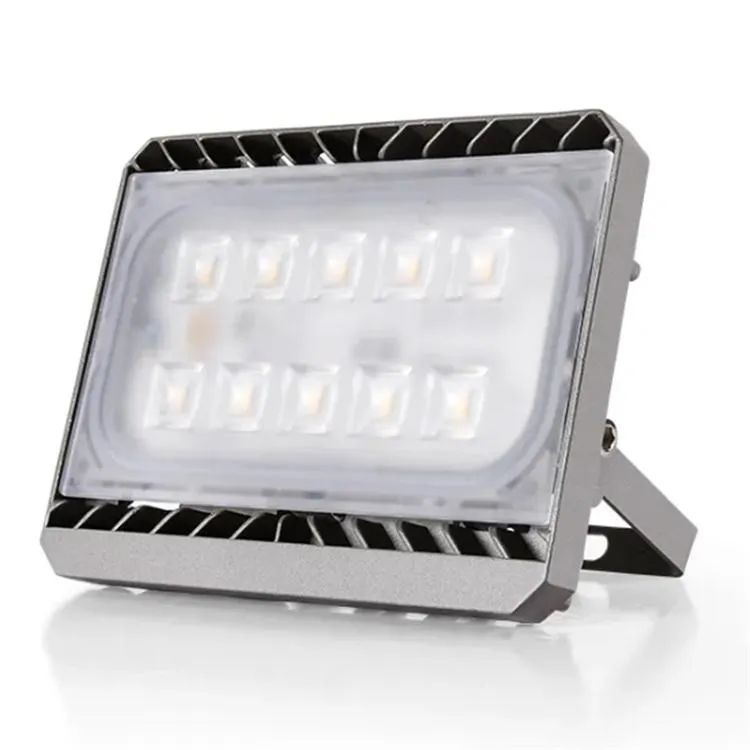
This high-performance modular SMD LED floodlight is developed targeting large-area industrial and commercial outdoor lighting demands including warehouse storage areas, sports stadiums, cargo yards and commercial plazas. The whole luminaire adopts split modular spliced framework paired with die-cast ADC12 aluminum radiator housing, allowing flexible combination of single, dual, triple or quadruple lamp modules to adjust total rated power ranging from 50W up to 800W according to actual illumination layout requirements. Each independent lighting module is configured with separate SMD light source assembly and exclusive constant-current driving circuit, which fundamentally realizes modularized maintenance without scrapping the entire floodlight when partial component failure occurs.
Key Basic Parameter Overview
Equipped with high-grade packaged SMD LED chips, the luminaire delivers industry-leading luminous efficacy spanning from 130lm/W to 155lm/W with general color rendering index Ra>80, covering customizable correlated color temperature options of 3000K warm white, 4000K neutral white and 5000K–6500K cool white. Built-in wide-voltage constant-current power driver supports global universal AC input from 85V to 265V at 50/60Hz, complying with mainstream power grid standards across North America, Europe, Southeast Asia and Oceania. The finished luminaire achieves IP67 dustproof and waterproof rating after multi-layer silicone sealing treatment, alongside 180° adjustable metal mounting bracket to facilitate multi-angle positioning installation for diversified site conditions.
Core Motivation to Eliminate Traditional MH Lighting in Warehouse and Stadium Projects
Persistent Drawbacks of Traditional MH Lamps Restricting Long-Term Operation
Metal Halide (MH) lamps have dominated large-area industrial lighting for decades yet carry inherent structural and performance defects unsuitable for modern warehouse and stadium long-cycle operation. First, MH lamps require 5–15 minutes of preheating to reach nominal luminous output after power-on, and instant restart is impossible once powered off, which severely influences emergency night lighting for warehouse temporary overtime operation and sudden game suspension at sports venues. Second, MH light source suffers severe luminous decay, with more than 35% lumen depreciation within the first 12 months of continuous service, leading to insufficient ground illumination and extra frequent replacement costs for facility operators. Besides, MH lamps generate excessive infrared thermal radiation during operation, raising ambient indoor temperature inside enclosed high-space warehouses and increasing additional air-conditioning load and auxiliary power consumption.
Economic and Operational Pressures Brought by High Energy Consumption of MH Fixtures
From facility investment accounting perspective, traditional MH lighting features low overall luminous efficiency roughly between 60lm/W to 80lm/W and low power factor below 0.6, producing massive reactive power loss and unreasonable electricity expenditure. For large-scale stadiums and multi-span high-ceiling warehouses with thousands of installed lamps, monthly power expense generated by MH lamps occupies a considerable proportion of daily operating cost. Meanwhile, short rated service life of MH tubes (average 6,000–10,000 working hours) brings repeated procurement, labor installation and waste disposal cost year by year, aggravating long-term operating burden of property management and engineering contractors.
Site Environmental Adaptability Defect of MH Lamps for Outdoor & High-Bay Scenarios
Warehouse open yards and outdoor stadiums are exposed to complex working conditions including rainwater immersion, coastal salt fog corrosion, drastic ambient temperature fluctuation and instantaneous grid surge. Ordinary MH lamp assembly lacks effective sealed protection structure; humid air and corrosive fog easily penetrate internal ballast components to trigger short circuit and unexpected lamp burnout. In contrast, modular SMD LED floodlight is tailor-made to fix above pain points, becoming the most cost-effective upgrading alternative for existing MH lighting renovation projects.
Performance Differentiation Between SMD Modular LED Floodlight and Conventional MH Lamp
Disparity on Light Source Composition and Luminous Mechanism
Traditional MH lamp relies on high-pressure metal halide gas discharge to produce visible light, consisting of quartz arc tube, auxiliary igniter and bulky inductive ballast; gas discharge working mode inevitably generates unstable light flicker and irregular spectrum distribution with poor color rendering performance. The modular LED floodlight applies solid-state SMD semiconductor chip luminescence principle, each module is pre-assembled with independent packaged high-stability SMD LED beads, solid-state light source structure eliminates gas leakage risk fundamentally and realizes flicker-free constant illumination output under rated operating status.
Contrast on Luminous Efficiency, Color Rendering and Light Distribution Effect
In terms of core optical indicators, qualified modular SMD LED floodlight hits 130–155lm/W luminous efficacy, nearly twice higher than conventional MH lamp; high-transmittance anti-UV tempered PC secondary optical lens precisely controls beam angle to avoid stray light waste and uneven ground illumination, while MH lamp's scattered light leads to serious light waste and partial over-bright or dark dead zones inside warehouse storage racks and stadium competition field. For color rendering index, mainstream MH products keep Ra only 60–70, failing to restore true object color for cargo identification inside warehouses and sports field real-color presentation; Ra>80 high CRI parameter of SMD LED perfectly satisfies visual demand of above two application fields.
Distinction on Power Supply Structure, Energy Consumption and Lifespan Parameter
MH lighting system matches inductive or electronic ballast with low power factor and no complete surge protection circuit, vulnerable to voltage spike damage during thunderstorm weather; modular LED floodlight integrates high-PF (PF>0.95) constant-current driver with built-in overvoltage, overcurrent, short-circuit and lightning surge protection modules, stabilizing operating current under unstable grid fluctuation. Under equal effective ground lumen output, SMD modular LED cuts total power consumption by 65%–78% versus MH counterparts. The nominal service lifespan of SMD LED chip reaches 50,000 hours with lumen maintenance rate over 92% after long-term continuous working, 5 times longer than standard MH lamp service cycle.
Differences in Maintenance Mode and Environmental Protection Attribute
Once any part of MH lamp including arc tube, igniter or ballast is damaged, the whole set of lighting fixture needs overall disassembly replacement, producing discarded quartz tubes containing trace harmful metal substances with difficult waste treatment. Modular split design of LED floodlight allows single faulty module independent dismounting and replacement without replacing intact lamp components, drastically cutting spare parts inventory cost and maintenance working hour; meanwhile, LED light source contains no mercury, lead or harmful inert gas, complying with global RoHS environmental certification standard for green building lighting renovation.
Comprehensive Advantages of Deploying Modular SMD LED Floodlight for Warehouse & Stadium Lighting Projects
Remarkable Long-Term Electricity Saving Benefit for Asset Cost Control
The prominent high luminous efficiency and high power factor design directly reduce unit power consumption, helping warehouse operators and stadium management teams slash monthly industrial electricity expenditure significantly. For large logistics warehouses with over 200 sets of high-power floodlights and standard professional sports stadiums, the saved electricity cost within 12 to 24 months can cover the initial procurement expense of LED renovation, realizing zero additional long-term investment after cost payback period.
Reduced After-Sales Maintenance and Component Replacement Expense
Thanks to independent modular split structure design, maintenance staff only need to remove and replace malfunctioned single module instead of entire lamp body when partial failure occurs, greatly reducing spare parts purchasing quantity and field installation labor cost. Ultra-long 50,000-hour service life lowers annual lamp replacement frequency to minimum, avoiding frequent shutdown interruption caused by centralized MH lamp damage which affects warehouse cargo loading work and normal stadium match arrangement.
All-Weather Environmental Adaptability Reduces Unexpected Lighting Failure Loss
IP67 fully sealed dustproof and waterproof construction plus anti-corrosion die-cast aluminum housing enables the floodlight to stably operate under heavy rain, snowfall, high-temperature summer and coastal salt fog corrosive environment. No sudden circuit short-circuit or lamp shutdown happens under severe outdoor climate, ensuring uninterrupted all-night illumination for open-air warehouse stacking areas and outdoor sports venues, preventing property loss and match delay risk caused by sudden lighting outage.
Optimized Lighting Quality Improves Site Operation Safety and Working Efficiency
Uniform anti-glare secondary optical lighting eliminates local dark areas inside high-bay warehouse racking channels, assisting warehouse workers to accurately identify cargo specification and barcode and lower falling and collision safety accidents; balanced field illumination without flickering creates professional competition environment for athletes and clear viewing experience for spectators in stadium projects, further improving overall site operation value for investors.
Flexible Power Combination Suits Phased Project Expansion and Renovation
Modular splicing design supports free increase or decrease of lamp module quantity to adjust total power according to later warehouse area expansion or stadium function area reconstruction, users can upgrade existing installed lamps without complete removal and repurchase of new integral floodlights, improving capital utilization efficiency for phased construction projects.
Standardized Usage Specification and Scientific Installation Guidelines of Modular SMD LED Floodlight
Pre-Installation Preparation and Site Inspection Requirements
Before formal installation construction, construction personnel shall firstly confirm local actual input voltage is within AC85–265V rated working range of the floodlight driver to prevent overvoltage burnout of internal circuit components. Check installation base load-bearing capacity of wall, lamp pole or steel truss for warehouse and stadium, ensuring mounting carrier can bear the full weight of assembled multi-module floodlight to avoid falling risk caused by insufficient bearing strength. Complete surface cleaning of installation position to guarantee tight fitting between mounting bracket and fixed base without gap leading to loose fixation after long-term vibration.
Step-by-Step Standard Installation Operation
Fix the adjustable metal mounting bracket onto pre-determined installation base with matched stainless steel expansion bolts and locking nuts, tighten all fixing accessories to eliminate bracket shaking margin;
Combine required quantity of single lamp modules according to pre-calculated lighting power demand, connect built-in waterproof quick plug between each module to finish internal circuit interconnection, ensure all plug interfaces are fully inserted and waterproof rubber ring is intact without deformation;
Lead external power cable through waterproof wiring port of main lamp body, strictly distinguish live wire, neutral wire and ground wire for standardized wiring connection, wrap wiring terminal with insulating waterproof tape to prevent short circuit caused by moisture penetration;
Adjust vertical and horizontal angle of lamp body via 180° rotating bracket according to on-site illumination simulation result, lock angle positioning screw after confirming optimal light projection range.
Scientific Daily Usage and Regular Maintenance Rules
After finishing installation, conduct no-load power-on test for 30 minutes to inspect luminous stability and heating condition of each module; abnormal flicker or overheating phenomenon shall be processed immediately before formal long-term operation. For daily routine maintenance, cut off total input power supply firstly before disassembling any lamp module, prohibit live plugging and unplugging of module quick connector to avoid electric shock and driver breakdown. Clean dust and salt deposit accumulated on lamp surface radiator and PC lens every 3–6 months according to local ambient environment; coastal high-salt areas shorten cleaning cycle to 2 months to guarantee stable heat dissipation and sustained luminous efficiency of the luminaire. Avoid artificial violent collision and chemical solvent erosion on lamp housing during warehouse forklift operation and stadium facility maintenance to extend whole lamp service life to rated design value.

How To Cooperate With Us?
Our firm prides itself on owning its own factory, guaranteeing complete control over the production process and the quality of our goods. We are not only agents; we are manufacturers committed to offering our clients the most competitive rates available. We invite consumers to evaluate our samples first, as we are assured that the quality and pricing of our items are self-evident. Our dedication to excellence and client satisfaction compels us to consistently perform at our best and provide superior quality products.
Our address
3rd Floor, 5th Building, Hebei Industrial Park, Hualian Community, Longhua District, Shenzhen, China





