

Introduction: The Necessity of Scientific IP Grade Selection for Indoor Downlights
Common Misjudgments of Protection Grade in Indoor Lighting Selection
In the current indoor lighting market, there are two extreme wrong cognitions about the protection grade of ceiling LED downlights. The first is the "ignorance theory", which believes that indoor environments are dry and closed without wind, rain, and dust erosion, so the protection grade of downlights does not need to be considered, and low-cost IP20 products can meet all indoor needs. The second is the "redundancy theory", which blindly pursues high waterproof grades such as IP44 and IP65, thinking that the higher the IP rating, the better the lamp quality, and ignores the problem of cost waste and structural performance redundancy caused by excessive protection. In practical application, these two misjudgments will bring hidden dangers to long-term lighting operation. Low-protection IP20 downlights cannot resist fine indoor dust and tiny particle impurities. Long-term dust accumulation inside the lamp body will block the heat dissipation channel of the LED chip and driver, resulting in heat accumulation, accelerated light decay, and shortened service life. Excessively high waterproof and dustproof grades will increase product production costs and ceiling installation difficulty, and the fully closed structure will instead affect the natural heat dissipation of indoor lamps, triggering overheating aging problems. Therefore, selecting the most matching protection grade according to the actual indoor ceiling environment is the core premise to ensure the long-term stable operation of LED downlights.
The Core Influence of IP Protection Grade on Downlight Service Performance
The IP protection grade of LED downlights is not a superficial parameter label, but a comprehensive technical standard that restricts the internal structural sealing, dustproof and waterproof capacity, heat dissipation efficiency, and environmental adaptability of lamps. For recessed ceiling downlights embedded in ceiling gaps, the protection grade directly determines three core performances of the product. First, it determines the anti-pollution ability of the lamp body, resisting the invasion of indoor dust, fiber debris, and tiny suspended particles to avoid internal circuit short circuit and heat dissipation blockage. Second, it affects the long-term anti-aging performance of the lamp, reducing the failure rate of chips and driving components caused by environmental pollution and humidity interference. Third, it controls the overall operation loss of the lamp body, effectively delaying luminous attenuation and maintaining stable luminous efficiency and color rendering consistency. For indoor long-term continuous lighting scenarios such as commercial offices, shopping mall retail areas, and hotel corridors, a reasonable protection grade can extend the service life of downlights by more than 30% and reduce later maintenance and replacement costs by 60%, which has extremely high practical economic value and application significance.
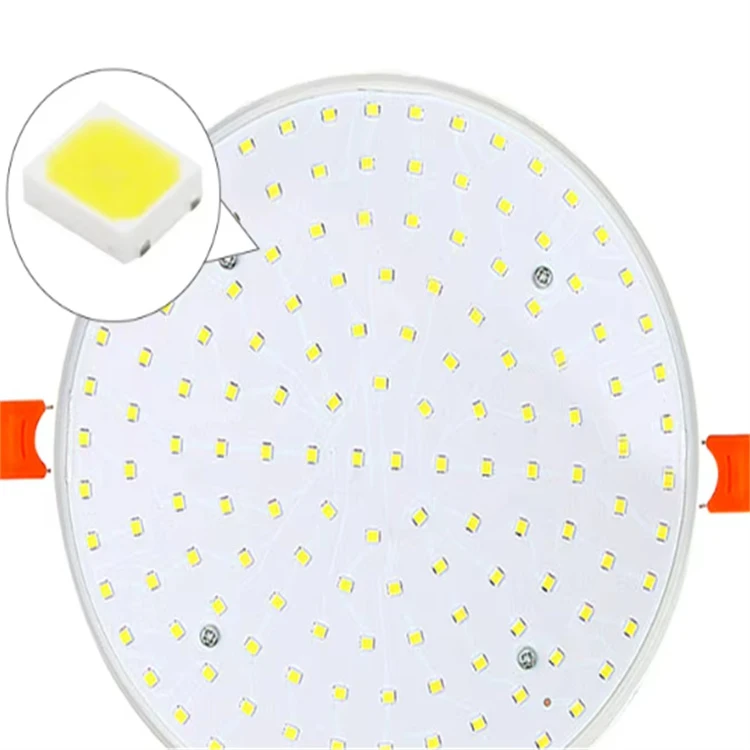
Systematic Interpretation of International IP Rating Standards for Lighting Fixtures
Definition and Coding Rules of IP Ingress Protection Rating
The IP rating, short for Ingress Protection Rating, is formulated according to the international IEC 60529 standard, which is universally applicable to electrical and lighting products worldwide. The rating consists of two independent numerical digits, corresponding to solid particle protection and liquid water protection respectively, and the higher the digit, the stronger the protection capability. The first digit represents the anti-intrusion level of solid foreign objects such as dust, debris, and particles, ranging from 0 to 6. The second digit represents the waterproof level of liquid splashing and infiltration, ranging from 0 to 9. Unlike industrial electrical equipment and outdoor lighting fixtures that need high-level dustproof and waterproof performance, indoor ceiling LED downlights focus more on solid dust protection rather than liquid waterproofing, because indoor ceiling environments are basically dry and closed, with almost no direct water splashing or immersion risks. Therefore, the core of indoor downlight protection grade selection is to optimize the solid dust protection level on the premise of matching the dry indoor environment, so as to balance structural air permeability and anti-pollution performance.
Performance Comparison of Common IP Grades for Indoor Downlights
In the field of civil and commercial indoor ceiling lighting, the mainstream protection grades of LED downlights are concentrated in IP20, IP40, and IP44, each with clear applicable scenarios and performance boundaries. IP20 is the most basic indoor protection grade, which can only block solid objects larger than 12.5mm, effectively preventing accidental finger contact but failing to resist fine indoor dust, fiber debris, and tiny suspended particles. This grade is mostly used in ultra-low-cost ordinary downlights, with poor long-term stability and obvious light decay problems. IP40 is an upgraded professional indoor protection grade, which can completely block solid foreign objects larger than 1mm, covering almost all indoor dust and tiny particle pollutants, while retaining reasonable structural air permeability to ensure the normal heat dissipation of the lamp body. IP44 adds all-directional splash-proof function on the basis of IP40 dustproof performance, which is suitable for semi-wet scenes such as bathrooms and kitchens, but its fully enclosed structure will cause heat dissipation obstacles when used in ordinary dry ceilings, increasing lamp operating temperature and accelerating aging. Through horizontal comparison, it can be seen that each protection grade has its own targeted scenarios, and only IP40 can perfectly adapt to the standard dry ceiling environment of residences, offices, and shopping malls.
Environmental Analysis of Typical Indoor Ceiling Lighting Scenarios
Dry Closed Scenarios: Residence, Office, Retail Mall
Most indoor ceiling lighting scenarios belong to dry and closed environment types, including residential living rooms, bedrooms, study rooms, commercial office buildings, shopping mall exhibition areas, and hotel lobby ceilings. The environmental characteristics of these scenarios are stable temperature, low air humidity, no direct water splashing, no corrosive gas, and the main environmental interference comes from daily floating dust, textile fiber debris, and tiny dust particles generated by indoor air circulation and human activities. Although these tiny pollutants are not visible to the naked eye, they will continuously invade the interior of downlights with low protection grades during long-term operation, adhere to the surface of LED chips, heat dissipation fins, and driving circuit boards, block heat conduction channels, cause local overheating of the lamp body, and eventually lead to reduced luminous efficiency, color shift, and accelerated light decay. The environmental demand of such scenarios is to have efficient fine dust protection capacity while maintaining unobstructed heat dissipation of the lamp body, without redundant waterproof performance, which puts forward precise technical requirements for the protection grade of ceiling downlights.
Special Semi-Wet Scenarios: Kitchen, Bathroom, Balcony Ceiling
A small number of indoor ceiling areas belong to semi-wet and multi-pollutant scenarios, including home kitchens, bathrooms, and closed balconies. Such environments have obvious humidity characteristics, accompanied by water vapor, oil fume, and tiny water splashing risks, which require certain waterproof and anti-fouling performance of lamps. However, it is worth noting that even in semi-wet indoor scenarios, ceiling downlights are installed overhead, far away from water source splashing points and oil fume concentration areas, and there is no risk of direct water immersion or strong liquid impact. Therefore, ultra-high waterproof grades such as IP65 are completely unnecessary. For these special indoor scenarios, IP44 graded downlights with splash-proof and dust-proof dual functions can meet the demand, while standard dry ceiling scenarios still take IP40 as the optimal choice. Clarifying the environmental differences between different indoor areas is the key to avoiding over-protection and under-protection problems.
Why IP40 Is the Optimal Protection Grade for Standard Indoor Ceiling Downlights
IP40 Solves the Core Pain Point of Indoor Dust Pollution
The biggest environmental threat to indoor ceiling downlights is not water erosion, but long-term accumulation of fine dust. Different from IP20 low-protection downlights that cannot block tiny particles, the IP40 protection grade can effectively isolate all solid pollutants larger than 1mm, covering almost all indoor floating dust, fiber debris, and tiny suspended particles. For recessed downlights embedded in ceiling gaps, the IP40 closed structural design can prevent dust from entering the lamp body along the installation gap and heat dissipation holes, keep the internal chip, heat dissipation system, and driving circuit in a clean state for a long time, and avoid heat dissipation failure and luminous attenuation caused by dust accumulation. In long-term use, IP40 downlights will not have local dark spots, brightness attenuation, or circuit short circuit failures caused by dust pollution, which greatly improves the overall stability and durability of indoor lighting systems, and solves the core pain point of short service life of ordinary low-protection downlights.
IP40 Balances Dust Protection and Heat Dissipation Efficiency
The biggest advantage of IP40 protection grade compared with high-grade waterproof IP44 and above is that it realizes the perfect balance between anti-pollution performance and heat dissipation efficiency. LED downlights rely on structural air permeability to export operating heat. Fully enclosed high-waterproof structures will block natural air convection, resulting in heat accumulation inside the lamp body and long-term high-temperature operation of chips and drivers, which seriously accelerates product aging. The IP40 structural design adopts a scientific semi-closed breathable structure, which can block external dust and tiny particles while retaining reasonable air circulation gaps, matching the efficient heat dissipation demand of die-cast aluminum lamp bodies. Combined with the integrated thickened die-cast aluminum heat sink of the product, it can rapidly export the heat generated by LED chips during operation, control the internal operating temperature of the lamp body within a safe range, avoid light decay and component damage caused by overheating, and ensure long-term stable and low-loss operation of the lamp. This balanced performance is incomparable to low-protection IP20 and over-protection IP44 products.
IP40 Matches the Long-Term Operation Law of Indoor Lighting
Indoor ceiling downlights have the characteristics of long-term intermittent operation, frequent switching, and long cumulative service time. Residential downlights can be used for 4–6 hours a day on average, and commercial downlights such as offices and shopping malls can operate continuously for more than 10 hours a day, with a design life of up to 50,000 hours. Long-term continuous operation puts forward high requirements for the environmental adaptability of lamps. IP40 professional protection grade can maintain stable structural sealing and anti-pollution performance in the whole life cycle of the product, without structural aging and protection performance decline caused by long-term operation. It can effectively resist the interference of indoor air changes, dust accumulation, and tiny humidity fluctuations, ensure that the luminous efficiency, color rendering performance, and circuit stability of the downlight are always in the optimal state, and realize ultra-low light decay and ultra-long service life. Compared with IP20 products that are prone to dust blockage and performance attenuation after 1–2 years of use, IP40 downlights can maintain stable lighting effect for more than 10 years, with extremely low later maintenance cost and higher long-term cost performance.
Product Performance Advantages of IP40-Grade Die-Cast Aluminum Recessed Downlights
Structural Synergy: Protection Performance and Heat Dissipation System Complement Each Other
This high-performance recessed LED downlight adopts industry-standard IP40 dustproof protection configuration, which is perfectly matched with the integrated die-cast aluminum heat dissipation structure. The precision die-cast lamp body has seamless splicing and tight structural fit, which fundamentally avoids dust penetration caused by structural gaps. The scientific breathable heat dissipation holes are designed according to the IP40 protection standard, which not only meets the fine dust isolation requirements, but also ensures three-dimensional circulating heat dissipation. Compared with ordinary plastic downlights and stamping aluminum downlights with rough structure and low protection level, this product eliminates the hidden danger of heat dissipation failure caused by dust accumulation, makes the heat dissipation efficiency of the die-cast aluminum radiator always stable, and ensures that the LED chip works at a constant low temperature for a long time, greatly delaying luminous attenuation and aging failure.
Stable Light Output: Long-Term Consistent Lighting Quality
Benefiting from IP40 efficient dust protection, the internal light source cavity and nano light-conducting panel of the downlight will not be polluted by dust for a long time, avoiding light scattering loss and light output darkness caused by dust coverage. The high-transmittance nano light-conducting panel can always maintain uniform and soft light output, no glare, no hot spots, and no stroboscopic flicker. The high-quality SMD chip and isolated wide-voltage driver will not be interfered by external dust and mild humidity, maintaining stable current and voltage output, accurate color rendering, and no color temperature drift. Whether it is long-term continuous lighting in commercial scenarios or frequent switching use in residential scenarios, it can maintain consistent high-quality lighting effect, effectively improve the grade of indoor lighting environment, and solve the problem of gradual deterioration of lighting quality caused by low protection grade of ordinary downlights.
Ultra-Low Loss Operation and High Engineering Cost Performance
The IP40 protection design enables the downlight to realize ultra-low loss long-term operation. Stable internal environment avoids power consumption increase and reactive power loss caused by dust blockage and circuit interference. The product power factor is stable, energy-saving efficiency is up to 75%, and there is no energy waste caused by performance degradation in the later stage. For engineering procurement and bulk purchasers, IP40 high-protection downlights have ultra-low failure rate and almost no need for later maintenance and replacement, which can greatly reduce the comprehensive operation cost of lighting projects. For residential end users, one-time installation can achieve more than 10 years of stable use, with excellent long-term cost performance, which is far superior to low-cost IP20 inferior products that need frequent replacement and high later use cost.
Professional Purchasing Guidelines for Indoor LED Downlights Based on IP Grade
Grade Elimination: Avoid Low-Protection and Over-Protection Products
In the purchasing process of indoor ceiling LED downlights, users should establish scientific IP grade screening logic. For all standard dry indoor ceiling scenarios including residence, office, shopping mall, and hotel, low-protection IP20 products should be completely eliminated due to poor dust resistance and fast performance attenuation. High-waterproof grades such as IP44 and above are only limited to semi-wet scenarios such as kitchens and bathrooms, and should not be blindly selected for ordinary ceilings, so as to avoid heat dissipation obstacles and cost waste caused by over-protection. Users must take IP40 as the preferred standard for conventional indoor ceiling downlights, which can perfectly balance protection performance, heat dissipation efficiency, and product cost, and is the most professional and applicable protection grade choice for mainstream indoor lighting scenarios.
Parameter Verification: Focus on Official IP Grade Certification
When purchasing IP40-grade downlights, it is necessary to strictly verify the official certification parameters of the product, and avoid choosing products with false standard labels. Many inferior merchants falsely label IP40 protection on IP20 products to raise prices, but their structural design has no effective dust isolation ability, and still has the problem of rapid dust accumulation and light decay. Professional high-quality downlights have official IP40 protection grade test certification, with precise structural sealing design, standard dust isolation parameters, and stable and reliable protection performance. Users should focus on checking the product parameter sheet and certification documents to ensure that the IP40 grade is true and effective, so as to guarantee the long-term stable operation of the lamps.
Scenario Matching: Realize Precise Protection Grade Selection
According to different indoor scenario characteristics, precise IP grade matching is carried out to maximize product performance. For dry and clean conventional ceiling scenarios, select standard IP40 die-cast aluminum downlights to obtain the best heat dissipation and anti-aging performance. For local semi-wet and oil-fume indoor scenarios such as kitchen and bathroom ceilings, select IP44 splash-proof and dust-proof upgraded products. For ultra-dust-free scenes such as studio and exhibition hall ceilings, IP40 high-protection products can still meet the demand without upgrading higher grades. This scenario-based precise selection method can not only ensure the durability of lighting equipment, but also avoid unnecessary cost investment, realizing the dual optimization of lighting quality and economic benefits.
Conclusion
The selection of protection grade for indoor ceiling LED downlights is not based on the higher the better, but on adapting to the actual indoor environmental characteristics and matching the long-term operation law of lamps. Through systematic analysis of international IP standards and indoor scenario environments, it is fully verified that IP40 is the most suitable, most balanced, and most cost-effective professional protection grade for standard indoor ceiling LED downlights. Compared with low-standard IP20 products that are prone to dust pollution and rapid aging, IP40 grade can effectively isolate indoor fine dust and pollutants, keep the internal structure of the lamp clean and stable, and fundamentally delay light decay and component aging. Compared with over-protected IP44 and above high-waterproof products, IP40 retains scientific breathable heat dissipation structure, avoids heat accumulation failure caused by fully closed design, and ensures long-term low-loss and high-stability operation of downlights. The high-performance die-cast aluminum recessed LED downlight with official IP40 protection grade integrates efficient dust protection, optimal heat dissipation performance, ultra-long service life, and stable lighting quality, which can fully meet the long-term high-standard lighting needs of residence, commercial office, retail shopping mall, hotel and other indoor scenarios. Mastering the IP grade selection logic of indoor downlights and taking IP40 as the core purchasing standard can help users avoid purchasing pitfalls, select high-value durable lighting products, reduce later maintenance costs, and create a stable, energy-saving, and high-quality indoor lighting environment.

How To Cooperate With Us?
Since we have our own facilities, we are pleased to have complete control over the production process and the quality of our goods. We are committed to giving our clients the finest prices since we are manufacturers rather than just brokers. We encourage buyers to see our samples first since we are certain that the cost and calibre of our items are transparent. Our dedication to excellence and client happiness motivates us to consistently provide superior products.
Our address
3rd Floor, 5th Building, Hebei Industrial Park, Hualian Community, Longhua District, Shenzhen, China





