

When many clients inquire about pricing, their first question is often, "What is the wattage of your sports field lights?" Rarely do they ask about the beam angle first. However, in actual projects, choosing the wrong beam angle causes more headaches than selecting insufficient wattage: you might achieve adequate brightness, but the field ends up with uneven lighting (bright and dark patches), players get dazzled by glare, and neighbors complain about light pollution.There is no single "best beam angle" for stadium lighting; there is only the angle that is "most suitable for the specific field, mounting height, and luminaire position." Below, we outline the key factors to consider during the selection process.
What exactly is beam angle?
Beam angle refers to the angle formed by the light emitted from a fixture where the luminous intensity drops to 50% of its peak value. A smaller angle means the light is more concentrated and travels further; a larger angle means the light is more dispersed, covering a wider area but resulting in lower central intensity.
The industry also commonly uses NEMA classifications to describe beam types:
NEMA 1–2: Approx. 10°–29° (extra-narrow to narrow beam)
NEMA 3–4: Approx. 29°–70° (medium beam)
NEMA 5–7: Above 70° (wide beam)
When reviewing luminaire specifications, be sure to distinguish between "beam angle" (50% intensity) and "field angle" (10% intensity). The field angle is usually much wider than the beam angle, a factor that directly impacts spill light control.
The relationship between beam angle, mounting height, and projection distance
The starting point for selecting a beam angle is the projection distance. Here is a simple estimation method:
Light spot diameter ≈ 2 × Projection distance × tan(Beam angle / 2)
Example: If a fixture is 30 meters from the target point with a 30° beam angle, the spot diameter is approximately 16 meters; at the same distance, a 60° angle results in a spot diameter of approximately 35 meters.
This formula provides only a rough estimate; in reality, one must also account for the elliptical shape of the light spot caused by the fixture's tilt angle, as well as the overlapping of light spots. However, it serves as a quick rule of thumb: choose a narrow angle for long distances and a wide angle for short distances.
Reference ranges for beam angles by sport
The following figures serve as empirical guidelines for common sports; final specifications should be based on illuminance simulations (e.g., DIALux or AGi32):
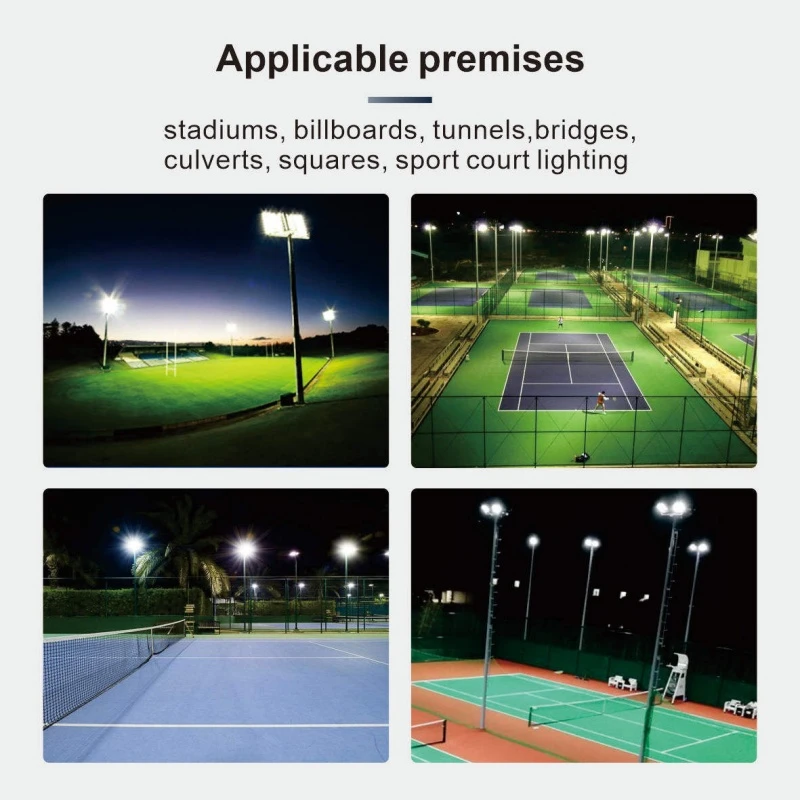
Soccer and rugby fields (pole height 20–35m): Typically 15°–40°; a combination of beam angles is often used.
Baseball and softball fields: 25°–45° for the infield; narrower angles for the outfield and high-ball zones.
Tennis courts (pole height 8–12m): Typically 40°–70°, or asymmetrical light distribution.
Outdoor basketball courts (pole height 8–12m): Typically 50°–80°.
Indoor sports halls and badminton courts (mounting height 7–12m): Typically 60°–110°; the priority is uniformity and low glare.
Track and field arenas: Wider angles for the track area; narrower-angle fixtures may be used for jumping and throwing zones.
How pole layout affects beam angle selection
For any given field, the placement of the light poles dictates the configuration of beam angles.
Four-corner layout: The distance to the field center is significant, requiring narrow beams for long-range projection, supplemented by medium beams for areas near the corners.
Side-mounted layout: The distance to the field is relatively short and balanced; medium beam angles predominate, supplemented by a few narrow-angle fixtures for the center area.
Surround layout (large stadiums): A single pole often carries a mix of beam angles to cover near, middle, and far zones respectively.
Practical experience suggests avoiding the use of a single beam angle across an entire pole; mixing different angles results in a smoother, more uniform illuminance curve.
Pros and Cons of Narrow vs. Wide Beam Angles
Narrow Beam Angle (approx. 10°–30°)
Pros: Long throw distance, high central luminous intensity (suitable for long-range projection from high masts); concentrated light with minimal spill light.
Cons: Small light spot, requiring more fixtures for full coverage; slight deviations in aiming angle result in noticeable hotspots and dark zones.
Wide Beam Angle (approx. 60° or greater)
Pros: Large coverage area, natural light transitions, and easier to achieve uniformity; suitable for lower mounting heights.
Cons: Limited throw distance (wasted luminous flux if used on high masts); prone to light spill, significantly impacting the surrounding environment.
Medium Beam Angle (approx. 30°–60°): Strikes a balance between the two and is the primary choice for most small-to-medium-sized venues.
Relationship Between Beam Angle, Glare, and Spill Light
Sports lighting is not solely about illuminance levels; the visual comfort of players and spectators is equally important.
If the beam angle is too wide and the fixture is aimed at a shallow angle, light can easily enter the players' field of view, resulting in high glare ratings (GR).
If the beam angle is too narrow and the aiming angle too steep, reflections off the ball's surface may occur, hindering the tracking of high-trajectory balls.
When controlling off-site light pollution is necessary, narrow-beam fixtures paired with baffles or louvers are recommended.
If the venue is adjacent to residential areas or roads, the choice of beam angle must be considered alongside spill light requirements, rather than focusing exclusively on on-field illuminance.
Common Pitfalls in Beam Angle Selection
Focusing solely on the beam angle figure while ignoring the light distribution curve: Two lights labeled "30°" can produce vastly different actual light patterns due to differing optical designs; always consult the IES file.
Using a single angle throughout: Standardizing all lights to one angle for procurement convenience often makes it difficult to meet uniformity standards across both the center and edges of the venue.
Overlooking fixture tilt angles: Beam angles and installation tilt angles are designed to work in tandem; changing the angle without re-simulating the lighting often yields results that fall short of expectations.
Failing to account for future adjustments: Some projects require flexibility between training and competition modes; it is best to select fixtures with interchangeable lenses or adjustable beam angle settings.
Summary
Key principles for selecting beam angles in sports venue lighting include:
Higher mounting positions and longer projection distances require narrower beam angles; lower mounting positions and shorter distances require wider beam angles.
Different sports and pole configurations call for different combinations of beam angles.
For large venues, a mix of beam angles is recommended rather than relying on a single angle.
Beam angle selection must balance uniformity, glare control, and spill light; brightness should not be the sole priority.
The final design must be verified using lighting simulation software before proceeding to on-site aiming and adjustment.
Based on this information, our engineers will provide beam angle recommendations and a complimentary lighting simulation plan, ensuring your budget is spent effectively. Please leave a message or send an inquiry, and we will get back to you promptly.
Our address
No. 5-3 Niujiao Road, Yanchuan Community, Yanluo Subdistrict, Bao'an District, Shenzhen
bwzm18@ledbenweilighting.com






