

Many people discover an issue after purchasing PAR30 LED grow bulbs: the same bulb might promote vigorous growth for herbs, yet fail to trigger flowering in orchids. The problem isn't the bulb itself; rather, it's a matter of matching the light to the specific plant.
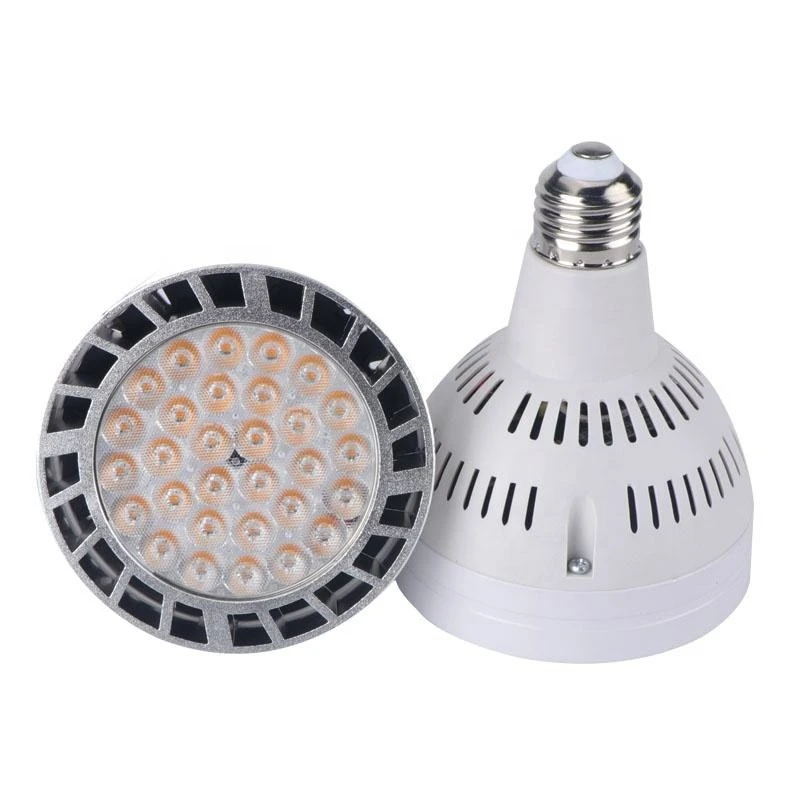
PAR30 is a common type of spotlight bulb featuring a standard E26/E27 base. Because it produces a concentrated beam-making it compatible with standard spotlights, track lighting, and desk lamps-it is widely used for home gardening, small-scale retail displays, and office greenery. However, due to its specific beam angle and power output, it does not suit every plant equally well. Below, we examine how herbs, succulents, and orchids respond to this lighting, helping you choose the right bulb and avoid common pitfalls.
Optical Characteristics of PAR30 Bulbs: Understanding Their Capabilities
The term "PAR" in PAR30 refers to a bulb structure that incorporates a built-in reflector, while "30" indicates a diameter of approximately 30/8 inches (about 95 mm). For horticultural purposes, three key characteristics are worth noting:
Concentrated Beam: Typically featuring a beam angle between 25° and 40°, the light is focused on a relatively small area-ideal for a single pot or a small row of plants, but not for illuminating large spaces.
Power Range: PAR30 bulbs designed for plants generally range from 10W to 18W. While this provides sufficient intensity for small to medium-sized plants, the light intensity drops off significantly as the distance from the plant increases.
Spectral Options: These bulbs are commonly available in either full-spectrum (approximating white light) or red-blue configurations. Full-spectrum light is generally better suited for home environments, as it renders foliage in natural-looking colors and makes it easier to monitor the health of your plants. Therefore, the hanging height of the light is crucial. It is generally recommended to keep the bulb 20 to 40 centimeters away from the top of the plant, depending on the light's wattage and the specific needs of the plant.
Herbs: The Ideal "Starter" Plants
Herbs such as basil, mint, cilantro, parsley, and thyme require "abundant and consistent" light-ideally 12 to 14 hours per day-which is exactly what a PAR30 bulb is designed to provide.
Rapid growth and visible results: Under proper lighting, plants like basil and mint will produce new leaves within a week or two, offering a rewarding experience for the grower.
Compact size: One or two pots of herbs placed on a windowsill or kitchen counter fit perfectly within the beam coverage of a PAR30 bulb.
Preference for a spectrum rich in blue light: During the vegetative (leaf-growth) stage, blue light helps keep plants compact and encourages thick, sturdy leaves-a need that a full-spectrum PAR30 bulb can easily meet.
Keep in mind that herbs are quite sensitive to distance. If the light is too close, the leaf tips may scorch; if it is too far away, the plants may become "leggy" (spindly) and weak. A safer approach is to start at a distance of 30 centimeters, observe the plants for a week, and then make minor adjustments.
Succulents: Suitable, but Variety Matters
While succulents are often perceived as "drought-tolerant and easy to care for," they are actually quite demanding when it comes to light. When light is insufficient, plants like Sedum or Echeveria will become leggy-the gaps between leaves will widen, and the foliage will turn a dull, dark green-causing them to lose their signature compact, rosette-like form.
Suitable varieties: Echeveria, Haworthia (such as Haworthia cooperi or Haworthia fasciata), and Sedum generally thrive under PAR30 lighting. Semi-shade-loving varieties like Haworthia are often even easier to grow successfully.
Varieties to watch out for: Some succulents-such as certain Lithops (living stones) or cacti that require intense light-may find the output of a single PAR30 bulb insufficient. In these cases, you may need to use multiple lights or reduce the distance between the light and the plant. Light Duration: 10 to 12 hours per day is ideal. Avoid 24-hour continuous illumination; succulents also require a period of "rest" at night.
Additionally, because PAR30 bulbs produce a concentrated beam, arranging succulents in rows may result in uneven lighting-brighter in the center and dimmer toward the edges. When growing multiple pots, consider offsetting the placement of two bulbs so that their light beams overlap.
Orchids: Requiring More Nuanced Care
Among the three categories, orchids are the most "demanding." Requirements for light vary significantly between Phalaenopsis (moth orchids), Oncidium (dancing-lady orchids), and *Dendrobium* orchids. Furthermore, flowering is linked to factors like temperature fluctuations, humidity, and dormancy periods; artificial lighting is just one piece of the puzzle.
Phalaenopsis (Moth Orchids): These prefer lower light levels. Keep the PAR30 bulb at a distance of at least 40 cm. Providing about 12 hours of light daily will help maintain healthy foliage and support flowering.
Oncidium and Cattleya Orchids: These require more intense light. A single PAR30 bulb can be used for small-scale cultivation, but it should be positioned closer to the plants. Use a fan to regulate the temperature, as spotlight-style bulbs generate more concentrated heat than flat LED panels.
Spectral Recommendations: If your goal is to promote flower bud formation, a spectrum with a higher proportion of red light is beneficial. For simply maintaining foliage health, a full-spectrum light is sufficient.
To be frank, if your objective is to "get your orchids to bloom again," a PAR30 bulb can serve as supplemental lighting, but it is not necessarily the only solution-it must be balanced with other environmental conditions.
Summary
In short: Herbs are the best fit; for succulents, the choice depends on the specific variety; for orchids, PAR30 bulbs can be used, but they require precise management.
Herbs are the best match for the light intensity and beam spread of PAR30 bulbs, making them a great choice for beginners.
For succulents, PAR30 bulbs are well-suited to varieties that prefer partial shade to moderate light; when growing multiple pots, ensure the light beams overlap.
Among orchids, Phalaenopsis are the most suitable candidates; success depends on carefully coordinating the distance, temperature, and photoperiod. While the PAR30 is not a universal solution, it offers distinct advantages-namely, ease of installation and a concentrated light beam-making it ideal for small-scale setups, individual planters, home environments, and display settings. Choosing the right plants is key to unlocking the full potential of this bulb.
Interested in our PAR30 grow lights?
Please let us know the types of plants you intend to grow, your intended setting, and the quantity required; we will then recommend the most suitable model for your needs. Simply send us an email-we look forward to hearing from you.
Our address
No. 5-3 Niujiao Road, Yanchuan Community, Yanluo Subdistrict, Bao'an District, Shenzhen
bwzm18@ledbenweilighting.com






