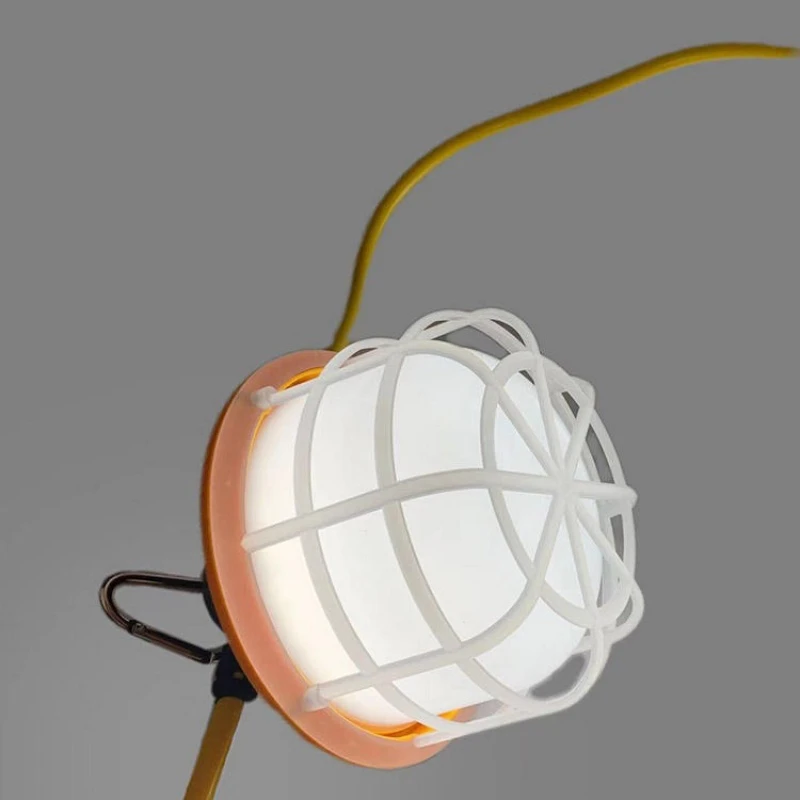
If you have ever visited a construction site, you have likely seen this scene: strings of lights draped along ceilings or scaffolding, connected by a prominent yellow power cord. While many might assume this is simply a matter of "habit," there are, in fact, very practical reasons behind this color choice.
As a manufacturer of construction lighting, we are frequently asked by clients: "Could you make them in black or white instead? They would look much tidier." While technically feasible, we almost always advise sticking with yellow. Here is why.
High visibility in a complex, crowded environment
Construction sites are rarely clean or level; they are filled with stacked materials, scattered tools, and workers moving about. Power cords for string lights often run along the ground or hang at low heights across walkways.
Bright yellow is highly conspicuous, allowing workers and forklift operators to spot the cables early.
This reduces the risk of tripping or having the cables run over by carts and heavy equipment.
Even at night or in poorly lit areas, the yellow sheathing remains clearly visible when illuminated.
This is the most immediate benefit-and the primary reason why yellow was adopted so widely in the first place.
Strong contrast against the construction environment
The dominant colors on a construction site are the gray of concrete, the brown of soil, the black of steel rebar, and the dark tones of wooden formwork. Black or gray cables tend to "blend" into the background, while white cables quickly become dirty and grimy.
Yellow offers high contrast against these surroundings; even when covered in a layer of dust, the path of the cable remains easy to trace from a distance. For string lights that span large areas, this ability to "see the entire line at a glance" is incredibly practical.
Yellow is a universally recognized warning color
In safety signage, yellow is the standard color for "caution" or "warning"-think of hazard tape, hard hats, safety railings, or floor markings. Workers have developed a conditioned response to this color; seeing yellow instinctively prompts them to exercise extra caution. Therefore, yellow cables are not just "easy to see"; they also serve as a silent warning: "There is live electricity here-do not step on it, pull it, or hang anything on it."
Easy identification of temporary electrical circuits
Construction sites contain a complex mix of wiring, including permanent installations, equipment power cords, and temporary lighting circuits. By using a uniform yellow color, site managers and electricians can quickly distinguish which cables belong to the temporary lighting system.
In some regions, such as the UK, yellow is customarily used to denote 110V electrical systems on construction sites.
Many projects require different colors for temporary lighting versus power circuits, which simplifies troubleshooting and maintenance during power outages.
It should be noted that regulations vary by country and project; yellow is not a universal mandate, but rather an established industry practice.
Easier detection of damage and aging
Construction site string lights are frequently subjected to dragging, scraping, compression, and sun exposure. If the outer sheath is cut or worn through, the internal conductors may become exposed, creating a risk of electrical leakage.
On a light-colored, glossy sheath, scratches, cracks, abrasions, and dirt are much easier to spot than on a black sheath. During routine inspections, electricians or safety officers can identify sections that need replacement at a glance, without having to examine every inch of the cable by hand.
A yellow sheath is more than just "a coat of paint"
Some clients may wonder: "Is the yellow color just for visibility, with no difference in quality?" In reality, for professional-grade construction string lights, the material of the sheath is what truly matters-the color is merely an external feature.
Common sheath materials include PVC and rubber (such as the H07RN-F type), which are engineered to be resistant to abrasion, oil, and low temperatures.
For outdoor use, the sheath should incorporate UV-resistant additives to prevent it from becoming brittle or fading under prolonged sun exposure.
The ingress protection (IP) rating-such as IP65-of the lamp sockets and covers must also match that of the cables; otherwise, even the most highly visible cable won't prevent water from getting in.
When purchasing, do not rely solely on color; instead, evaluate the material specifications, protection ratings, and relevant certifications.
Summary
Bright yellow cables are used for string lights on construction sites for several key reasons:
Visibility: They help reduce the risk of tripping or being run over in busy, complex environments.
High Contrast: They stand out clearly against backgrounds like soil, concrete, and steel reinforcement.
Universal Recognition: Yellow signifies a warning, which workers immediately understand.
Simplified Management: It makes it easy to identify temporary lighting circuits.
Easier Inspection: Damage or signs of aging are spotted more quickly.
Durability: When paired with weather-resistant and abrasion-resistant sheathing, they are truly suited for construction site conditions.
Choosing yellow is a simple decision, yet it offers practical benefits for both safety and site management.
Need string lights for a construction site? Let's talk.
If you are sourcing string lights for a construction site, tunnel, underground parking garage, or temporary exhibition space, please share your project details and requirements with us. We will recommend the ideal solution and provide a quote along with samples.