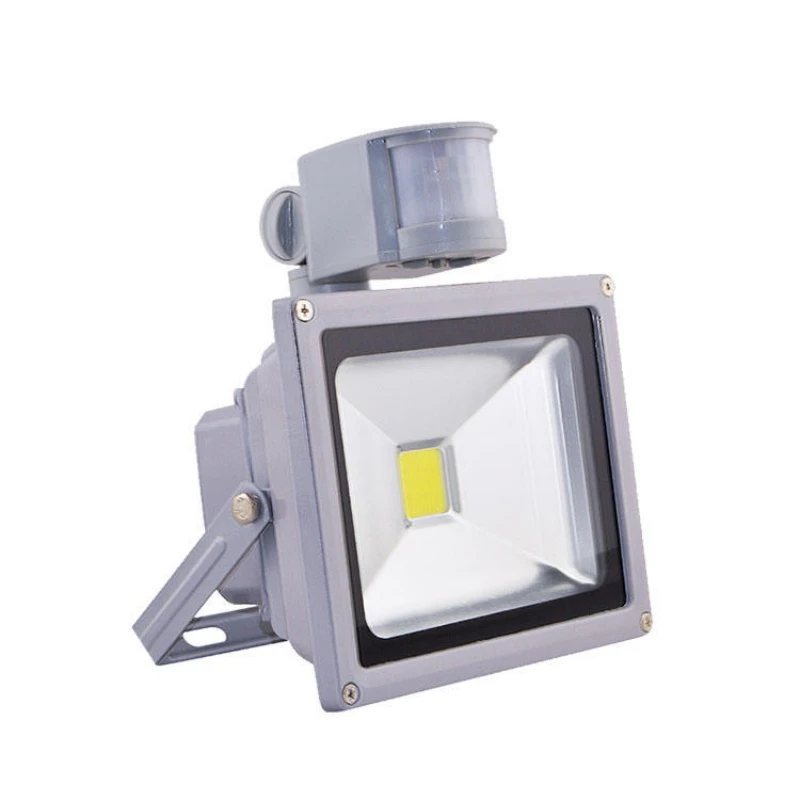
Have you ever experienced a situation where a motion-activated floodlight fails to turn on when someone walks down your driveway, or conversely, keeps switching on because a stray cat wandered by? Many buyers assume that such lights will simply "turn on whenever something moves," but that is not the case. The light's response varies significantly depending on what is moving within its detection zone. This article explains the underlying sensor technology, clarifies how these lights distinguish between vehicles, pets, and people, and helps you make the right choice when selecting a product.
How Motion-Activated Floodlights "See" Objects
Most motion-activated floodlights on the market use Passive Infrared (PIR) sensors. Rather than actively emitting signals, these sensors detect changes in infrared thermal radiation within their environment. When an object with a temperature different from its surroundings moves through the detection zone, the sensor registers a shift in the heat distribution and triggers the light.
Keep two key factors in mind:
Temperature difference: The greater the temperature contrast between an object's surface and its background, the easier it is for the sensor to detect it.
Movement: Sensors are most sensitive to motion that crosses the detection zone laterally (side-to-side); they are less responsive to objects moving directly toward the sensor.
Most of the variations in performance can be explained by these two principles.
Detecting Humans: The Most Reliable Scenario
The human body has a surface temperature of approximately 30–34°C (86–93°F). Its relatively large size and the constant motion of limbs while walking make a human an ideal target for a PIR sensor.
Detection range: Standard models can reliably trigger within 8–12 meters; the "rated" range provided by manufacturers is typically based on the detection of a human-sized object.
Detection angle: Products are available with coverage angles ranging from 120° to 270°. A wider angle reduces the chance of missing movement when someone enters the zone from the side.
Limitations: In summer, when ambient temperatures approach human body temperature, the temperature contrast decreases, which can significantly reduce the effective detection range. Wearing thick outerwear can also slightly diminish detection performance.
Overall, motion-activated floodlights are optimized specifically for detecting humans, which is why they perform most reliably in security and general lighting applications.
Detection of Pets: The Impact of Size and Temperature
Whether a pet triggers the sensor depends on its size, body temperature, and how it moves.
Large dogs: Being similar in size to humans, they typically trigger the sensor, though the effective detection range may be slightly reduced.
Small dogs and cats: Due to their small size and weak thermal signature, they often only trigger the sensor at close range-sometimes as near as 3–5 meters.
Height considerations: The higher the light is mounted, the more the sensor's field of view shifts toward the height range of an adult human; consequently, small animals moving close to the ground are more likely to fall into a "blind spot."
Pet-immunity features: Some products offer sensitivity adjustments or "pet-immunity" settings. By lowering the sensitivity or altering the detection angle, you can reduce false triggers caused by small animals-though this inevitably decreases sensitivity to humans at greater distances, requiring a trade-off.
If your goal is to prevent frequent triggers by pets, consider mounting the light higher and angling it downward, so that the detection zone avoids the area near the ground.
Detection of Vehicles: Why It Often Fails
Many assume that because vehicles are large, they should easily trigger the sensor; in reality, this is the scenario most prone to issues.
Minimal temperature differential: The temperature of a vehicle's metal exterior is often close to the ambient temperature, resulting in a weak thermal signature, while the heat from the engine is shielded by the car body.
High speed: Vehicles pass through the detection zone so quickly that the sensor may not have time to react before the vehicle has already moved past.
Direction of travel: When a vehicle moves directly toward the sensor, there is very little lateral displacement, which further lowers the probability of triggering.
Exceptions: A vehicle that has just been turned off may still retain residual heat in the engine bay or exhaust system, potentially allowing for detection at close range; conversely, a "cold" vehicle in winter is even harder to detect.
Therefore, if your requirement is for lights to turn on automatically when a vehicle enters a driveway, a standard PIR (passive infrared) motion-sensing floodlight is not the best solution. You would be better served by using microwave radar sensors, ground-loop detectors, or products that incorporate multi-technology sensing.
Four Key Factors Affecting Detection Performance
Beyond the characteristics of the object being detected, the following factors also determine overall performance:
Installation height: Generally, a height of 2–3 meters is recommended. Mounting it too high reduces the effective detection range, while mounting it too low increases the risk of obstruction or accidental triggering.
Installation Angle and Orientation: The sensor should be positioned so that targets move "across" the detection zone, rather than approaching it head-on.
Ambient Temperature: High temperatures reduce the temperature differential, weakening detection; lower temperatures generally enhance sensitivity.
Interference Sources: Swaying tree branches, air conditioning vents, reflective surfaces, and direct sunlight can all cause false triggers or missed detections.
Selection Recommendations for Various Use Cases
Home Gardens and Entrances: Primarily for detecting people; a standard PIR (passive infrared) sensor is sufficient-ideally with a wide-angle coverage of 180° or more.
Homes with Pets: Choose models with adjustable sensitivity and range settings; you may need to lower the sensitivity and mount the unit at a higher position.
Driveways and Parking Lots: Prioritize microwave radar sensors or dual-technology (PIR + microwave) models, rather than relying solely on thermal (PIR) sensing.
Warehouses and Industrial Perimeters: These areas require broad coverage; select products with long detection ranges and high ingress protection ratings (e.g., IP65 or higher). Also, be mindful of potential interference from metal structures.
Conclusion
Returning to the question posed in the title: Sensor-equipped floodlights do not detect cars, pets, and people with equal effectiveness.
People: Detection is most stable; this is the primary focus of such product designs.
Pets: Detection depends on the animal's size-smaller animals may only be detected at shorter ranges-though this can be managed through installation positioning and sensitivity adjustments.
Cars: Due to the minimal temperature differential and high speed, standard PIR-based lights are the least reliable; radar or dual-technology solutions are required.
Choosing the right sensing technology, combined with proper installation, ensures that the light turns on exactly when it should-and remains off when it shouldn't.
Need to customize or bulk-purchase sensor-equipped floodlights?
We offer a variety of sensor-equipped floodlights, including PIR, microwave radar, and dual-technology models. Detection range, angle, sensitivity, and ingress protection (IP) ratings can all be customized to suit your specific market and application requirements. If you are selecting products for retail, engineering projects, or your own brand, please leave a message or send an inquiry. Let us know your intended application and the required quantities, and our team will recommend the right solutions, provide a quote, and supply samples.