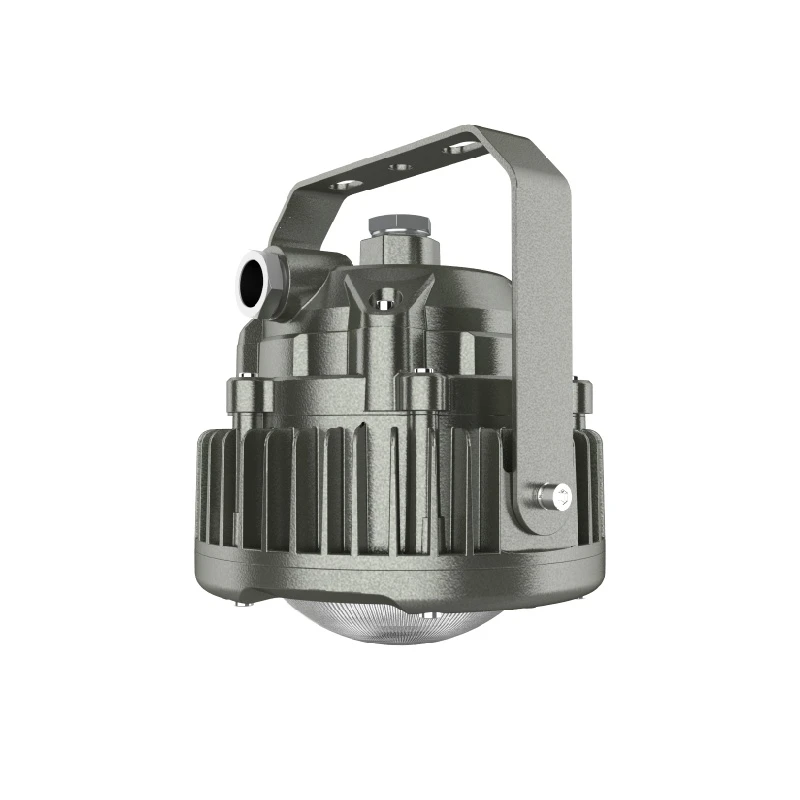
When selecting high-bay lights, many procurement professionals instinctively assume that all "UFO" style lights are essentially the same-believing that explosion-proof versions are simply those with thicker housings and higher price tags. This is a potentially dangerous misconception. In environments such as oil and gas facilities, chemical plants, or spray-painting workshops, choosing the wrong lighting fixture is not merely a matter of brightness; it is a critical safety issue.
This article avoids complex regulatory jargon, focusing instead on a straightforward explanation: what an explosion-proof LED UFO light is, how it differs from a standard UFO high-bay light, and which technical parameters to consider during the selection process.
What is an explosion-proof LED UFO light?
Simply put, an explosion-proof LED UFO light retains the form factor and optical design of a standard UFO high-bay light-characterized by a disc-like shape, high luminous efficiency, and suitability for high-ceiling mounting-but features a structural design engineered to meet explosion-proof standards and has undergone rigorous certification.
Its primary objective is not to be "brighter," but to ensure that the fixture does not become an ignition source in environments containing flammable or explosive gases, vapors, or dust. Even in the event of an internal malfunction-such as the generation of sparks or high temperatures-the fixture is designed to prevent the ignition of hazardous substances in the surrounding atmosphere.
Difference 1: Certification and Safety Ratings
This is the most fundamental distinction.
Standard UFO high-bay lights: Typically carry only general electrical and energy-efficiency certifications (such as CE, RoHS, or UL/DLC). These confirm that the product is electrically safe and meets specific luminous efficiency standards, but they do not address explosion-proof requirements.
Explosion-proof UFO lights: Must possess specific explosion-proof certifications-such as ATEX, IECEx, UL 844 (North American Class I/II Division system), or the Chinese "Ex" explosion-proof certification. These certifications explicitly define the hazardous zones, gas/dust groups, and temperature classes for which the equipment is approved.
In short: If a light lacks an explosion-proof certification mark, it cannot be used as an explosion-proof fixture, regardless of how thick its housing may be.
Difference 2: Housing and Sealing Structure
The housing of a standard UFO light is primarily designed for heat dissipation and is typically relatively thin. The lens or cover is usually made of polycarbonate (PC) or standard glass, and the ingress protection (IP) rating is generally around IP65. Explosion-proof UFO-style lights typically employ a "flameproof" (explosion-proof enclosure) design:
High-strength die-cast aluminum housing: Features thicker walls capable of withstanding internal explosion pressure without rupturing.
Flameproof joints: The gaps at the interfaces of the housing components are precisely controlled; any internal flame or high-temperature gas passing through these gaps is cooled down, preventing it from igniting the external atmosphere.
Thickened tempered glass lens: Resistant to impact and thermal shock, and equipped with a secure seal.
Higher ingress protection (IP) rating: Typically IP66 or even IP67, ensuring robust protection against dust and water.
Difference 3: Surface Temperature Control
This is a factor often overlooked. In hazardous locations, if the surface temperature of a luminaire exceeds the ignition temperature of the surrounding gases or dust, it can trigger an accident.
For standard UFO lights, the primary concern is ensuring the LED chip and driver do not overheat (to maintain their service life); the housing becoming hot to the touch is generally not an issue.
Explosion-proof UFO lights, however, must keep their maximum surface temperature within specified limits-categorized by temperature classes such as T4 (≤135°C), T5 (≤100°C), or T6 (≤85°C). Consequently, these units feature more conservative designs regarding heat dissipation, power output, and driver protection.
This is why, even for lights with the same 100W rating, the explosion-proof versions often differ significantly in appearance and weight.
Difference 4: Cable Entry and Installation
Standard models: Typically feature a direct power cord exit or basic terminal blocks; they can be installed using hooks or chains, with relatively simple installation requirements.
Explosion-proof models: Require the use of explosion-proof cable entry devices (cable glands) or explosion-proof conduit systems. The wiring compartment is usually separated from the light source (LED) compartment, and the cable entry points must remain hermetically sealed. Once installed, it is strictly prohibited to replace components with non-explosion-proof parts, and the housing must never be opened for maintenance while the unit is energized in an environment where hazardous gases may be present.
Therefore, it is recommended that the installation and maintenance of explosion-proof lighting be performed by electricians who are well-versed in explosion-proof standards and regulations.
Key Information to Confirm During Selection
Clarifying the following details before requesting a quote from a supplier will help you avoid unnecessary complications:
Hazardous Area Classification: Is it Zone 1/2 (gases), Zone 21/22 (dust), or a North American Class/Division rating?
Gas or Dust Group: For example, groups like IIB or IIC; different substances impose specific requirements on the lighting equipment.
Temperature Class: T4, T5, or T6?
Ambient Temperature Range: High-temperature or extreme cold environments will influence the choice of lighting.
Mounting Height and Illumination Requirements: These factors determine the necessary power (wattage) and beam angle.
Required Certifications: ATEX, IECEx, UL, or other certifications specific to your target market.
Summary
While explosion-proof LED UFO lights may look similar to standard UFO high-bay lights, they are fundamentally different products. Standard models are for ordinary environments, whereas explosion-proof models are mandatory for areas where flammable or explosive substances are present. A simple rule of thumb: if your facility contains combustible gases, vapors, or dust, do not hesitate-choose an explosion-proof model. This is not an area where you should cut costs.
Need a solution for explosion-proof UFO lighting? Please feel free to contact us.
Unsure which certification or temperature class is required for your facility? No problem-simply share your application environment, hazardous area classification, and illumination requirements with us. Our engineers will help you select the appropriate model and provide the necessary specifications, certification documents, and a price quote.