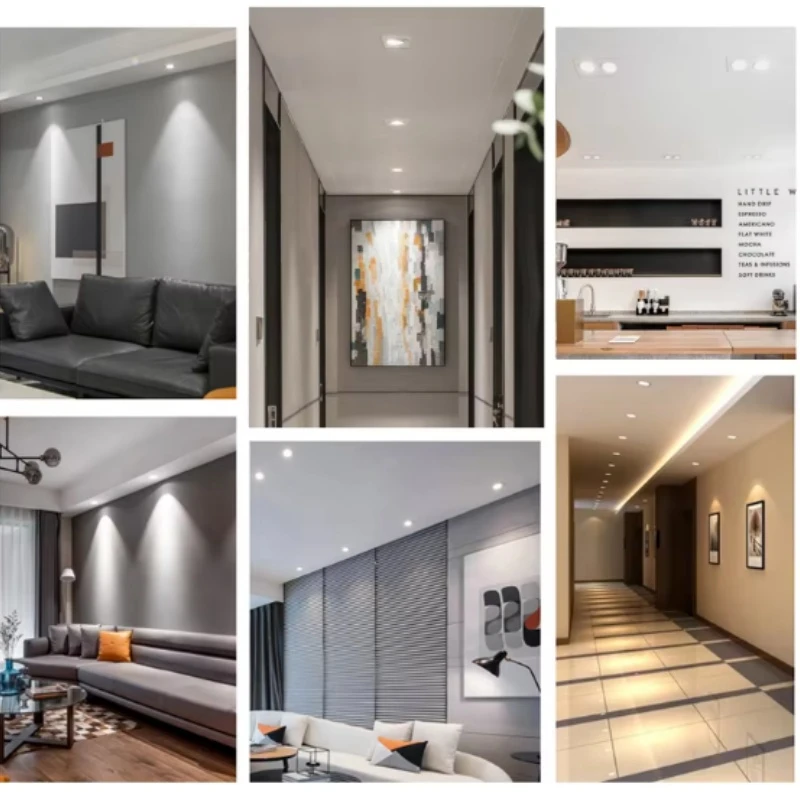
If you are selecting a lighting solution for a project, you have likely come across the term "LED spot downlight" in various specification sheets. While the name sounds simple, few people truly understand the product; many clients know only that it is "bright" and "energy-efficient," without clearly grasping which spaces it suits best or how it outperforms standard downlights. This article clarifies these points to help you avoid common pitfalls during the selection process.
What is an LED Spot Downlight?
An LED spot downlight is a type of recessed directional lighting fixture. Unlike standard downlights that produce diffuse light, these fixtures typically feature a narrower beam angle (usually between 15° and 40°). This allows them to focus light on a specific point or area, making them ideal for accent lighting-such as highlighting an exhibit, a decorative wall, or a kitchen countertop that requires focused illumination.
Key Advantages
Ultimately, the reasons people choose LED spot downlights come down to the following factors:
Significant energy savings: Compared to traditional halogen lamps or older downlights, LED spot downlights consume over 60% less power while delivering the same level of illumination. For projects involving hundreds or thousands of fixtures-such as hotels or shopping malls-this difference in electricity costs is substantial.
Long lifespan and low maintenance costs: High-quality LED chips typically last over 30,000 hours, translating to roughly ten years of continuous use. This is particularly important for installations in high-ceiling areas (like commercial atriums or corridors with dropped ceilings), as no one wants to climb a ladder constantly to replace light bulbs.
Excellent color rendering: Most mainstream products now offer a Color Rendering Index (CRI) of over 90, ensuring true-to-life color reproduction. This is essential for settings where color accuracy is critical-such as retail stores and art galleries-to prevent merchandise or artworks from appearing distorted or discolored under the light.
Flexible installation options: Common market varieties include fixed, adjustable-angle, and track-mounted models. Adjustable-angle versions are especially popular because the direction of the light can be fine-tuned after installation to meet specific needs, eliminating the need to cut new ceiling openings. Low heat generation and enhanced safety: Compared to halogen lamps, LEDs operate at significantly lower temperatures. They do not become dangerously hot to the touch during prolonged use and cause far less degradation to surrounding materials (such as gypsum ceiling boards).
Common Application Scenarios
LED spotlights and downlights have a wide range of applications, but they are most frequently used in the following types of spaces:
Retail stores: To highlight featured products or window displays.
Hotel lobbies and corridors: To create layered ambient lighting.
Residential living rooms and entryways: For targeted accent lighting.
Museums and galleries: To showcase exhibits requiring high color rendering.
Office conference rooms or reception areas: To elevate the overall aesthetic quality.
Key Details to Consider When Purchasing
If you are a purchaser, it is recommended to focus on the following parameters when selecting models:
Beam angle: Narrow beams (15°–24°) are suitable for accent lighting, while wide beams (36° and above) are better for uniform, large-area illumination; choosing the wrong angle can significantly compromise the effect.
Color temperature: Warm white (3000K) creates a cozy atmosphere, making it ideal for homes and dining areas; neutral white (4000K) is better suited for retail and office spaces.
Dimming compatibility: If the project requires a dimming system, confirm in advance whether the fixtures support it and which dimmers are compatible.
Heat dissipation design: The size of the heat sink and whether it is made of die-cast aluminum directly determine the fixture's actual lifespan. Since this information may not be clearly stated on the spec sheet, it is best to ask the supplier directly.
Certifications: For exports to European and American markets, CE and RoHS certifications are standard requirements; some regions may also require UL or SAA certification, so it is best to verify this before purchasing.
Summary
LED spotlights and downlights have become the mainstream choice for commercial and residential lighting due to a few key factors: energy efficiency, durability, excellent color rendering, and flexible installation. However, for any specific project, decisions regarding beam angle, color temperature, and dimming capabilities must be based on the actual requirements of the space; there is no one-size-fits-all answer.
If you are currently selecting LED spotlights or downlights for a project, or if you have specific parameter requirements you would like to verify, please feel free to contact our team. We can provide tailored product solutions and detailed specifications based on the specifics of your project.