

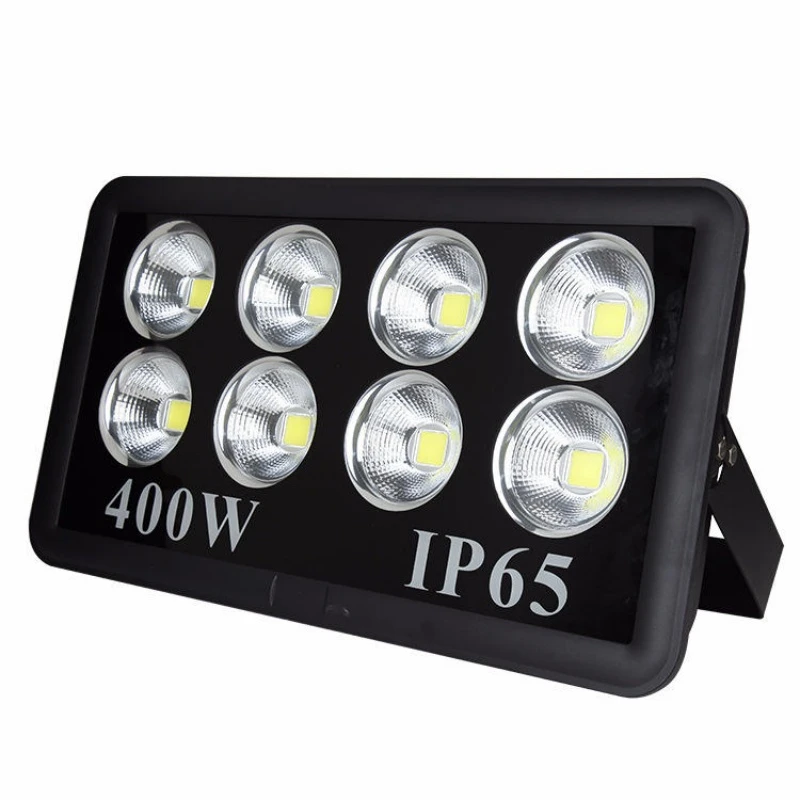
If you have ever taken apart a few LED floodlights, you might have noticed an interesting contrast: traditional SMD (Surface-Mounted Device) floodlights feature dozens or even hundreds of tiny individual LED chips densely packed across their surface, whereas COB (Chip-on-Board) floodlights typically present as a single, continuous circular or square light-emitting surface. This is not a result of lazy design, but rather a characteristic inherent to COB packaging technology. Let's explore this further by looking at the manufacturing process, optics, thermal management, and typical use cases.
What exactly is COB?
COB stands for "Chip-on-Board." It refers to a technology where bare LED chips are mounted directly onto a substrate, rather than being packaged into individual, discrete LED units before being soldered onto a circuit board. In SMD technology, each LED unit has its own frame, solder pads, and encapsulant (resin). COB eliminates these intermediate components, allowing dozens or even hundreds of chips to be concentrated on a single substrate.
Therefore, what we perceive as a "large light source" is, in reality, a dense array of many individual chips, rather than one single, oversized chip.
How the packaging method creates a "unified" appearance
The production process for COB generally involves the following: mounting the chips onto a metal substrate (typically aluminum or ceramic), connecting them via a series-parallel circuit using gold wires, and finally covering the entire assembly with a layer of silicone mixed with phosphor powder.
The final step is the key. Because the phosphor-infused silicone is applied as a single, continuous layer-without any frames separating the individual chips-the light emitted by the chips blends within this layer and radiates from one unbroken surface. Visually, this results in a uniform, continuous light-emitting area (circular or square) rather than a collection of distinct, individual points of light.
How multiple chips form a single light source
Many people assume that a COB unit contains one large chip, but that is not the case. A common approach is to arrange low-power chips into a matrix using a series-parallel configuration, with the circuit design distributing the electrical current across them.
This offers two main advantages:
Since each individual chip carries only a small amount of current, the system operates more stably, and light degradation (lumen depreciation) remains relatively well-controlled.
If one or more chips fail, the entire unit does not necessarily stop working immediately-though the exact outcome depends on the specific series-parallel circuit design. The phosphor layer serves to uniformly convert and blend the blue light emitted by the individual chips, ensuring a consistent color temperature and brightness across the entire light-emitting surface.
Optical Advantages of a Single Light Source
For floodlights, the form of the light source directly influences light distribution. COB (Chip-on-Board) technology offers three primary benefits:
A more uniform light-emitting surface. There are no distinct, scattered points of light, which significantly reduces the "grainy" appearance when viewed up close.
Closer to a point source. The entire light-emitting area is concentrated within a compact space. When paired with a reflector or lens, it becomes easier to control the direction of the light and achieve precise beam angles.
Better glare control. Because the light source is concentrated and the surface is continuous-as opposed to multiple, scattered LED chips-it is easier to manage and minimize multiple light spots and stray light through optical design.
Shorter, More Concentrated Heat Dissipation Path
Floodlights often operate at high power and are frequently used outdoors, making thermal management critical to their lifespan. In a COB setup, the chips are mounted directly onto a metal substrate; heat travels from the chips to the substrate and then to the cooling fins on the fixture body-a short path with minimal interfaces.
Furthermore, because the chips are concentrated in one area, the heat is also concentrated. This places high demands on the fixture's base plate, thermal interface materials, and cooling fin design. Consequently, the quality of the thermal design-even among different COB products-directly impacts the actual service life, making it a key factor to consider when making a purchase.
Significance of a Single Light Source for Light Distribution Design
Floodlights often require long-range projection, clearly defined beam edges, and concentrated illuminance. A single COB light source is ideally suited for secondary optical systems:
When paired with a reflector, it can produce a concentrated, narrow beam, perfect for long-distance projection.
When paired with a lens, it can generate beams with various angles, allowing for selection based on specific application requirements.
With the light source fixed and centered, it is easier to ensure accurate alignment and consistency of optical components, leading to more stable light distribution in mass production.
In contrast, when multiple SMD (Surface-Mounted Device) LEDs are distributed over a larger area-each requiring its own individual lens-the overall light distribution is more prone to cumulative errors.
Limitations and Considerations
COB technology is not a universal solution; understanding its drawbacks is essential for making the right product choice:
The light-emitting area is larger than that of a single LED chip, meaning it is not a true "point source." Consequently, controlling ultra-narrow light beams is less flexible compared to using a lens paired with an individual LED chip.
If a specific part of the array fails, it cannot be replaced individually; the entire light-emitting board usually needs to be replaced.
It places higher demands on thermal management and the LED driver. Low-quality products are prone to issues like lumen depreciation (light decay) and color temperature drift.
There is significant variation in the quality of phosphor coatings and LED chips. Two COB units that look identical may differ substantially in terms of their Color Rendering Index (CRI) and luminous efficacy.
When purchasing, it is advisable to focus on luminous efficacy, CRI, lumen depreciation data, thermal design, and the brand of the LED driver, rather than relying solely on external appearance or nominal power ratings.
Summary
The reason a COB LED floodlight features a single, large light source is its packaging method: multiple LED chips are mounted directly onto a substrate and covered with a unified layer of phosphor, transforming them into a single, continuous light-emitting surface. This structure ensures more uniform light distribution, easier beam control, and a shorter thermal path. However, it also necessitates superior heat dissipation and makes localized repairs difficult. Understanding these characteristics allows for a more accurate assessment of a product's true quality when selecting floodlights.
Need more information or a customized solution?
If you are sourcing COB LED floodlights for engineering projects, wholesale, or brand procurement, please get in touch with us. Based on your specific application-such as sports venues, building facades, parking lots, or industrial facilities-we can recommend the appropriate power, beam angle, and thermal design. We are also happy to provide samples, photometric data files (IES files), and price quotes.
Our address
No. 5-3 Niujiao Road, Yanchuan Community, Yanluo Subdistrict, Bao'an District, Shenzhen
bwzm18@ledbenweilighting.com






