

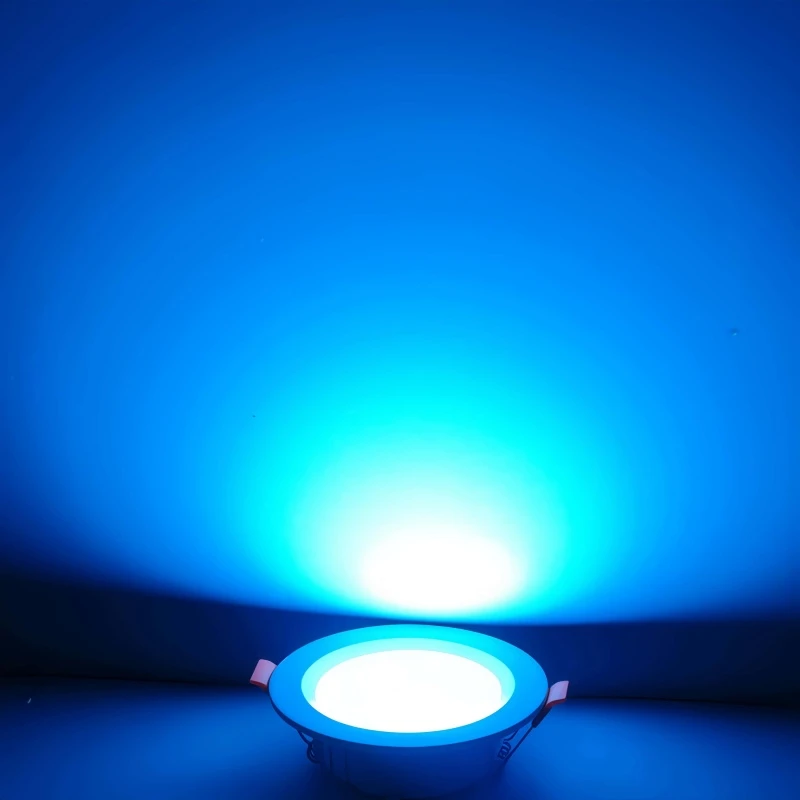
You press the red button on your remote, but the recessed light emits an orange-hued glow; you select cyan, yet it appears as a grayish blue on the ceiling. It is easy to assume you've purchased a defective product, but the issue often lies in the wiring, power supply, controller compatibility, or the LED chips themselves. Troubleshooting these elements before replacing the light can save you a great deal of trouble. Below, common causes are listed in order of diagnostic difficulty-from easiest to most complex.
Incorrect Wiring Sequence (Red, Green, and Blue)
This is the most common issue and also the easiest to resolve. RGB lights typically feature four wires: one common terminal (common anode or common cathode) and three individual channels for red, green, and blue. Manufacturers do not always follow a standardized wiring sequence; some may use R-G-B, while others might use R-B-G or G-R-B.
If the wiring sequence is incorrect, selecting "red" might produce green, while selecting "blue" might result in red. This manifests as a "complete color mix-up" rather than a slight color shift.
How to diagnose: Turn on each color-pure red, pure green, and pure blue-one by one to see if the actual output matches your selection. If all three primary colors are incorrect, it is almost certainly a wiring sequence issue; simply swap the positions of the wires at the controller's output terminal.
Additionally, ensure that the common anode or common cathode configuration matches your controller. A mismatch can cause the lights to fail to turn on entirely or result in inverted color effects.
Mismatch Between Power Supply Voltage and the Light Fixture
Common voltage specifications include 12V, 24V, and 220V. Most recessed RGB lights operate on low-voltage constant-voltage or constant-current drivers. If the voltage falls below the rated value, the red light-which has the lowest forward voltage-typically dims first, disrupting the brightness balance between the three colors. Conversely, if the voltage is too high, the blue and green channels may become overly bright, giving the overall light a "cooler" (bluish) tone.
For fixtures using constant-current drivers, you must also ensure that the output current matches the specifications. An incorrect current will likewise cause an imbalance in the brightness ratio of the three colors.
How to diagnose: Use a multimeter to measure the voltage at the power supply output and the light fixture's input terminal, then compare these readings against the rated values found on the fixture's nameplate.
Voltage Drop Leading to Color Shift at the End of a Run
The more lights connected in series or parallel on a single circuit-and the longer or thinner the wires-the lower the voltage becomes toward the end of the run. This manifests as lights near the power source displaying the correct color, while those further away appear dimmer, or shift toward red or yellow-a phenomenon particularly noticeable when producing white light.
This issue frequently occurs in settings with a large number of fixtures, such as corridors or expansive ceiling installations.
Solutions: Shorten the length of individual circuits, use thicker-gauge wiring, implement zoned power supply, or introduce supplementary power injection points along the run.
Incompatibility Between Controller and Fixture Protocols
RGB lighting can be controlled via various methods, including simple PWM controllers, DMX512, DALI, or other smart lighting systems. If the signal type or channel count output by the controller does not match the requirements of the fixture's built-in driver chip, it can lead to inaccurate colors, flickering, or the failure of specific channels.
For example, connecting an RGB controller to an RGBW fixture will prevent the white channel from being accessed correctly; alternatively, if a fixture requires DMX addressing but the controller has not been configured with the corresponding channels, the system will not function as intended.
How to diagnose: Consult the fixture's manual to verify the required control method, channel count, and addressing settings, then compare these against the controller's specifications.
LED Binning and Color Consistency Issues
Even with a perfectly installed electrical system, color shifts can still originate from the fixtures themselves. During production, LED chips are categorized-or "binned"-based on their specific wavelength and brightness. Consequently, chips from different batches may exhibit slight variations in the ratios of red, green, and blue light output. If fixtures from different batches are installed in the same space and set to the same values, the differences will be visible to the naked eye-especially when producing white or light-colored hues.
How to avoid: Whenever possible, use products from the same production batch for a single project. Confirm the LED binning standards with your supplier during procurement, and ensure you order extra units from the same batch to account for future replacements or additions.
Improper Dimming and PWM Frequency Settings
Most RGB lighting systems rely on PWM (Pulse Width Modulation) dimming to mix colors. When set to low brightness, the duty cycle for all three channels becomes very small. This amplifies any non-linear discrepancies between the channels-a common symptom being a color shift toward red or green, making it impossible to achieve the desired soft, balanced hue.
Furthermore, if the PWM frequency is too low, it may cause visible flickering or the appearance of banding (stripes) when captured by a smartphone camera. While not strictly a "color shift," this is often perceived as color instability.
Solution: Use a controller that supports high-frequency PWM and Gamma correction, and avoid demanding precise color accuracy at extremely low brightness levels.
Signal Interference and Poor Contact
Loose terminals, oxidized connectors, or running signal wires parallel to high-voltage power lines can cause intermittent signal loss. This results in the occasional dropout of a specific color channel, leading to sudden, erratic color changes.
How to diagnose: Re-secure all connectors, check terminals for signs of oxidation (blackening), and ensure signal wires are routed through separate conduits, kept well away from high-power electrical lines.
Color Shift Due to Poor Heat Dissipation
When recessed lights are installed in a ceiling cavity with limited space, heat cannot dissipate effectively. As the temperature of the LEDs rises, the luminous efficiency of the red LED chips drops faster than that of the blue or green ones. Consequently, after the light has been in use for some time, the color temperature shifts toward the "cooler" (bluer/greener) end of the spectrum, causing white light to take on a cyan or greenish tint.
This type of color shift is gradual-if the light appears normal upon startup but shows a noticeable change after half an hour, heat dissipation is likely the culprit.
Solution: Choose fixtures with well-designed thermal management, ensure adequate ventilation space within the ceiling cavity, and avoid covering the back of the fixture with thermal insulation material.
Summary
Color shifts in RGB recessed lighting generally fall into three categories:
Installation-related issues: Incorrect wiring sequences, voltage drops, or poor contact. These are the most common and typically the easiest to resolve.
Compatibility-related issues: Mismatches in voltage, driving methods, or controller protocols. These require verifying each technical specification.
Product-related issues: Variations between batches of LED chips, inadequate thermal design, or poor PWM dimming performance. These should be addressed during the product selection and purchasing phase. We recommend starting by checking the wiring sequence and voltage, followed by the controller and cable length; the quality of the light fixtures themselves should be considered last.
Need a professional RGB recessed lighting solution?
If you are sourcing RGB recessed lights for a hotel, commercial space, residential project, or other professional installation, please get in touch. We can recommend the ideal voltage, control method, and fixture models for your specific environment. We also offer samples for testing and ensure that all products in a single shipment come from the same production batch, minimizing the risk of color inconsistency.
Our address
No. 5-3 Niujiao Road, Yanchuan Community, Yanluo Subdistrict, Bao'an District, Shenzhen
bwzm18@ledbenweilighting.com






