It is not uncommon for a poultry farmer to enter a chicken coop and see steady, constant lighting, only to find the flock restless, exhibiting increased feather-pecking, and failing to reach expected egg-production levels. After ruling out issues with feed, vaccines, or environmental temperature and humidity, the culprit is often discovered to be the lighting itself. Many farmers focus solely on brightness and color temperature, overlooking an invisible factor: flicker. This article explains three key points: why chickens are so sensitive to flicker, how flicker negatively impacts egg production, and how to avoid this pitfall when purchasing lighting for a poultry house.
What chickens perceive as "flicker" differs from what humans see
The human eye has a "flicker fusion threshold"-at frequencies above approximately 60Hz, we perceive light as continuous. Chickens, however, possess a much faster visual system; research indicates their flicker fusion frequency is significantly higher than that of humans, reaching around 100Hz or even more under bright lighting conditions.
This has a very practical implication: a light source that appears perfectly steady to a human may, to a chicken, appear to be constantly flickering. For instance, power-line ripples at 100Hz or 120Hz-imperceptible to humans-can be clearly detected by chickens.
Where does flicker in a poultry house come from?
Common sources include:
Older fluorescent lamps with inductive ballasts: The flicker frequency is linked to the frequency of the AC power supply, falling well within the range that chickens can perceive.
Low-cost LED drivers: These often feature undersized filter capacitors, leading to high ripple current, which causes the light's brightness to fluctuate in sync with the current.
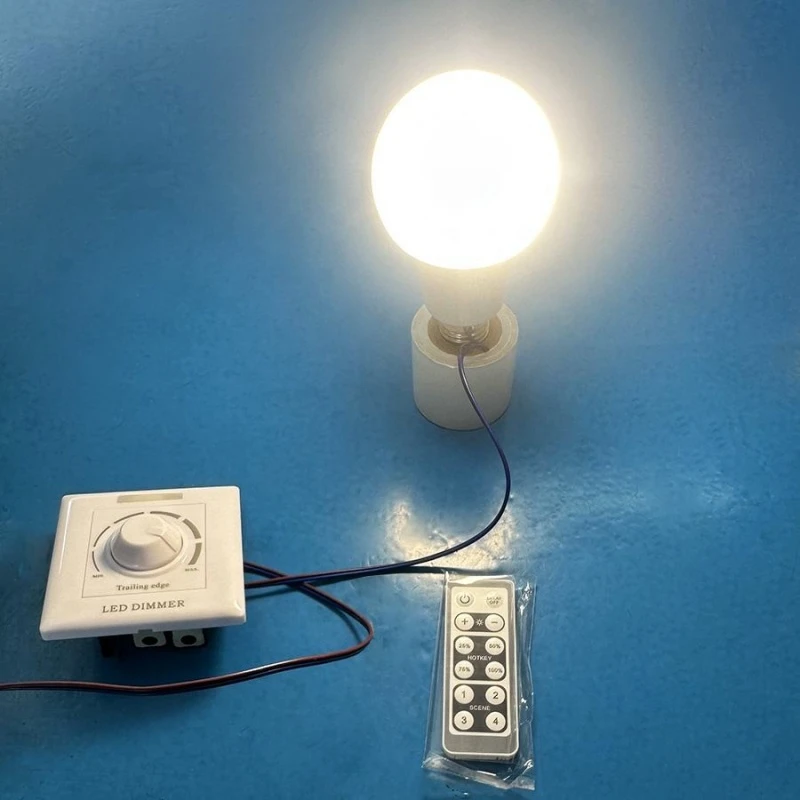
PWM (Pulse-Width Modulation) dimming: Many dimmable lights adjust brightness through rapid switching. If the switching frequency is not sufficiently high, the flicker becomes even more pronounced when the light is dimmed.
Voltage fluctuations and dimmer incompatibility: Unstable power grids on farms, or a mismatch between the lighting fixtures and the dimming equipment, can also cause the brightness to fluctuate.
The issue of dimming is particularly easy to overlook. Many poultry houses implement a progressive lighting program, which requires daily adjustments to light intensity. Consequently, whether the dimming mechanism is flicker-free is even more critical than how the lights perform at full brightness.
Direct Stress Responses in Chickens Caused by Flickering
Chickens are easily startled; persistent light flickering acts as a constant environmental disturbance, keeping them in a state of chronic alertness. Common manifestations include:
Agitation within the flock, leading to crowding or chaotic flight when startled.
An increase in abnormal behaviors, such as feather pecking or vent pecking.
Disrupted rest periods, resulting in restless lying or poor-quality sleep.
Elevated levels of stress hormones within the body.
These are observable short-term changes. If the flickering persists, the flock cannot simply "adapt," as the stimulus recurs daily.
How Stress Affects Egg Production
Egg production is highly sensitive to a hen's physiological state. Stress impacts performance through several pathways:
Feed intake and energy allocation: Chronic stress disrupts a hen's feeding rhythm, diverting nutrients-which would otherwise support egg production-toward managing the stress response.
Disruption of endocrine rhythms: Light serves as the primary signal for regulating the egg-laying cycle. Unstable light signals interfere with hormonal secretion patterns, affecting the regularity of ovulation.
Egg production rate and quality: Common consequences include a lower peak in egg production or a shorter duration of the peak period, alongside an increase in issues such as soft-shelled eggs, rough-shelled eggs, or broken eggs.
Flock uniformity: Individual birds react to stress differently, which widens the gap in their physiological states and leads to an inconsistent overall egg-production curve.
It should be noted that a decline in egg production is often the result of multiple overlapping factors. While flickering may not be the sole cause, it is a factor that is easily overlooked during troubleshooting-yet one that can be entirely eliminated.
How to Determine If There Is an Issue with Poultry House Lighting
You can perform a preliminary check without the need for specialized equipment:
Smartphone slow-motion test: Use the slow-motion (high frame rate) video mode on your smartphone to record the lights. If scrolling light and dark bands appear in the footage, it indicates significant flickering. Observe the flock's behavior: Check for signs of unusual agitation or an increase in pecking behavior after turning on or dimming the lights.
Compare different poultry houses: Within the same batch and under identical management, assess whether there are differences in egg production between houses with upgraded lighting and those without.
Examine lighting specifications: Reputable products will specify flicker metrics or provide test reports; be cautious if no such information is available.
While smartphone-based testing can reveal obvious issues, definitive conclusions require official technical test data for the lighting equipment.
Key Considerations for Selecting Flicker-Free Poultry Lighting
Constant-current driver with low ripple: This minimizes brightness fluctuations at the source and is the foundation for flicker-free operation.
High-frequency or analog dimming: Verify the dimming method and frequency; the light should remain stable even at low brightness levels.
Suitable spectrum and brightness range: The system should support low-intensity settings to facilitate effective lighting programs.
Waterproof, dustproof, and corrosion-resistant: Poultry houses are characterized by high humidity, ammonia, and dust. If the ingress protection (IP) rating is insufficient, the driver may fail, leading to the onset of flicker.
Test reports and after-sales support: Manufacturers capable of providing flicker test data generally have greater confidence in the reliability of their drivers.
Summary
Chickens possess much sharper vision than humans; they can perceive flicker that remains invisible to us. Flicker-often caused by ballasts, inferior drivers, or improper dimming methods-can trigger panic, pecking, and hormonal imbalances. These factors negatively impact feed intake and endocrine function, ultimately reducing egg production and quality. You can begin your assessment by using a smartphone's slow-motion camera and observing the flock's behavior. When selecting lights, prioritize driver quality, the dimming method, and the availability of technical test reports.
If you are currently selecting or upgrading lighting for your poultry facility, please share details such as the housing type (caged, floor-reared, or free-range), the scale of the operation, and your existing lighting setup. Our engineering team can recommend a suitable flicker-free lighting solution tailored to your specific needs, and provide samples along with flicker test data for your evaluation. Alternatively, leave us a message to receive one-on-one product selection advice and a price quote.