High-power LED corn lights are widely used in factories, warehouses, parking lots, and outdoor areas to replace traditional metal halide lamps and energy-saving lamps. Many buyers have reported that low-priced, inferior corn lights develop noticeable flickering after only a few weeks of use, with visibly fluctuating brightness. This not only harms eyesight and reduces workplace comfort, but in severe cases, it can cause the driver to burn out, rendering the entire light unusable and resulting in significant after-sales returns and project rework costs.
Many customers attribute flickering solely to lamp malfunction, unaware that inferior corn lights often cut corners in raw materials, circuit design, and heat dissipation processes, leading to flickering malfunctions after a short period. This article analyzes the root causes of flickering in inferior LED corn lights, differentiates various malfunctions, and provides purchasing and usage avoidance solutions to help engineering wholesalers avoid substandard sources.
Substandard Driver Power Supply: The Primary Cause of Flickering
The stable illumination of LED corn lights relies heavily on constant current drivers, which is also where inferior manufacturers most severely cut costs.
Using a non-isolated, simple RC driver without a stable constant current chip, the light flickers even with slight voltage fluctuations. After prolonged use, the capacitor rapidly degrades, leading to unstable output current and increasingly noticeable flickering within weeks.
The driver capacitors and resistors use cheap, low-quality components with poor high-temperature resistance. They degrade under heat, causing fluctuating output current and visible high-frequency flickering.
The driver has a falsely advertised power rating, forcing a high-power light board with a small power supply. Prolonged full-load and overload operation causes continuous overheating, quickly resulting in erratic current output and continuous light flickering.
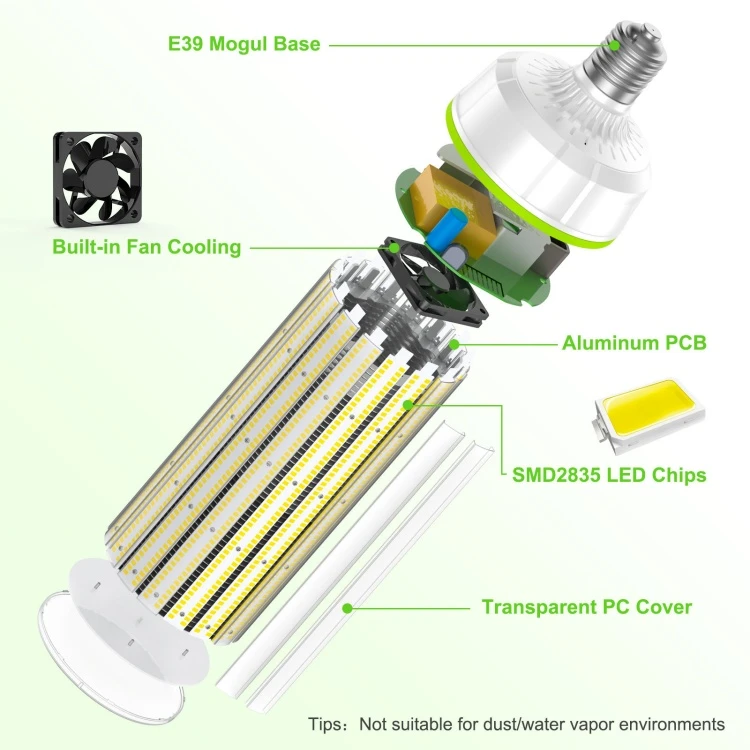
High-quality lights come standard with a fully isolated constant current driver and built-in filter capacitors, ensuring stable current and eliminating flickering over long-term operation.
Inferior quality and aging of LED chips and aluminum substrate,leading to poor circuit contact.
Low-priced LED corn lights use outdated, low-grade LED chips paired with thin, low-quality fiberglass boards, making them prone to short-term flickering failures: Poor quality LED chips with thin gold wires and inferior encapsulation adhesive cause the gold wires to detach after heating, resulting in one or more LED chips flickering on and off, and overall light flickering. Using insulated fiberglass boards instead of high thermal conductivity aluminum substrates results in extremely poor thermal conductivity. Heat cannot be dissipated from the bottom of the LED chips, leading to rapid chip aging, unstable conductivity, and flickering.
Poor LED chip mounting process and poor solder joints cause the contacts to break and re-bond after slight vibration or temperature rise, resulting in intermittent flickering.
Inadequate heat dissipation structures accelerate component failure and flickering at high temperatures.
High-power corn-shaped LED lights have densely packed LEDs, and insufficient heat dissipation can trigger a chain reaction of flickering problems, a common issue with inferior products: The outer shell uses thin sheet metal or aluminum without widened heat dissipation fins, resulting in severely insufficient heat dissipation area; the internal temperature rises sharply after the light fixture is turned on.
Under high temperatures, the internal capacitors, LED chip pads, and circuitry age rapidly, causing rapid performance degradation and flickering after only one or two months of use; sustained high temperatures can directly burn out the driver, causing the light fixture to stop working completely.
Reputable industrial corn-shaped LED lights use thickened, multi-finned aluminum heat dissipation shells to quickly dissipate heat, protecting the circuitry and ensuring stable operation of the LEDs.
Rough Wire and Solder Joints, Leading to Loose Connections and Power Trips
Low-cost production simplifies soldering and wiring processes, resulting in unreliable circuit connections. After short-term use, vibration and thermal expansion and contraction cause poor contact:
The lamp board and driver connection uses inferior copper core wire with poor heat resistance. The insulation melts when heated, leading to unstable circuit contact.
Simple manual spot welding results in thin, unreinforced solder joints. Solder joints detach after switching the lamp on or off, or with slight vibration, causing intermittent circuit continuity and frequent flickering.
Internal wiring is messy and lacks secure clips. Transportation and installation shaking can cause short circuits due to wire compression, resulting in intermittent flickering.
Lack of Voltage Regulation and Filtering Design, Directly Causes Flickering Due to Voltage Fluctuations
Factory and outdoor power grid voltages frequently fluctuate. High-quality lamps have built-in voltage regulation and filtering circuits for buffering, but inferior lamps omit this structure:
The lack of EMC filtering circuits causes voltage fluctuations and current noise during the start-up and shutdown of high-power equipment in the factory, immediately causing low-frequency flickering. Prolonged direct viewing can easily lead to dizziness and eye fatigue.
Incompatible with wide voltage ranges, even slight drops in mains voltage can cause driver output imbalance, resulting in noticeable fluctuations in brightness and significantly increasing the failure rate in outdoor and factory conditions.
Summary
The short-term flickering of inferior LED corn lights is essentially a chain reaction of failures caused by manufacturers significantly reducing specifications in multiple areas such as the driver, LED chips, heat dissipation, and manufacturing processes, rather than simply wear and tear.
When purchasing high-power industrial corn lights, to avoid flickering after-sales issues, focus on three key points: adequately isolated constant current driver, thickened finned aluminum alloy heat sink housing, and high thermal conductivity aluminum substrate paired with genuine LED chips. Purchasing only low-priced, simplified models may save on short-term costs, but will lead to numerous returns, rework on-site, and customer loss in the long run. For long-term outdoor lighting projects in factories, parking lots, and elsewhere, prioritize industrial-grade corn lights with robust materials and complete circuit protection for more stable and flicker-free long-term use.
Our entire series of high-power LED corn lights utilizes fully isolated constant current drivers, built-in filtering and voltage regulation circuits, and a thickened multi-fin aluminum alloy heat dissipation structure. Combined with a high thermal conductivity aluminum substrate and highly stable LED chips, they offer flicker-free, low-light-decay operation for 24/7 operation. Power ranges from 20W to 120W, suitable for various engineering scenarios including warehouses, factories, outdoor high-pole installations, and parking lots.
For inquiries regarding internal parameters of the light driver, sample lighting tests, bulk wholesale pricing, and large-scale factory lighting solutions, please feel free to contact us.
www.benweilighting.com/professional-lighting/corn-light/super-bright-e39-35000lm-led-corn-light.html
Our address
No. 5-3 Niujiao Road, Yanchuan Community, Yanluo Subdistrict, Bao'an District, Shenzhen
benwei10@benweilighting.com