

Introduction: The Silent Killer of Industrial Lighting
The LED Corn Bulb, specifically designed as a high-output retrofit for streetlights, high-bay fixtures, and parking lots, is particularly vulnerable to thermal buildup. Packing dozens of high-intensity LED chips into a compact cylindrical form factor creates a high-density thermal environment. For years, manufacturers have attempted to solve this by adding passive fins and larger heat sinks. However, the true breakthrough in thermal management isn't just about moving heat away from the LEDs-it is about preventing the heat from accumulating in the first place. This is where Photoelectric Separation revolutionizes the industry.
The Anatomy of Thermal Failure in Traditional LED Bulbs
In a standard integrated corn bulb, the driver (the electronic circuitry that converts alternating current AC into the direct current DC required by the LEDs) is typically located directly below the LED arrays, often within the same enclosed housing, or immediately adjacent to the heat sink. While this makes the bulb compact, it creates a catastrophic "heat trap." The LEDs, operating at high currents to achieve a 130lm/w luminous efficacy, generate a massive amount of heat at their base. Simultaneously, the driver, which is handling high voltage, also generates its own operational heat. In an integrated design, these two heat sources compound one another.
The core of the driver consists of electrolytic capacitors. These components are notoriously sensitive to heat. According to the Arrhenius equation-a formula used in engineering to describe the temperature dependence of reaction rates-for every 10°C increase in ambient temperature, the lifespan of an electrolytic capacitor is cut in half. When the driver is integrated with the LEDs, it is bathed constantly in the intense heat radiating from the LED chips. This "thermal soaking" causes the electrolytic fluid inside the capacitors to slowly evaporate, leading to a phenomenon known as "capacitance loss." As the capacitance drops, the ripple current to the LEDs becomes unstable, causing flickering, color shifting, and ultimately, premature death of the bulb. Furthermore, this intense heat accelerates lumen depreciation-the gradual lowering of light output over time-rendering the bulb useless long before its mechanical components have worn out.
Defining the Game-Changer: The Mechanics of Photoelectric Separation
In this specific product, the driver is fully housed in the upper section of the bulb, completely physically separated from the LED body below. However, mere physical distance is not enough; the design incorporates a total thermal barrier. The driver is fully sealed with thermal paste. This thermal paste acts as a highly efficient dielectric heat conductor. Instead of the driver relying on air (which is a poor conductor of heat) to dissipate its heat, the thermal paste conducts the heat generated by the driver directly outward to the shell of the bulb, away from the sensitive electronic components.
Meanwhile, the 5630 LED/LG chips and the aluminum body are isolated in their own thermal zone. By separating the two heat sources, the thermal load is effectively bifurcated. The LED arrays do not have to suffer the additional burden of the driver's heat, and the driver operates in a much cooler microclimate. This physical separation is the first and most critical line of defense in ensuring the longevity of the fixture, directly contributing to the LM80 certification of the light source by maintaining optimal junction temperatures.
The Synergistic Effect of Advanced Materials and Intelligent Design
First, the utilization of an aluminum material body is paramount. Aluminum possesses a high thermal conductivity, making it the ideal material for drawing heat away from the LED chips. The aluminum acts as a massive heat sink, absorbing the thermal energy generated by the 130lm/w LED arrays and distributing it across the surface area of the cylindrical body.
Second, the structural design of the bulb features diversion grooves and small holes located at the top cap. This is not merely an aesthetic choice; it is a highly functional environmental and thermal engineering feature. These grooves and holes serve a dual purpose. Primarily, they facilitate rapid heat dissipation through a process of convective cooling. As hot air rises within the fixture, the diversion grooves allow cooler ambient air to enter, creating a continuous thermal cycle. Secondarily, in outdoor applications such as street lighting or parking garages, these precise grooves are designed to quickly direct water flow and prevent water pooling. By preventing water from pooling on the top of the bulb, the design mitigates the risk of thermal shock, corrosion, and electrical short circuits, preserving the integrity of the internal components.
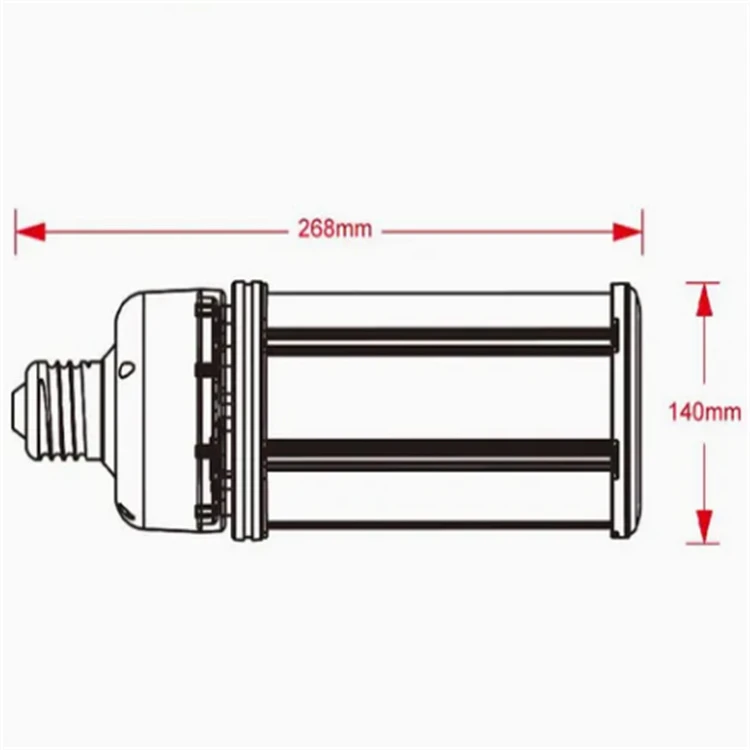
Third, the inclusion of a central cooling fan mechanism (as depicted in the cross-sectional imagery) further enhances this convective process. This fan actively draws air in through the bottom and forces it up through the center of the LED array, creating a dynamic, forced-air cooling effect that works in tandem with the passive aluminum heat sink.
Finally, the system is anchored by premium Rubycon capacitors within the driver. Rubycon is renowned in the electronics industry for manufacturing exceptionally reliable, high-temperature-tolerant capacitors. Because the photoelectric separation design keeps the driver's operating temperature significantly lower, these Rubycon capacitors can function at their optimal efficiency for years. The synergy of low-stress operation (due to photoelectric separation), premium components (Rubycon), and a highly effective physical cooling structure (aluminum + grooves + fan) creates a thermal management ecosystem that is virtually impervious to burnout.
The Domino Effect of Lower Operating Temperatures
First and foremost is the dramatic reduction in lumen depreciation. The 5630 LED/LG chips are rated for high brightness, and the LM80 certification guarantees that they will maintain this brightness over an exceptionally long lifespan. Heat is the primary accelerator of lumen depreciation. By ensuring the LEDs are thermally isolated from the driver, the bulbs maintain their 130lm/w efficacy for vastly longer periods, ensuring that the facility's lighting levels remain consistent and safe without requiring frequent replacements.
Furthermore, the lower operating temperature expands the environmental tolerances of the bulb. This product boasts a working temperature range of -40°C to 65°C. This extraordinary resilience is a direct result of the thermal design. In extreme cold (-40°C), the physically separated and fully sealed driver ensures no condensation forms on the electronics, and the capacitors provide reliable cold-start capabilities. In extreme heat (65°C), the photoelectric separation prevents the driver's heat from adding to the ambient heat within an enclosed fixture. The ability to operate in a totally enclosed fixture without overheating is a rare and highly valuable trait in industrial lighting. Traditional bulbs would fail in these enclosed environments because the heat cannot escape, but the advanced thermal architecture of this bulb allows it to thrive.
This resilience is further protected by the IP64 rating. The dustproof design ensures that particulate matter from harsh industrial environments-such as sawmills, cement factories, or agricultural facilities-cannot infiltrate the housing and act as an insulating blanket over the electronics, which would otherwise trap heat. The water-resistant design ensures that the rapid temperature changes (thermal cycling) common in outdoor environments do not cause water ingress, which would instantly destroy the separated driver.
The Economic Impact: Total Cost of Ownership (TCO)
In a massive warehouse or a city-wide street lighting network, changing a single bulb requires a scissor lift, a crew of electricians, and traffic or operational delays. If a bulb fails every two years due to thermal degradation, the labor cost to replace it far exceeds the cost of the bulb itself.
By engineering a bulb with photoelectric separation, the lifespan of the fixture is extended exponentially. The bulb becomes a "fit-and-forget" asset. Over a 10-year period, a facility manager might replace traditional bulbs two or three times. With this 360-degree IP64 LED corn bulb, they will likely replace it zero times. The dramatic reduction in maintenance labor, combined with the energy savings from the 130lm/w efficacy, means the bulb pays for itself in a matter of months, and the subsequent years of operation represent pure, unadulterated savings.
Conclusion

How To Cooperate With Us?
We are happy to have total control over the manufacturing process and the calibre of our products since we have our own facilities. Since we are producers rather than just brokers, we are dedicated to providing our customers with the best pricing. Since we are certain that the price and quality of our products are clear, we invite customers to see our samples first. Our commitment to quality and customer satisfaction drives us to continuously provide top-notch goods.
Our address
3rd Floor, 5th Building, Hebei Industrial Park, Hualian Community, Longhua District, Shenzhen, China





