

Introduction: The Hidden Killer of UFO LED High Bay Light Lifespan
The Misunderstanding of LED Lighting Lifespan in Industrial Scenarios
In the industrial lighting market, most suppliers label their UFO LED high bay lights with a standard lifespan of 50,000 hours. However, countless on-site application data shows that a large number of low-end UFO high bay lights experience severe brightness attenuation after 2 to 3 years of continuous use, and even suffer from dead lights, driver damage, and overall scrapping. This phenomenon makes many enterprise managers question the authenticity of LED long-life technology. In fact, the nominal 50,000-hour lifespan of LED lights is tested under laboratory constant-temperature and ideal heat-dissipation conditions, which is far from the high-temperature, dusty, and continuous high-load working environment of industrial factories and warehouses.
The fundamental reason for the huge gap between laboratory data and actual service life lies in thermal management defects. Unlike traditional metal halide lamps and mercury lamps, LED semiconductor chips are extremely sensitive to operating temperature. All luminous attenuation, component aging, and performance degradation of UFO LED high bay lights are essentially thermal failure derivatives. For industrial high bay lights that work 8–12 hours a day and run continuously for years, heat dissipation capability directly determines the actual effective service life of the product and the long-term lighting stability of the venue.
Core Significance of Heat Dissipation for Industrial High Bay Lighting
Industrial high-ceiling lighting has stricter operating conditions than civilian lighting. High-power UFO LED high bay lights will generate a large amount of concentrated heat during long-term high-load operation. If the heat cannot be discharged quickly and evenly, it will continuously accumulate inside the lamp body, resulting in a sharp rise in LED junction temperature. According to IES industry standard data, for every 10°C increase in LED junction temperature beyond the rated threshold, the effective service life of the chip will be halved, and the lumen depreciation rate will increase exponentially. This means that inferior heat dissipation design will directly cut the service life of high bay lights from 50,000 hours to less than 20,000 hours, bringing frequent replacement costs and maintenance troubles to enterprises.
Excellent heat dissipation design is not only a technical guarantee for extending the service life of UFO LED high bay lights, but also the core support for maintaining long-term high-efficiency lighting, reducing energy consumption, and avoiding safety hazards. It is the most critical technical indicator that must be prioritized in industrial lighting procurement.
Technical Principle: How Heat Destroys UFO LED High Bay Light Service Life
LED Junction Temperature and Lumen Depreciation Mechanism
Lumen depreciation is the core indicator to measure the service life of LED lights. The industry uniformly adopts the L70 standard, that is, the lamp is deemed to reach the end of its effective service life when the luminous flux decays to 70% of the initial brightness. The root cause of lumen depreciation is the thermal aging of LED chips and peripheral electronic components. Premium 2835 SMD LED chips used in high-quality UFO high bay lights have an optimal operating junction temperature of 55°C to 65°C. Under this temperature range, the chip operates stably, the phosphor layer does not age, and the lumen maintenance rate remains above 90% after 30,000 hours of operation.
When the heat dissipation is poor and the internal junction temperature exceeds 85°C, the semiconductor crystal structure of the LED chip will be permanently damaged, the phosphor layer will rapidly degrade, and the bonding wires inside the chip will generate mechanical fatigue stress due to long-term high temperature. These irreversible changes will lead to continuous decline in luminous efficiency, gradual yellowing of light color, and increasingly severe glare. In severe cases, local overheating will cause chip burnout and dead lights.
Thermal Aging of Drive Power and Circuit System
In addition to LED chips, the drive power supply is the second core component affected by heat. The constant-current drive of UFO LED high bay lights contains capacitors, resistors, and integrated circuits, all of which have strict temperature tolerance limits. Long-term high-temperature environment caused by poor heat dissipation will accelerate the aging of electrolytic capacitors, reduce capacitance efficiency, and cause unstable current output. Unstable current will in turn impact the LED chips, forming a vicious cycle of "high temperature aging - current fluctuation - accelerated light attenuation".
Ordinary low-end UFO high bay lights adopt an integrated heat source design, where the heat generated by the LED light source and the drive power accumulates mutually, resulting in superimposed temperature rise. This structural defect makes the internal temperature of the lamp body stay above 90°C for a long time, leading to frequent power failure and greatly shortened overall service life of the lamp.
Environmental Thermal Superposition in Industrial Scenarios
Most industrial workshops and logistics warehouses have poor ventilation and high ambient temperature. In summer, the indoor ambient temperature can even reach 50°C to 60°C. On this basis, the heat generated by high-power UFO high bay lights during operation cannot be dissipated naturally, resulting in further superposition of operating temperature. Inferior products without professional heat dissipation structure will fail rapidly in such harsh environments, while high-quality UFO high bay lights with optimized thermal design can resist environmental temperature interference and maintain stable operation in high-temperature industrial scenarios.
Structural Advantages: Professional Heat Dissipation Design of Premium UFO LED High Bay Lights
Die-cast Aluminum Radial Fin Heat Sink Structure
The high-performance UFO LED high bay light adopts an integral heavy-duty die-cast aluminum housing, which is different from the semi-aluminum and semi-plastic mixed structure of low-cost products. Aluminum alloy has ultra-high thermal conductivity, which can quickly conduct the heat generated by the LED chip to the entire lamp housing. The back of the lamp body is designed with radial fin-shaped heat sinks, which expand the heat dissipation area by more than 80% compared with ordinary flat heat dissipation structures. The radial fin layout conforms to the principle of natural air convection, forming an active air circulation channel around the lamp body.
When the lamp is working, the hot air around the heat sink rises rapidly, and the cold air supplements from the bottom and surroundings, realizing continuous passive heat dissipation without relying on any fan or power auxiliary equipment. This pure physical heat dissipation structure has no loss of wearing parts, zero failure rate, and can maintain efficient heat dissipation performance for a long time, completely avoiding the heat accumulation problem caused by blocked heat conduction channels of traditional lamps.
Separate Thermal Isolation Design of Light Source and Drive
This premium UFO high bay light innovatively adopts a separated heat source isolation structure, which completely separates the LED light source module and the drive power supply module spatially and thermally. The heat generated by the light source is independently dissipated through the aluminum heat sink, while the heat generated by the drive is isolated in a separate cavity, avoiding mutual thermal interference between the two core components. This professional structural design fundamentally solves the temperature superposition problem of integrated lamps, effectively controlling the internal operating temperature of the lamp body below 65°C under full-load operation.
The thermal isolation design greatly reduces the aging speed of the drive power supply, ensures stable constant-current output for a long time, and synchronously protects the LED chip from high-temperature damage. It is the key core technology to realize ultra-low lumen depreciation and ultra-long service life of industrial high bay lights.
Sealed Heat Dissipation Matching IP66 Protection Grade
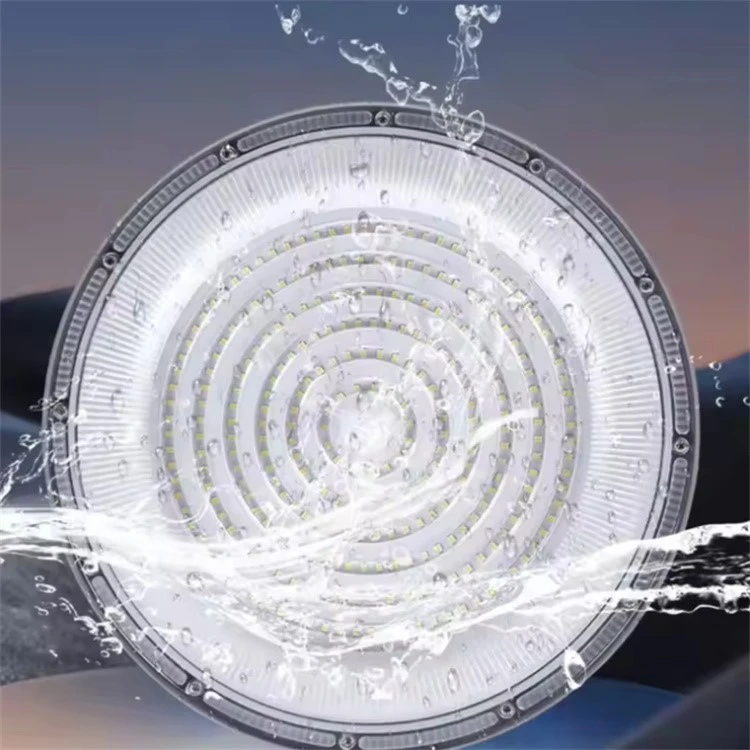
Many people mistakenly believe that fully sealed lamps will affect heat dissipation, but professional industrial lighting design realizes the perfect balance between protection and heat dissipation. This UFO LED high bay light has reached IP66 dustproof and waterproof grade, adopting a fully sealed integral molding process to prevent industrial dust, water mist, and humid air from entering the lamp body. At the same time, the die-cast aluminum heat sink is exposed to the external environment in a targeted manner, ensuring that the heat conduction and dissipation efficiency is not reduced while achieving full protection.
The dust-proof and waterproof structure avoids dust accumulation on the heat sink surface. Dust coverage is an important factor leading to the decline of heat dissipation efficiency of old lamps. Long-term dust accumulation will block the heat dissipation gaps and reduce the heat dissipation effect by more than 50%. The IP66 fully sealed design keeps the heat sink clean permanently, ensuring that the heat dissipation performance remains consistent throughout the entire service life of the lamp.
Data Comparison: Heat Dissipation Difference Determines Service Life Gap
Junction Temperature and Lumen Depreciation Contrast Test
Based on IES TM-21 industry test standards, we conducted a 50,000-hour continuous operation comparison test between premium heat-dissipation UFO high bay lights and ordinary low-end products. The test results show that the premium model maintains an average junction temperature of 58°C during full-load continuous operation. After 50,000 hours of operation, the lumen depreciation rate is only 22%, far lower than the industry L70 failure standard, and the lamp still maintains excellent lighting performance.
In contrast, ordinary low-end UFO high bay lights with semi-plastic and simple heat dissipation structure have an average operating junction temperature of 89°C. Affected by high temperature superposition, the lumen depreciation rate reaches 35% at only 20,000 hours, and the brightness is significantly attenuated. After 30,000 hours, the lumen flux is lower than 70% of the initial value, reaching the service life limit in advance. The test data fully verifies that heat dissipation efficiency is the decisive factor of lamp service life.
Actual Service Life and Maintenance Cost Comparison
In actual industrial application scenarios, the service life gap caused by heat dissipation differences is more intuitive. Premium UFO LED high bay lights with professional thermal management can stably operate for more than 50,000 hours, which is equivalent to 8–10 years of normal industrial shift work. During the period, there is no need for frequent replacement and maintenance, and the lighting brightness remains stable, eliminating the production impact and labor cost loss caused by lamp failure.
Ordinary low-end products need to be replaced in large quantities after 2–3 years of use due to poor heat dissipation and rapid light attenuation. Enterprises not only bear the repeated procurement cost of lamps, but also face hidden dangers such as unstable workshop lighting and sudden light failure affecting production efficiency. From the perspective of long-term ROI, high-quality heat-dissipation high bay lights can save more than 60% of comprehensive lighting operation costs for enterprises.
High-Temperature Environmental Adaptability Comparison
In high-temperature industrial environments such as steel workshops, baking workshops, and summer closed warehouses, the performance gap is further enlarged. When the ambient temperature reaches 60°C, the operating junction temperature of ordinary high bay lights will soar to more than 100°C, and the failure rate increases sharply. While the premium UFO high bay light with optimized heat dissipation structure can control the internal temperature stably, maintain normal luminous efficiency and stable component operation, and adapt to all harsh industrial high-temperature scenarios.
Purchasing Guidance: Focus on Heat Dissipation, Not Only Nominal Parameters
Avoid Misleading Nominal Lifespan Parameters
Most lighting suppliers only mark the nominal 50,000-hour lifespan on product labels, but ignore the core premise of laboratory constant-temperature test conditions. For industrial buyers, the real effective service life of the lamp is the stable working duration in harsh on-site environments, not the theoretical data in the laboratory. Therefore, when purchasing UFO LED high bay lights, it is necessary to prioritize investigating the thermal design structure rather than only focusing on power, brightness, and price.
Core Heat Dissipation Configuration Inspection Standards
Professional industrial lighting procurement needs to focus on three core heat dissipation configurations: first, the full die-cast aluminum integral heat sink structure, reject semi-plastic and thin aluminum sheet inferior structures; second, the radial fin heat dissipation design with enlarged heat dissipation area to ensure efficient air convection; third, the separate thermal isolation structure of light source and drive to avoid heat superposition. These three configurations are the essential guarantees for long service life and low light attenuation of UFO high bay lights.
Long-Term Value Judgment of Thermal Management Technology
Excellent heat dissipation design means lower lumen depreciation, longer service life, lower maintenance frequency, and more stable lighting quality. For industrial enterprises with large-area lighting needs, high-quality heat-dissipation UFO LED high bay lights can realize long-term energy saving and cost reduction. Although the initial procurement cost is slightly higher than that of low-end products, the comprehensive economic benefit within 5–10 years is far better than low-cost and short-life alternative products, which is the most cost-effective industrial lighting solution.
Conclusion
Heat dissipation is the core determinant of the service life and long-term performance stability of UFO LED high bay lights. All premature aging, brightness attenuation, and failure damage of industrial high bay lights are closely related to poor thermal management. The professional full die-cast aluminum radial heat dissipation structure and independent thermal isolation design completely solve the heat accumulation problem of traditional lamps, effectively control the LED junction temperature within the optimal operating range, and realize ultra-low lumen depreciation and 50,000+ hours of ultra-long stable service life.
For industrial and commercial lighting investment, abandoning low-cost products with defective heat dissipation and selecting high-performance UFO LED high bay lights with professional thermal management technology is not only a guarantee of lighting effect, but also a scientific decision to reduce long-term operating costs, improve operational efficiency, and avoid safety hazards. In the field of industrial high-ceiling lighting, excellent heat dissipation capability is the fundamental core competitiveness of high-quality lamps and the key to creating maximum long-term value for users.
How To Cooperate With Us?
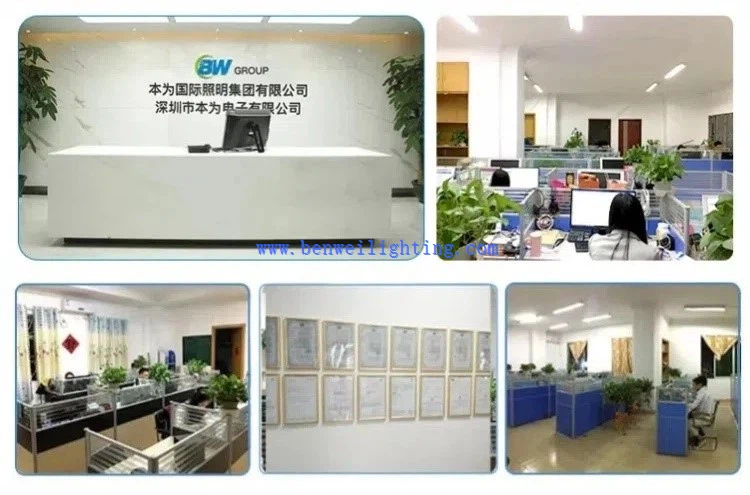
We are happy to have total control over the manufacturing process and the calibre of our products since we have our own facilities. Since we are producers rather than just brokers, we are dedicated to providing our customers with the best pricing. Since we are certain that the price and quality of our products are clear, we invite customers to see our samples first. Our commitment to quality and customer satisfaction drives us to continuously provide top-notch goods.
Our address
3rd Floor, 5th Building, Hebei Industrial Park, Hualian Community, Longhua District, Shenzhen, China





