

What IP65 Actually Means - and Why It Matters More Than the Label Suggests
Ingress protection is the single most reliable predictor of whether a linear lamp will survive in a damp, dusty or wash-down environment. A product called "waterproof" on a seller page is a marketing claim; IP65 is a testable, internationally agreed rating defined by the IEC 60529 standard, and every digit inside that number corresponds to a specific laboratory test the product has passed.
Breaking Down the Two Digits of IP65
The IP code is always two digits. The first digit governs solids; the second governs liquids. Neither can be skipped, and a high water rating does not compensate for a weak dust rating.
A rating of 5 only means "harmful dust deposits" are prevented; some dust may still enter. A rating of 6 means the enclosure is dust-tight: no ingress of dust at all under the standardised dust-chamber test. In cold-storage corridors, flour and grain processing plants, wood workshops, mine tunnels and construction site temporary lighting, fine airborne particles are the slow poison that clogs LED drivers and shortens electronic life. An IP6x shell keeps that contamination out of the PCB, the solder joints and the connector pins, which is the difference between a five-year product and a two-year product in a dusty room.
The second digit "5" means the enclosure has been tested against low-pressure water jets (6.3 mm nozzle, 12.5 L/min, 3 m distance) projected from any direction. It is not a "splash" rating and it is not merely "rain resistant". It survives direct hose wash-down, condensation drip, high-pressure misting and outdoor rainfall combined with wind-driven spray. This is the threshold rating at which a tube can honestly be installed inside a walk-in freezer, above an industrial sink line, in a car wash tunnel, over an aquarium, or under a covered outdoor canopy without a separate sealed luminaire housing.
Why IP65 Is the Practical Sweet Spot, Not Just a Marketing Tier
Ratings below IP65 - typically IP20, IP44 or IP54 - are designed for dry offices, hallways and lightly damp bathrooms. They fail, quietly and predictably, in exactly the environments buyers most need lighting to keep working: refrigerated display cabinets where warm, humid air meets a -25 °C panel and condenses; fish tanks and seafood processing floors with constant splash; brewery and food-prep rooms that are washed down every shift; and covered loading bays where rain and fog work their way into the fixture. IP67 and IP68 exist, but they are typically reserved for submersible or direct-buried equipment and carry a cost premium that is unnecessary for linear indoor and covered-overhead lighting. IP65 is therefore the engineering sweet spot: complete dust protection plus genuine water-jet protection, at a price point that does not require a custom luminaire.
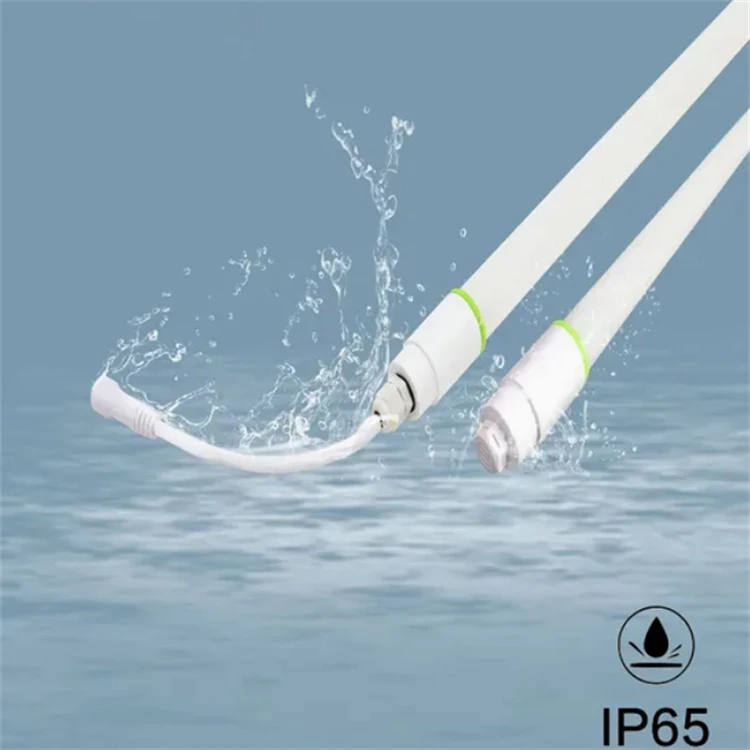
Core Performance Benefits of the IP65 Waterproof T8 LED Tube
Ingress protection alone does not make a good lamp. The optical, thermal and electrical design underneath the sealed housing determines whether the product is merely sealed, or actually productive. The IP65 waterproof T8 LED tube examined here is built around three performance pillars: high-efficacy SMD2835 chips, a wide 85–277 V input range, and an isolated flicker-free driver.
Optical Performance - Bright, Even and Long-Lasting Light
The tube uses surface-mount SMD2835 LED chips arranged along an aluminium or PCB core that doubles as a heat-spreader. Typical system efficacy reaches 130–150 lumens per watt, meaning a 1.2 m 18 W tube delivers roughly the same usable output as a 36 W or 40 W fluorescent T8 while consuming less than half the power. For a supermarket walk-in fridge that runs 24 hours a day, seven days a week, that efficiency gap is not a spec-sheet curiosity - it is the line item that decides whether the lighting retrofit pays back in under two years or never pays back at all.
Unlike narrow, spot-style LED tubes designed for recessed troffers, this waterproof T8 emits over a nominal 330° beam angle. That wide distribution is exactly what linear open fixtures, freezer cabinet tops and walk-in racks need: it washes the entire shelf, floor and aisle without hot spots or dead zones. Buyers can also choose the diffuser that matches the application - a milky frosted PC cover for glare-free, visually comfortable retail and display lighting, or a transparent clear PC cover that maximises raw lumen output for industrial workshops and storage corridors. The cover itself is UV-stabilised, anti-ageing polycarbonate, so it does not yellow, crack or become brittle after years of cold cycling and condensation.
Electrical and Driver Performance
Commercial grids are not uniform. North American facilities run nominally 120 V or 277 V, European and Asian sites run 220–240 V, and many cold-storage facilities suffer brownouts, generator cut-in, or unstable three-phase balance at peak load. A narrow-input LED tube that is factory-tuned to 220–240 V will over-drive itself on a 277 V leg or drop into flicker on a brownout. This tube's universal 85–277 V AC input absorbs the entire single-phase world voltage range and tolerates the sags and surges that accompany refrigeration compressor start-up - a common failure source for cheap waterproof tubes installed next to cold-room racking.
Two technical choices inside the housing separate a durable waterproof tube from a cheap one. The first is an isolated constant-current driver: it actively regulates current to the LED array regardless of mains fluctuation, which protects the chips from current spikes that accelerate lumen decay. The second is no visible low-frequency flicker. In a freezer where staff spend entire shifts inside, or in a food-processing line where visual inspection is critical, 100–120 Hz stroboscopic light causes eye fatigue, headaches and inspection errors. A flicker-free driver is not a comfort feature; it is a productivity and workplace-safety feature.
Water ingress is not the only failure mode. Lightning-induced line surges, refrigeration contactor switching and phase imbalance can each destroy an unprotected driver. The isolated driver topology, combined with flame-retardant PVC wiring and sealed cable glands, absorbs and suppresses these transients and isolates any fault to a single tube rather than tripping an entire circuit - a detail that matters a great deal when the circuit in question sits inside a -25 °C freezer and an emergency replacement requires thermal PPE.
Service Life, Light Depreciation and Total Cost of Ownership
The most expensive number on a lamp datasheet is not watts or lumens; it is hours. A tube that costs two dollars more to buy but runs five times longer wins every financial comparison, and that gap widens sharply in harsh environments where lamp replacement is genuinely inconvenient.
A 50,000-Hour Rated Life Under Normal Operating Conditions
Under rated ambient conditions, the IP65 waterproof T8 LED tube is rated at up to 50,000 hours. At 12 hours of operation per day, that is more than 11 years of service; in a 24/7 cold-room application, it still exceeds five years. Traditional fluorescent waterproof tubes typically last 10,000–15,000 hours and fail even earlier in cold conditions because fluorescent cathodes struggle to strike at sub-zero temperatures. A buyer retrofitting a 100-tube freezer therefore avoids, conservatively, three to four complete rounds of lamp replacement - each round involving labour, freezer defrost time, ladder work and disposal of mercury-containing glass.
Controlled Thermal Management and Slow Lumen Depreciation
Lumen decay - the gradual dimming of an LED array - is governed almost entirely by junction temperature. The sealed waterproof housing is, paradoxically, a thermal design challenge: water protection and heat rejection compete inside the same shell. This product addresses it by routing heat through the internal aluminium structure to the ends of the tube where the sealed end caps can dissipate it, and by selecting SMD2835 chips with a proven long-tail depreciation curve. The result is slow lumen loss across the early and middle years of life, rather than the abrupt burn-out pattern of cheap replacement tubes. Brightness stays stable year after year; the buyer does not enter year three of a five-year maintenance contract only to discover the facility is half as lit as it was on day one.
The Total-Cost-of-Ownership Picture
Comparing an IP20 office LED tube, a generic IP54 "waterproof" tube and a genuine IP65 waterproof T8 LED tube across a typical 200-tube, 24/7 freezer installation makes the value proposition concrete. All three may look similar on a product page; the five-year numbers are not even close.
|
Five-year factor |
Ordinary IP20 LED tube |
Generic IP54 tube |
Genuine IP65 waterproof T8 |
|---|---|---|---|
|
Rated life |
25,000–30,000 h |
20,000–30,000 h in damp use |
Up to 50,000 h |
|
Replacement rounds in 5 years (24/7) |
3–4 |
2–3, often early failures from condensation |
0–1 |
|
Condensation / splash resistance |
None; water ingress kills the driver |
Limited; fine splashes and dust may enter |
Dust-tight, water-jet resistant from any direction |
|
Maintenance labour & freezer downtime |
High; frequent call-outs |
Medium; warranty disputes common |
Very low; predictable, planned service |
|
Typical payback vs. fluorescent baseline |
Not recommended in wet/cold areas |
Uncertain |
Under 2 years in 24/7 cold-room use |
The table makes the strategic point plainly: in a dry office, an IP20 tube is a fine choice. In a wet or cold environment, selecting on purchase price alone guarantees the second-cheapest decision - because the cheapest lamp gets re-bought, repeatedly, at the most inconvenient possible moment.
Application-Scene Benefits - Where the IP65 Tube Earns Its Keep
The engineering described above matters most when it is matched to a real operating environment. Four application categories account for the large majority of bulk purchases of this product type, and each stresses a different part of the IP65 design.
Cold Storage, Walk-In Freezers and Refrigerated Display Cabinets
Cold rooms are the harshest mainstream lighting environment in commerce. Inside, temperatures sit between 0 °C and -30 °C; every time the door opens, warm, humid air rushes in and condenses on the coldest surfaces - which are often the lights. Ordinary tubes corrode, leak current, or simply fail to strike on a frosty morning. The IP65 sealed housing prevents condensation from reaching the driver, the wide 85–277 V input survives the large voltage dip when rack compressors start, and the 50,000-hour life removes the annual ritual of sending staff into a -25 °C box on a ladder to change lamps. For supermarket refrigerated display cabinets, the wide 330° distribution and choice of frosted diffuser also means merchandise is evenly lit without glare on the cabinet glass.
Wet Workshops, Car Wash Bays and Aquariums
Car wash tunnels, seafood processing floors, brewery wash-down zones and aquarium rooms share one trait: water is not an occasional hazard, it is the medium the room is built around. IP65's resistance to water jets from any direction is what allows the fixture to be mounted directly in these spaces without a separate IP65 enclosure. The flame-retardant PVC power cord and sealed waterproof cable gland maintain the rating all the way from the tube end to the junction box, so the weakest point of a cheap "waterproof" light - the gland - does not become the failure point.
Covered Outdoor Walkways, Canopies and Bathrooms
Covered loading bays, sheltered corridors, parking canopies and public shower areas expose fittings to rain, fog, temperature cycling and vandalism dust. Here the IP65 rating plus the UV-stabilised PC cover means the tube stays optically clear and electrically safe for years, while the wide-voltage input tolerates the less stable grid typical of a building's exterior circuits. In bathrooms and changing rooms, the sealed shell also eliminates the corrosion pattern that turns cheap tubes into yellowed, flickering eyesores within a single winter.
Installation and Logistics Benefits That Cut Project Costs
A product that performs well but takes three electricians a day to install is still a bad investment. The IP65 waterproof T8 LED tube is deliberately designed to minimise on-site labour - the single largest line item in most commercial lighting retrofits.
Single-End Power and Daisy-Chain Series Connection
The tube uses a single-end power feed and ships with a matched waterproof interconnect cable, so multiple units can be daisy-chained in series along a rack, shelf run or freezer length. Instead of running a dedicated conduit back to a junction box for every lamp, the installer runs one feed and links the tubes end to end. For a 20-tube refrigerator aisle or a 50-metre aquarium rim, this can cut installation time by more than half and reduces the number of penetration points into a sealed cold room - which is where condensation almost always begins.
Direct Retrofit Into Existing T8 Fixtures
The form factor is a standard T8 tube. Where the existing luminaire is a shunted, single-end or bi-pin weatherproof holder, the tube drops in after fluorescent starters and ballasts are removed or bypassed. No new luminaire, no special bracket, no architectural modification. That retrofit simplicity is what allows a supermarket chain to convert a distribution centre overnight, or a food processor to upgrade a wash-down line during a single scheduled shutdown, rather than staging a multi-week capital project.
Globally Compatible Voltage and Safety Materials
Because the input range covers 85–277 V, a distributor can stock one SKU and serve the North American 120/277 V market, the European 230 V market and the Asian 220/240 V market from the same inventory. The housing and wiring use flame-retardant materials with no mercury or hazardous phosphor, which simplifies end-of-life disposal and allows the product to satisfy increasingly strict environmental procurement clauses in corporate and public tenders.
A Buyer's Checklist - What to Verify Before You Order
Not every product labelled "IP65" on a listing is built to the same standard. A professional buyer should confirm the following line items at quotation stage, because each one is a known failure point in cheap alternatives.
Verify the actual IP rating test report. Ask for the IP65 test certificate, not a self-declaration. Confirm the test covers both dust (6) and water jets (5), and that the cable gland and end cap are included in the test.
Confirm the driver topology. An isolated constant-current driver with surge protection is materially more durable than a non-isolated capacitor-drop or non-isolated buck design, especially on unstable grids.
Check the rated life and the L70 claim. A 50,000-hour figure should be backed by an LM-80 style lumen-maintenance statement; ask whether the number is L70 (70% output retained) or a less rigorous "end of life" definition.
Confirm the input voltage range. A genuine 85–277 V universal input is a real engineering cost; products that claim it without qualification are often the first to fail on brownout or generator load.
Ask about the daisy-chain cable and gland. The waterproof rating of a system is only as strong as its weakest connector. Confirm that the interconnect cord, gland and end cap all carry the same rating.
Validate the cold-weather claim. If the lamp is destined for a freezer, ask the supplier to confirm low-temperature start-up and continued operation rather than relying on a generic "IP65" label.
Conclusion - The Right Lamp for the Room That Will Not Stay Dry
The business case for an IP65 rated waterproof T8 LED tube is not emotional and it is not about aesthetics. It is a measurable reduction in lamp replacements, labour call-outs, freezer downtime and energy spend, combined with a provable guarantee that the fitting will keep working in the one environment - wet, cold, dusty, washed-down - where ordinary lights cannot. With high-efficacy SMD2835 chips, a 330° wide beam, a universal 85–277 V input, an isolated flicker-free driver, sealed dust-tight and water-jet-proof construction, a daisy-chain single-end wiring scheme, and a 50,000-hour service life, this category of lamp converts what used to be a recurring maintenance headache into a nearly invisible five-year asset. For cold-chain operators, food and beverage processors, car wash operators, aquarium designers, facility managers and lighting contractors specifying a real-world wet or cold application, the question is no longer whether to pay the small premium for IP65 - it is how many sites can be upgraded before the next winter maintenance cycle begins.
How To Cooperate With Us?
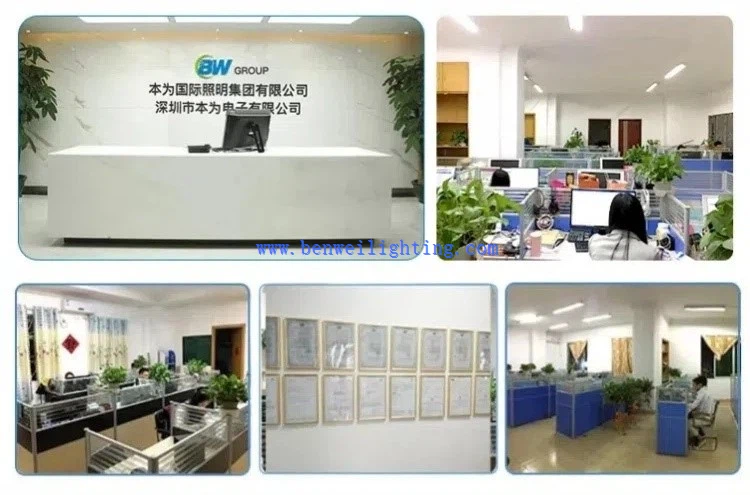
We are happy to have total control over the manufacturing process and the calibre of our products since we have our own facilities. Since we are producers rather than just brokers, we are dedicated to providing our customers with the best pricing. Since we are certain that the price and quality of our products are clear, we invite customers to see our samples first. Our commitment to quality and customer satisfaction drives us to continuously provide top-notch goods.
Our address
3rd Floor, 5th Building, Hebei Industrial Park, Hualian Community, Longhua District, Shenzhen, China





