

Introduction: The Photobiological Foundations of Poultry Growth
Lighting in a modern poultry house is far more than a mere utilitarian necessity; it is a profound biological stimulus that dictates the endocrine and metabolic trajectory of the flock. To achieve maximum growth, one must first understand the intricate science of avian photobiology.
The Avian Endocrine Response to Light
The avian visual and extra-retinal systems are highly evolved. Light penetrates the skull and is absorbed by the hypothalamus, a region of the brain responsible for regulating the autonomic nervous system and endocrine function. This stimulation controls the pineal gland, which secretes melatonin (a sleep-inducing hormone), and the anterior pituitary gland, which releases growth hormones and gonadotropins. Proper light duration (photoperiod), intensity, and spectral quality ensure that the birds' metabolic energy is directed toward somatic growth (muscle and bone development) rather than stress responses or reproductive inefficiency.
The Economic Imperative: Feed Conversion Ratio (FCR)
In poultry production, the Feed Conversion Ratio (FCR) is the ultimate metric of profitability. It measures how efficiently a bird converts feed into body mass. Poor lighting induces physiological stress, elevated corticosterone levels, and increased physical activity (such as pacing or feather-pecking), all of which burn caloric energy that should otherwise be directed toward growth. Conversely, a scientifically optimized lighting environment reduces stress, calms the flock, and encourages resting and eating, thereby significantly improving the FCR.
The Shift to Advanced LED Technology
Legacy lighting systems, such as incandescent and fluorescent bulbs, are fundamentally inadequate for modern growth optimization. They emit high levels of radiant heat, flicker at frequencies that cause chronic stress, and lack the spectral accuracy required for natural visual perception. The modern paradigm demands LED lighting, but specifically, those engineered with high CRI, stable isolated drivers, and advanced diffusion.
The Science of High CRI in Poultry Environments
The Color Rendering Index (CRI) is a quantitative measure of a light source's ability to reveal the true colors of objects in comparison to a natural light source. While human-centric lighting often targets a CRI of 80-90, the application of High CRI in poultry farming has profound biological and behavioral implications.
Avian Tetrachromatic Vision
To understand why CRI matters, one must first recognize that chickens are not humans. Avian species possess tetrachromatic vision, meaning they have four types of cone cells in their retinas (compared to the three in humans). Additionally, they possess oil droplets in their photoreceptors that filter light, allowing them to perceive a broader spectrum of colors, including ultraviolet light.
Visual Acuity and Foraging Behavior
A light source with a low CRI distorts the natural appearance of the environment. In a low-CRI lighting system, feed pellets may blend visually with the litter (shavings, rice hulls, or dirt), making it difficult for the bird to locate food. A high-CRI LED system accurately renders colors, creating a stark visual contrast between the feed and the floor. This enhanced visual acuity directly stimulates active foraging, leading to more consistent and higher feed intake across the entire flock.
Reducing Stress through Accurate Spectral Rendering
Stress is a hidden inhibitor of growth. A high-CRI light mimics natural daylight, providing a visually comfortable and biologically appropriate environment. When birds are visually comfortable, they exhibit fewer stress-induced behaviors such as aggressive pecking, cannibalism, and huddling. A calm flock directs more energy toward nutrient absorption and muscle deposition.
The Product Engine: High Lumen LED PCB
To deliver high CRI, the LED chips themselves must be of superior quality. The featured product utilizes a High Lumen LED PCB densely populated with premium, high-CRI chips.
Thermal Management for Lumen and Color Stability
A critical but often overlooked aspect of high-CRI LEDs is thermal management. As LEDs heat up, their color spectrum can shift (color shift), and their lumen output can degrade (lumen depreciation). The use of an aluminum-backed PCB in this product ensures "good dissipation." By rapidly pulling heat away from the LED junctions, the PCB ensures that the light maintains its high CRI and intense brightness over thousands of hours of operation, without degrading into a yellowish or dim light.
Engineering for Maximum Growth: Beyond CRI
While high CRI is crucial, it must be delivered through a stable and safe electrical architecture. Inconsistent power supply leads to flickering, which is scientifically proven to elevate stress hormones and reduce growth rates.
The Isolated Driver: The Heart of Stable Illumination
The driver is the power supply that converts high-voltage AC electricity into the low-voltage DC power required by the LEDs.
Safety and Flicker-Free Operation
Many budget agricultural lights utilize non-isolated drivers, which pose a significant shock hazard, especially in damp environments, and are highly susceptible to voltage fluctuations. The featured product utilizes an isolated driver. This engineering design physically separates the high-voltage input from the low-voltage output via a transformer.
Eliminating the Stress of Flicker
An isolated driver delivers a highly stable, constant current. This eliminates the stroboscopic flicker inherent in cheaper LEDs and legacy fluorescent tubes. While humans may not perceive this flicker, the avian eye is far more sensitive. Flicker-free lighting prevents chronic psychological stress, reduces aggressive behaviors, and promotes deep, restorative rest. A well-rested flock exhibits superior weight gain and optimal FCR.
High-Efficiency PC Diffusion Cover: Uniform Light Distribution
Direct, unshielded LED chips produce harsh glare and sharp shadows. In a poultry house, uneven lighting causes birds to congregate in the brightest areas, leading to localized crowding, heat buildup, and smothering.
Light Scattering for Optimum Comfort
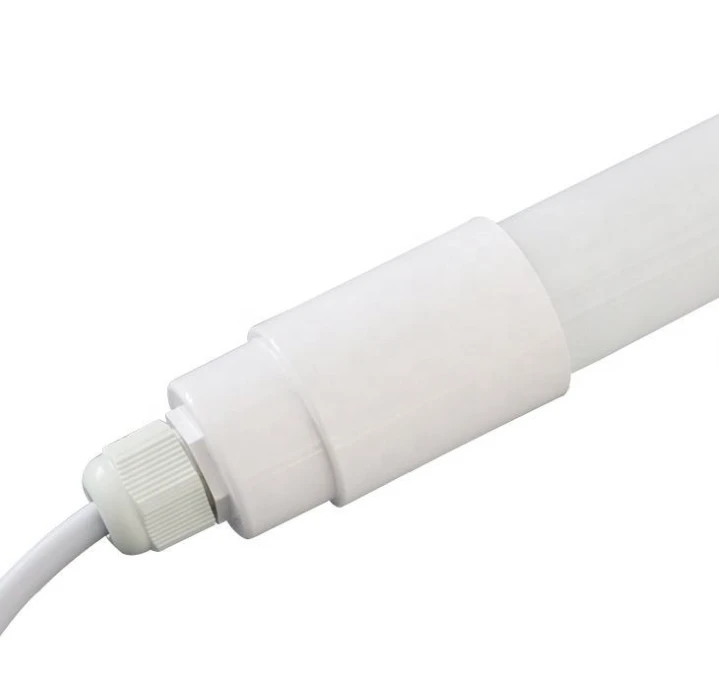
The featured light uses a High Efficiency PC (Polycarbonate) diffusion cover. This specialized frosted casing acts as a sophisticated lens. It scatters the directional light, transforming it into a soft, uniform wash of illumination across the entire coop floor. This uniform distribution ensures that every bird has equal access to well-lit feed and water, resulting in a uniformly sized and healthy flock.
Biosecurity and Scalability: Operationalizing the Lighting System
A lighting system designed to maximize growth must also survive the hostile environment of a commercial poultry house. Humidity, ammonia, and sanitation chemicals quickly destroy standard electrical equipment.
Absolute Waterproofing for Biosecurity
The environment of a chicken coop is corrosive. Ammonia gas from manure dissolves into moisture to create a corrosive electrolyte that attacks metal components.
Waterproof Base and Silicone Gland
To prevent moisture ingress and electrical failure, the featured light utilizes a specialized waterproof base at the cable entry point. This features a heavy-duty, threaded cable gland that compresses a medical-grade silicone seal around the power cord. This creates an airtight, watertight barrier. It allows the farmer to perform high-pressure washdowns between flocks without damaging the lights, ensuring maximum biosecurity and disease prevention.
Double-End Waterproof Connectors
Furthermore, the light features Double End Wires with molded male and female waterproof connectors. When daisy-chaining multiple lights together, these connectors form a seamless, watertight seal, eliminating the need for exposed junction boxes that are notorious for corroding in agricultural environments.
Cost-Effective Scalability and Installation
The unique double-end daisy-chain design allows multiple lights to be connected end-to-end from a single power drop. This significantly reduces the cost of copper cabling, conduit, and electrical labor. It creates a clean, organized ceiling environment that is easier to sanitize and less prone to dust accumulation.
Strategic Implementation for Optimal Yield
To harness the full biological potential of high-CRI, flicker-free LED lighting, installation must be strategic.
Proper Placement and Lux Management
Lighting should be suspended parallel to the feeding lines. The height and spacing should be calculated to deliver the optimal lux levels:
Broilers (Days 1-7): 30-40 lux (to encourage early feed intake and establish feeding patterns).
Broilers (Days 8-Harvest): 5-10 lux (to promote rest, reduce activity, and maximize FCR).
Layers: 10-20 lux (to maintain consistent egg production without inducing stress).
Photoperiod Control
The stable, isolated driver allows for seamless integration with dimming systems. Farmers must utilize photoperiods tailored to the specific breed and growth stage. For example, a common broiler program is 18 hours of light and 6 hours of dark, ensuring adequate feed intake while allowing the birds to rest.
Conclusion: The Definitive Investment in Flock Potential
The pursuit of maximum growth and optimal Feed Conversion Ratios in modern poultry farming demands a lighting system that is as biologically sophisticated as the birds themselves. High CRI is not a luxury; it is a biological necessity that allows birds to accurately identify feed, forage effectively, and maintain low stress levels.
The featured waterproof, double-end wired LED poultry tube represents the pinnacle of this technological evolution. By integrating a High Lumen LED PCB for superior color rendering and thermal dissipation; a High-Efficiency PC diffusion cover for uniform, glare-free light distribution; an Isolated Driver for safe, flicker-free power; and a robust waterproof design with silicone glands and molded connectors, this system delivers a comprehensive solution.
Investing in this advanced lighting technology is a direct investment in the productivity and profitability of your poultry farm. It ensures that every bird receives the precise spectral environment required to thrive, resulting in faster growth cycles, better feed efficiency, and a safer, more biosecure agricultural operation.

Shenzhen Benwei Lighting Technology Co., Ltd
Shenzhen Benwei Lighting Technology Co., Ltd is a well-known company that designs, develops, makes, and sells high-tech goods, including LED lighting products. The plant where we work opened in 2010 and is in Shenzhen.
Our address
3rd Floor, 5th Building, Hebei Industrial Park, Hualian Community, Longhua District, Shenzhen, China





