

Introduction: The Unforgiving Reality of Humid Industrial Environments
The Invisible Adversary: Moisture and Corrosives
In a typical general warehouse, lighting is subjected to ambient dust and normal temperatures. However, a humid factory environment is a relentless assault on luminaire integrity. In food and beverage processing facilities, fixtures are exposed to daily high-pressure chemical washdowns. In chemical plants and coastal warehouses, airborne salt and acidic vapors aggressively attack any exposed metal. In foundries and steel mills, the air is laden with conductive metallic dust that, when combined with high ambient humidity, creates a highly conducive environment for electrical short circuits.
Standard commercial-grade LED high bays are not built to withstand these conditions. When moisture infiltrates a standard fixture, it does not merely cause a nuisance. It deposits condensation on the PC lens, blocking light output. More critically, it reaches the printed circuit board (PCB), bridging fine-pitch LED solder joints and triggering electrolytic corrosion. This leads to catastrophic failure, flicker, or, in worst-case scenarios, electrical arcing and fire hazards.
The Hidden Costs of Lighting Failure
The financial impact of lighting failure in a harsh environment extends far beyond the cost of replacing the fixture. High-bay lighting is typically mounted at elevations between 10 and 15 meters. The labor required to replace a failed unit involves certified electricians, the rental of scissor lifts or bucket trucks, and the disruption of adjacent production lines. Industry data consistently reveals that the labor, equipment, and downtime costs of replacing a single high-bay fixture can be three to five times the original purchase price of the luminaire. When a facility deploys cheap, non-waterproof fixtures that fail every two to three years, they are locking themselves into a perpetual cycle of operational disruption and financial loss.
Redefining the Standard: More Than Illumination
To achieve true reliability in a hostile environment, a high bay light must be engineered as a sealed, hardened system, not merely a light source. The transition from "standard" to "premium waterproof" requires a fundamental redesign of material science, structural engineering, and thermal management. This specific UFO High Bay Light answers this call, engineered to deliver uncompromised illumination while remaining completely impervious to the most extreme environmental stressors.
The Anatomy of Environmental Failure: How Moisture Destroys Luminaires
The Mechanisms of Ingress and Condensation
Moisture ingress is rarely a singular, sudden event. In industrial environments, it occurs through three primary pathways:
Direct Spray: High-pressure washdowns in food processing directly target fixtures, forcing water through the smallest gaps in poorly sealed gaskets.
Capillary Action: Dust and debris accumulate on the fixture's surface. When humidity rises, moisture is drawn into the fixture's internal cavities via capillary action along wire entries and seams.
Thermal Pumping (Breathing): As the LED fixture heats up during operation and cools down after shutdown, the air inside the fixture expands and contracts. If the seals are not perfectly airtight, this "breathing" effect literally pumps humid ambient air into the driver compartment and optical cavity. When the fixture cools, the moisture condenses on the electronic components.
The Consequences: Electrolytic Corrosion and Lumen Degradation
Once moisture is inside, the destruction begins. The combination of DC electrical current and water creates an electrolytic reaction that rapidly corrodes copper traces on the PCB. This leads to open circuits, flickering, and eventual luminaire death. In the optical cavity, condensed moisture clouds the lens and can cause the phosphor layer on the LED chips to degrade, resulting in a severe drop in luminous flux and a shift in color temperature.
The Imperative of Passive Thermal Management in Sealed Fixtures
To prevent moisture ingress, a fixture must be completely sealed. However, sealing a high-wattage LED fixture creates a massive thermal challenge. If the housing is sealed, how does the immense heat from the LED array and the driver escape?
Budget manufacturers often circumvent this by adding fans and air vents. In a harsh environment, this is a fatal design flaw. Fans inevitably draw in dust, grease, and moisture, leading to clogged filters, seized bearings, and severe contamination. The only acceptable solution is passive thermal management-a hermetically sealed housing that dissipates heat entirely through conduction and natural convection.
High-Strength Waterproofing: The Engineering of Invulnerability
Structural Integrity: The Integrated Die-Cast Aluminum Shell
The foundation of high-strength waterproofing is the physical rigidity of the housing. Budget fixtures frequently use stamped steel or thin plastics, which flex under mechanical stress or thermal expansion. This flexing breaks the seal between the lens and the housing, allowing water to enter.
This UFO High Bay Light utilizes an Integrated Die-Cast Aluminum Shell. The one-piece, monolithic casting provides exceptional structural rigidity. ADC12 die-cast aluminum is dense, pressure-resistant, and highly resistant to warping. Because the housing is a single continuous piece, there are zero seams or bolted joints where water can penetrate. The precision-machined mating surfaces ensure that the lens and the housing fit together with microscopic tolerances, providing an impenetrable barrier against high-pressure water jets.
Sealing Mechanics: Industrial-Grade Gaskets and Fasteners
While the housing provides the rigidity, the gaskets provide the actual seal. The fixture utilizes high-grade, industrial silicone gaskets. Unlike cheap rubber, which degrades and cracks under UV exposure and temperature extremes, silicone retains its elastomeric properties across a vast range of temperatures (-50°C to 200°C). The precise compression of this gasket, secured by uniformly torqued stainless steel screws, guarantees a hermetic barrier. The use of stainless steel fasteners is critical; ordinary screws would rust and fail in a humid environment, compromising the seal.
Material Resilience: Anti-Corrosion Surface Treatment
In coastal or chemical environments, the aluminum housing itself must be protected from oxidation and chemical etching. This fixture undergoes a rigorous multi-stage pre-treatment process, followed by an electrostatically applied, oven-cured powder coat. This finish creates a chemically inert, highly durable barrier that withstands salt fog testing (ASTM B117) and resists caustic cleaning agents. This ensures the structural integrity and thermal properties of the heat sink remain intact for decades, even in the most corrosive atmospheres.
Achieving the IP65/IP67 Standard
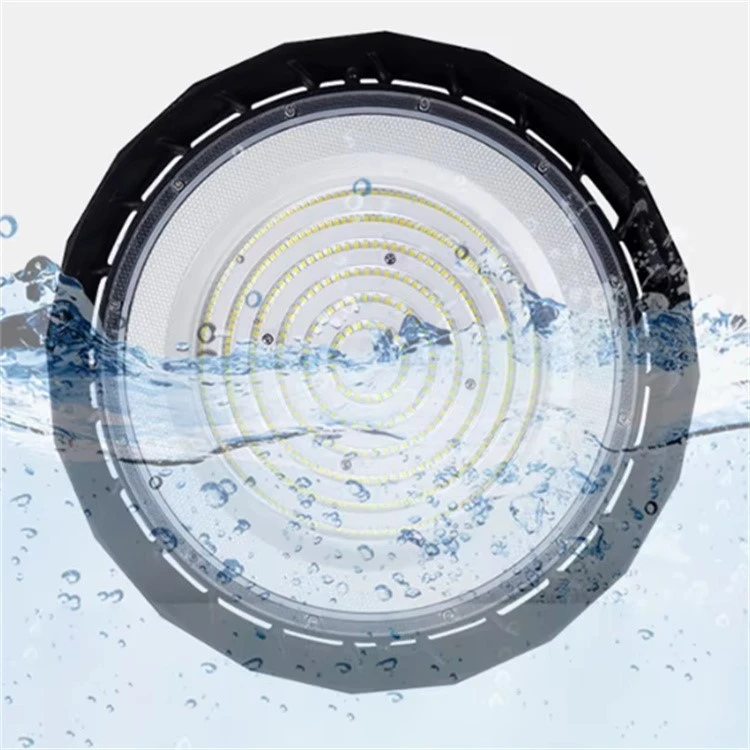
Through the combination of monolithic die-cast aluminum, silicone gaskets, and secure fasteners, the fixture achieves a stringent IP65 or IP67 rating. IP65 guarantees total protection against dust ingress and protection against low-pressure water jets from any direction. IP67 denotes complete protection against dust and immersion in water up to 1 meter. This means the fixture can withstand high-pressure washdowns and torrential environmental conditions without any internal compromise.
The Thermal Paradox: How a Sealed Fixture Cools Itself
The Physics of Natural Air Convection Cooling
A completely sealed fixture must rely on conduction and natural convection. The integrated die-cast aluminum body is the engine of this thermal process. With a thermal conductivity of approximately 96-120 W/m·K (more than double that of steel), the aluminum rapidly absorbs heat from the LED board and the driver.
To dissipate this heat into the ambient air, the exterior is engineered with deep radial fins. These fins create a massive surface area for heat exchange. As the hot aluminum heats the surrounding air, the air becomes less dense and rises. Cooler ambient air rushes in to replace it, creating a continuous, self-sustaining cycle of passive air convection cooling.
The Chimney Effect: Maximizing Airflow in a Slim Profile
The specific UFO architecture amplifies this cooling effect through the Chimney Effect. The center of the fixture features a hollow cavity. The heat generated by the driver-mounted at the core-rises rapidly through this chimney. As the hot air exhausts out the top, it creates a low-pressure zone at the perimeter, forcefully pulling cool ambient air across the radial fins from the bottom and sides.
This design achieves heat dissipation efficiency comparable to active cooling, but with zero moving parts. It cannot be clogged by dust, and it does not require unfiltered air intake, preserving the waterproof seal.
The Consequences of Inadequate Cooling
If a waterproof fixture lacks this advanced thermal architecture, the heat cannot escape. The LED junction temperature rises dramatically, causing rapid lumen depreciation and driver failure. The premium thermal design of this UFO High Bay ensures that the waterproofing does not come at the cost of thermal degradation.
Core Components Engineered for Hostile Environments
The Philips Driver: The Electrical Fortress
In a sealed, harsh environment, the driver is completely isolated, making its internal quality paramount. This fixture is powered by a Genuine Philips Drive Power Supply. Philips drivers are renowned for their reliability, featuring a Mean Time Between Failures (MTBF) exceeding 100,000 hours. They are equipped with robust surge protection (4-6 kV) to withstand the electrical transients common in industrial grids. The driver's high Power Factor (PF ≥ 0.95) and low Total Harmonic Distortion (THD < 20%) ensure stable, efficient power delivery, preventing the electrical stress that leads to component failure.
The Polycarbonate Lens: Optical Clarity and Impact Resistance
The optical lens must protect the LEDs while maintaining maximum light transmission. Polycarbonate (PC) is selected for this harsh environment over PMMA or glass. PC boasts exceptional impact resistance (250 times that of glass) and a high thermal tolerance (up to 130°C). It is UV-stabilized to prevent yellowing and degradation under prolonged exposure to the LED light and environmental UV. The micro-structured surface of the lens ensures uniform light diffusion, eliminating glare and preventing the "hot spot" effect that causes eye fatigue.
The Circular LED Array: Distributing Heat and Light
The LED chips are arranged in a Circular Array across multiple concentric rings. This is not an aesthetic choice; it is an engineering necessity. By distributing the chips, the heat generation is spread over a larger area, preventing the central heat concentration that accelerates LED degradation. The circular array also behaves as a large surface emitter, delivering highly uniform illuminance to the factory floor, improving safety and visual acuity for workers.
The Procurement Framework: Calculating True Value
Escaping the "Lowest Initial Bid" Trap
When specifying lighting for a harsh environment, the procurement decision must shift from unit price to Total Cost of Ownership (TCO). A standard high bay that costs $100 but fails in 18 months incurs hundreds of dollars in labor and equipment costs to replace, not to mention the disruption to operations. A premium waterproof high bay, backed by a genuine Philips driver and an integrated die-cast aluminum housing, is designed to operate maintenance-free for 10+ years.
Verifying the Manufacturer's Claims
To ensure the fixture will survive the environment, buyers must demand verifiable data:
IP Test Reports: Look for official IP65 or IP67 certification from accredited laboratories.
Driver Authenticity: Insist on the specific Philips driver model number and check its datasheet for surge protection ratings.
Material Verification: Confirm the housing is integrated die-cast aluminum (ADC12), not stamped steel or plastic.
LM-79 and LM-80 Reports: Verify the actual lumen output, efficacy (lm/W), and the L70/L80 lifespan projections.
The Financial Case for Premium Waterproofing
The initial investment in a high-waterproof high bay is quickly amortized through:
Elimination of Maintenance Costs: No lift rentals, no electrician fees, no downtime.
Energy Savings: True full-wattage operation with a high power factor minimizes utility costs.
Safety and Compliance: Eliminating electrical hazards from water ingress ensures compliance with stringent OSHA and facility safety regulations.
Productivity: Consistent, flicker-free, high-CRI illumination improves worker morale, reduces errors, and boosts overall efficiency.
Conclusion: Illumination as an Engineered Asset
In harsh, humid factory environments, a light fixture is subjected to chemical, thermal, and electrical stresses that would destroy standard commercial products. The concept of "More Than Just Illumination" is not a marketing slogan; it is a fundamental engineering mandate.
This UFO High Bay Light answers that mandate by combining the structural invulnerability of an Integrated Die-Cast Aluminum Shell, the hermetic sealing of industrial-grade gaskets, the electrical reliability of a Philips Drive Power Supply, and the advanced thermal management of Air Convection Cooling. It delivers high-strength waterproofing without sacrificing light output or longevity.
For the facility manager or procurement officer, investing in this level of engineering is a commitment to operational continuity. It is the definitive choice to banish the cycle of frequent replacements, ensuring that the factory floor remains brilliantly lit, safe, and productive for decades to come.
How To Cooperate With Us?
We are happy to have total control over the manufacturing process and the calibre of our products since we have our own facilities. Since we are producers rather than just brokers, we are dedicated to providing our customers with the best pricing. Since we are certain that the price and quality of our products are clear, we invite customers to see our samples first. Our commitment to quality and customer satisfaction drives us to continuously provide top-notch goods.
Our address
3rd Floor, 5th Building, Hebei Industrial Park, Hualian Community, Longhua District, Shenzhen, China





