

Introduction: The Evolving Demands of Modern Warehousing
The New Reality of Warehouse Operations
Warehouses are no longer simple storage spaces; they are high-velocity fulfillment centers. The rise of e-commerce has led to the construction of taller racking systems (often exceeding 12 to 15 meters), narrower aisles, and the deployment of automated guided vehicles (AGVs). In this high-density environment, lighting must be exceptional. It must deliver high vertical and horizontal illuminance, eliminate shadows within racking, and provide a safe, visually comfortable environment for workers and automated machinery alike.
The Limitations of Legacy and Conventional High Bays
For decades, facilities relied on metal halide fixtures or early-generation LED high bays. These traditional fixtures are characterized by bulky, heavy housings, large external heat sinks, and clustered light sources. They present several operational drawbacks: they are heavy (increasing structural load), difficult to transport and install, and often produce a harsh "hot spot" of light directly below the fixture, leaving aisles dimly lit. Furthermore, their heavy mass often traps heat or relies on passive airflow that is easily choked by warehouse dust.
The Paradigm Shift: Ultra-Thin Circular Architecture
In response to these challenges, a new standard has emerged: the Ultra-Thin Circular High Bay Light. According to recent industry trend analyses, this specific form factor is capturing an increasing share of the industrial lighting market. Why? Because it resolves the paradox of achieving massive light output and superior thermal management within a sleek, lightweight, and easily manageable profile. This article unpacks the engineering and business reasons behind this widesp
Structural Logistics: The Advantages of the Ultra-Thin Form Factor
Reducing Ceiling Load and Structural Stress
Warehouse roofs, particularly in older facilities, have strict load-bearing limits. Conventional LED high bays with heavy, multi-piece die-cast or stamped steel housings can add significant weight to the structural grid. Over hundreds of fixtures, this weight accumulates. The ultra-thin design utilizes an optimized material distribution, drastically reducing the weight per fixture. This reduces structural stress on the building, eliminates the need for costly roof reinforcements, and ensures compliance with building codes.
Streamlining Installation and Maintenance Logistics
The logistics of warehouse lighting are heavily influenced by the physical profile of the fixture.
Shipping and Handling: Ultra-thin fixtures require significantly less packaging volume and are easier to handle on-site.
Installation: A lighter, slimmer fixture is easier to hoist up to high ceilings. It allows technicians to work faster and with less physical strain.
Maintenance Access: In high-bay environments, accessing the fixture for maintenance is expensive. The slim profile allows for easier visual inspection and simplifies the process of replacing components (should the need ever arise).
Aesthetic and Spatial Integration
While aesthetics may seem secondary in a warehouse, the visual bulk of traditional fixtures can make high-density spaces feel oppressive. The ultra-thin, circular "UFO" design blends seamlessly into the ceiling architecture. Its sleek black or dark housing reduces glare and visual clutter, creating a cleaner, more modern working environment.
The Optical Superiority of the Circular LED Array
Eliminating the "Hot Spot" with Uniform Illuminance
One of the most critical flaws of budget or conventional fixtures is the clustered LED array. By placing dozens of chips in the center, manufacturers create a blinding intensity directly below the fixture, while the spaces between the racking remain dark.
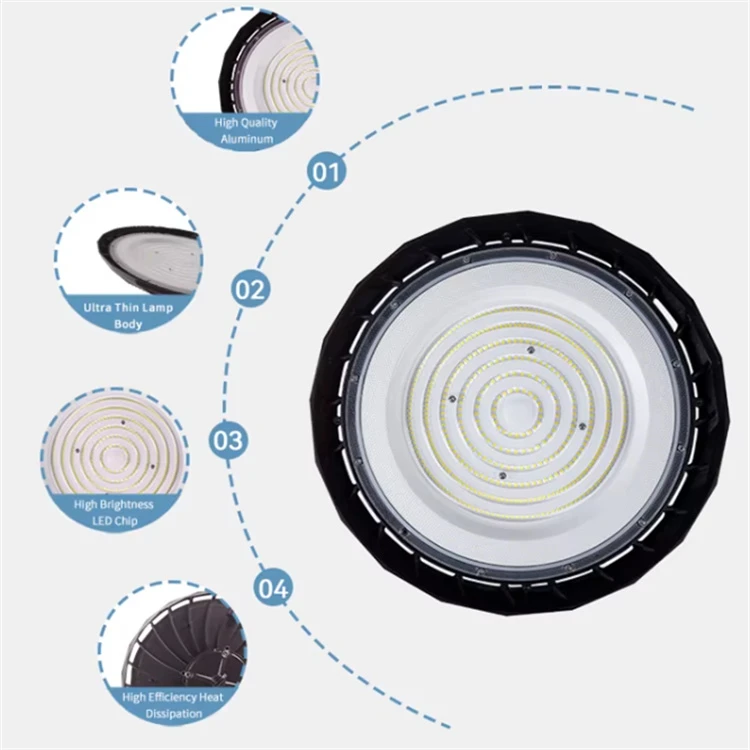
The Circular LED Chip Array solves this by distributing the light sources across multiple concentric rings. This transforms the fixture from a "point source" into a "surface emitter." The light is spread evenly across a much wider area, ensuring that the aisles, lower rack levels, and floor are uniformly illuminated. This high Uniformity Ratio (U0) is critical for reducing eye strain and ensuring the safety of forklift operators.
The Physics of Heat Spreading in a Circular Geometry
The circular layout is not just an optical strategy; it is a thermal one. Heat generation is distributed across a larger surface area, preventing the "heat stacking" that occurs in dense clusters. Because the LED chips extend toward the perimeter of the fixture, the distance from any individual chip to the exterior heat-sinking material is minimized. This geometric advantage lowers the peak junction temperature (Tj), directly extending the lifespan of the LEDs and minimizing lumen depreciation.
The PC Lens: Glare Control and Optical Mixing
The ultra-thin circular fixture utilizes a high-grade Polycarbonate (PC) Lens. PC is chosen over PMMA or glass for its exceptional thermal tolerance (withstanding up to 120-130°C) and impact resistance. The lens is micro-structured to perform two critical functions:
Optical Mixing: It blends the discrete points of light from the circular array into a single, smooth, and uniform beam, eliminating harsh glare.
Environmental Protection: It acts as a hermetically sealed barrier, protecting the delicate LED chips from dust and moisture.
Core Engineering: Why "Thin" Does Not Mean "Weak"
Integrated Die-Cast Aluminum: The Thermal Backbone
Critics of ultra-thin lighting often assume that less material equals poor cooling. In this specific product, that assumption is fundamentally wrong. The housing is constructed from Integrated Die-Cast Aluminum (ADC12 alloy). Aluminum boasts a thermal conductivity of roughly 96-120 W/m·K-double that of steel and hundreds of times greater than plastic.
Crucially, the fixture is not assembled from multiple bolted pieces. It is a one-piece, monolithic casting. This integration eliminates interfacial thermal resistance (the air gaps between bolted heat sinks). Heat flows seamlessly from the LED board, through the aluminum core, and directly into the exterior fins.
The Hollow Chimney Effect: Passive Air Convection Cooling
To achieve efficient heat dissipation in a slim profile, the fixture leverages the physics of Air Convection Cooling. The exterior of the housing features a series of deep, radial fins. More importantly, the center of the housing is hollow.
As the fixture operates, the heat from the LED array and the driver warms the air inside this central cavity. This hot air becomes less dense and rises rapidly, escaping through the top of the fixture (the Chimney Effect). As the hot air evacuates, it creates a negative pressure zone that forcefully draws cooler ambient air across the deep radial fins from the perimeter. This continuous, self-sustaining loop provides massive, passive heat dissipation without the need for vulnerable, dust-clogging mechanical fans.
The Philips Driver: Guaranteeing Longevity in a Slim Profile
The most temperature-sensitive component in any LED fixture is the driver. To ensure the slim fixture operates reliably for a decade, it is powered by a Genuine Philips Drive Power Supply.
Philips drivers are the gold standard in the industry, featuring a Mean Time Between Failures (MTBF) exceeding 100,000 hours. They are engineered with robust surge protection (4-6 kV) to withstand the voltage spikes common in industrial power grids, and a Power Factor (PF) of ≥0.95 for maximum electrical efficiency. By generating less heat and being thermally isolated by the aluminum housing, the Philips driver ensures consistent, flicker-free performance over tens of thousands of hours.
The Business Case: Total Cost of Ownership (TCO) and Efficiency
Escaping the Cycle of False Economy
The decision to upgrade warehouse lighting is ultimately a financial one. Budget fixtures might have a lower initial purchase price, but they are plagued by deceptive practices-specifically, power derating (under-driving the LEDs to prevent them from burning out) and poor thermal management. These fixtures rapidly lose brightness (lumen depreciation) and experience high failure rates.
The labor cost to replace a single high-bay fixture-including scissor lift rental, electrician wages, and operational downtime-can exceed $300 to $500. A budget fixture that fails in year two or three erases its initial savings and becomes a recurring financial drain.
Maximizing Energy Savings
A premium ultra-thin circular high bay delivers True Full-Wattage Brightness. A 150W model typically delivers upwards of 19,500 to 21,000 lumens (an efficacy of 130-140 lm/W). Compared to a legacy 400W metal halide system, this represents a massive reduction in kilowatt-hour (kWh) consumption. Coupled with the Philips driver's high power factor, the facility minimizes reactive power penalties and maximizes the return on their energy investment.
Safety, Productivity, and Compliance
An inadequately lit warehouse is a dangerous warehouse. Poor lighting contributes to forklift accidents, picking errors, and worker fatigue. By upgrading to a uniform, high-CRI, flicker-free illumination system, the facility:
Reduces the risk of workplace injuries and compensation claims.
Increases picking accuracy and operational throughput.
Ensures compliance with rigorous occupational health and safety standards (e.g., EN 12464-1).
Procurement Framework: Evaluating Ultra-Thin Circular High Bays
To ensure a successful warehouse lighting upgrade, procurement officers must look beyond marketing claims and evaluate the engineering substance of the fixture.
Verifying Thermal Architecture and Material
Material: Confirm the housing is integrated die-cast aluminum, not thin stamped steel or plastic. Look for the radial fin geometry and the hollow central cavity designed for convection cooling.
Sealing: Ensure a high IP rating (IP65 or IP67) with silicone gaskets to protect against dust and washdowns.
Authenticating Electrical Components
Driver: Demand the specific model number of the Philips driver. Verify its surge protection rating and power factor. A generic or "house brand" driver is a red flag for reliability.
LED Chips: Check for LM-80 and LM-79 test reports. Verify the actual input wattage against the labeled wattage to ensure you are not buying a derated, low-output fixture.
Calculating the 10-Year TCO
Do not compare the invoice price. Compare the 10-year TCO. Add the purchase price, estimated energy costs (based on lumens per watt), and maintenance costs (lift rental and labor). The premium ultra-thin fixture will almost always demonstrate a payback period of 1.5 to 2.5 years, followed by nearly a decade of pure savings.
Conclusion: The Future of Warehouse Illumination is Ultra-Thin
The shift toward ultra-thin circular high bay lights is not a fleeting trend; it is the logical conclusion of modern engineering applied to industrial necessity. Warehouses require fixtures that are lightweight, thermally brilliant, optically superior, and economically efficient.
By combining the thermal resilience of Integrated Die-Cast Aluminum, the optical uniformity of the Circular LED Array, the convective efficiency of Hollow Radial Fins, and the electrical stability of a Genuine Philips Driver, this UFO High Bay Light represents the pinnacle of this design evolution. It resolves the dual challenges of dim illumination and high energy costs, delivering a safer, brighter, and more profitable environment. For any business planning a warehouse lighting upgrade, the ultra-thin circular high bay is not just an option; it is the standard.

How To Cooperate With Us?
We are happy to have total control over the manufacturing process and the calibre of our products since we have our own facilities. Since we are producers rather than just brokers, we are dedicated to providing our customers with the best pricing. Since we are certain that the price and quality of our products are clear, we invite customers to see our samples first. Our commitment to quality and customer satisfaction drives us to continuously provide top-notch goods.
Our address
3rd Floor, 5th Building, Hebei Industrial Park, Hualian Community, Longhua District, Shenzhen, China





