

Introduction
In the realm of outdoor and industrial illumination, the procurement of lighting is often treated as a recurring operational expenditure rather than a strategic capital investment. This shortsighted approach stems from the inherent flaws in traditional lighting design. Conventional flood lights are often bound by fixed, rigid mounting systems, prone to severe lumen depreciation due to inadequate heat management, and vulnerable to environmental destruction. When a fixture fails, dims, or succumbs to water ingress, the cost extends far beyond the purchase of a replacement unit. The true expense lies in the labor required for removal and reinstallation, the operational downtime of the facility, and the perpetual inefficiency of fixtures operating at a fraction of their original brightness.
To demand "uncompromising brilliance" is to require an illumination solution that refuses to fade, corrode, or misalign. It requires a fundamental rethinking of how light is generated, managed, protected, and deployed. The modular LED flood light examined in this paper represents the culmination of this rethinking. It is not merely a product; it is an engineering statement. By dissecting its advanced features-from the microscopic composition of its heat sink to the macroscopic adjustability of its mounting bracket-we can understand why this fixture is engineered to be the final lighting purchase for a vast array of demanding applications.
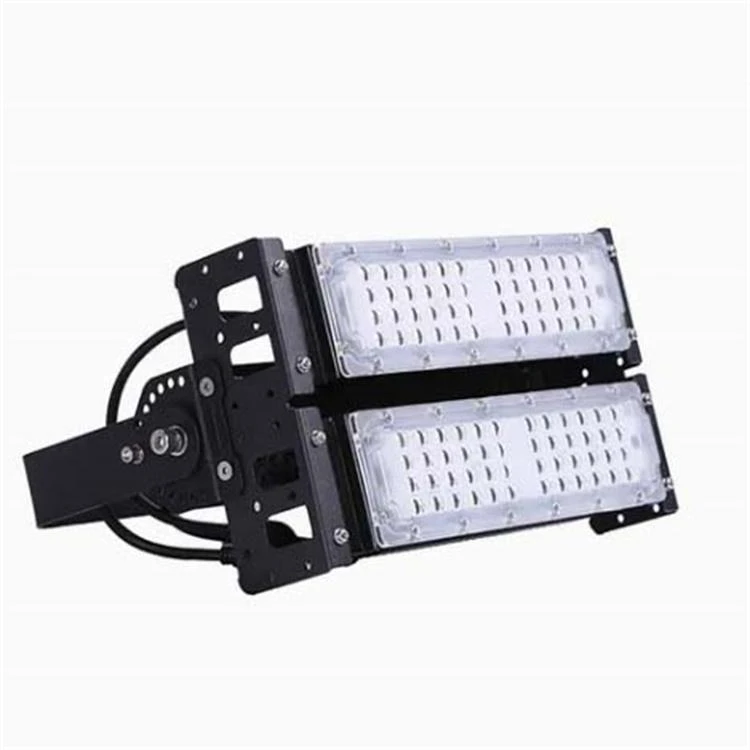
The Thermal Imperative and the 1070 Pure Aluminum Architecture
At the very heart of LED longevity lies an inescapable physical law: heat is the enemy. Unlike traditional incandescent bulbs that project heat outward via infrared radiation, LEDs generate heat at the semiconductor junction level. This heat must be conducted away from the chip and dissipated into the atmosphere. If this thermal energy is allowed to accumulate, the LED junction temperature rises exponentially, leading to rapid lumen depreciation, catastrophic color shift, and ultimately, total diode failure.
To combat this, this advanced flood light utilizes a lamp body constructed through a 1070 pure aluminum stamping process. In the world of metallurgy and thermal engineering, the choice of 1070 aluminum is highly deliberate. Alloy 1070 contains a minimum of 99.7% aluminum, making it one of the purest commercial grades available. This exceptional purity translates directly into superior thermal conductivity. While standard aluminum alloys (such as 6061) prioritize structural rigidity, 1070 prioritizes the rapid transfer of thermal energy.
Furthermore, the stamping process used to shape this die-cast body allows for the creation of an intricately designed, high-density heat sink. The resulting structure is both incredibly lightweight and immensely durable. The densely packed fins maximize the surface area exposed to the surrounding air, facilitating rapid convective cooling. This superior heat dissipation effectively extends the lifespan of the LEDs exponentially, pushing it well beyond the 50,000-hour benchmark. It also minimizes lumen depreciation over time, ensuring that the light remains brilliantly bright from the first day of installation to its ten-thousandth. In the context of "the last flood light you will ever need," this thermal architecture is the foundational promise. It guarantees that the light will not burn itself out, delivering unwavering, uncompromising brilliance year after year, even in the most demanding continuous-duty industrial environments.
Optical Excellence: Imported Chips and Toughened Glass
While thermal management provides the longevity, the optical system delivers the actual performance. To achieve uncompromising brilliance, one cannot rely on generic components. This fixture utilizes imported LED chips, which effectively improve the brightness of the luminaire by approximately 30% compared to standard market alternatives. This is not a marginal gain; it is a quantum leap in photometric efficiency. These imported chips feature advanced phosphor coatings and superior die structures, allowing them to generate a higher luminous flux (lumens) per watt of electricity consumed. This translates directly into massive energy savings and the ability to utilize fewer fixtures to illuminate the same area, reducing overall project costs without sacrificing light levels.
Protecting these high-performance chips is a toughened glass lamp shade. In the rugged world of industrial lighting, standard polycarbonate (PC) lenses are common, but they possess a fatal flaw: they degrade under prolonged exposure to ultraviolet (UV) radiation. Over time, PC lenses yellow, become cloudy, and drastically reduce light transmission, sapping the fixture of its brightness. Toughened glass, conversely, is immune to UV degradation. It maintains high light transmission and optical clarity for decades. Furthermore, this tempered glass mask boasts a high explosion-proof coefficient and exceptional hardness. It is engineered to withstand the impact of hail, debris, and accidental collisions without shattering into dangerous shards, ensuring both safety and uninterrupted illumination in the harshest environments.
Powering this optical engine is a certified power driver. The driver serves as the cardiovascular system of the fixture, regulating the electrical current. This unit features a high power conversion factor, minimizing energy wasted as heat. It delivers a constant, high-precision current, ensuring flicker-free operation and stable, reliable light output. A low-quality driver can cause stroboscopic effects and voltage fluctuations that quickly destroy LED chips. By utilizing a certified, high-precision driver, the fixture guarantees a stable, reliable quality of light, safeguarding the imported LEDs and maximizing their operational lifespan. The synergy of these components-imported chips, toughened glass, and certified drivers-ensures that the brilliance is not only uncompromising on day one but remains unyielding throughout its entire extended lifecycle.
The Versatility of Modular Design and Scalability
The concept of "the last flood light you will ever need to buy" is further reinforced by the fixture's modular design. Traditional flood lights are monolithic, single-purpose blocks. If a facility expands, or if the lighting requirements change, the existing fixtures often become obsolete or inadequate, forcing the purchase of entirely new equipment. This modular system shatters that limitation.
Available in versatile configurations-such as 1x2, 2x2, 1x4, and 1x5 arrays-this fixture is essentially a lighting system that can be built like a brick wall. If a warehouse needs higher lux levels for high-density racking, modules can be added. If a stadium needs lighting for a newly constructed grandstand, additional modules can be seamlessly integrated. This scalability ensures that the lighting infrastructure evolves in perfect lockstep with the facility's needs.
This adaptability drastically reduces long-term capital expenditure. Instead of replacing entire lighting systems, operators simply augment or reconfigure the existing modules. When paired with the rotatable brackets, the modular design allows for the creation of massive, sweeping light walls, or tightly focused, high-intensity beams, all from the same core product. This modularity is the ultimate expression of investment protection, ensuring that the initial purchase is never rendered obsolete by changing spatial dynamics or technological advancements.
Mechanical Superiority: The 180° Gear-Lock Rotatable Bracket
Even the most brilliant light is useless if it is pointed in the wrong direction. The mechanical deployment of the light is arguably as critical as its optical output. This fixture features a heavy-duty, 180° rotatable bracket, representing a monumental leap forward in lighting deployment flexibility. This immense range of motion allows for precise and flexible operating angles, enabling installers to accurately target light exactly where it is needed-whether that is washing the side of a building, illuminating a stadium playing field, or providing critical light for a shipping port crane operation.
However, adjustability without stability is a liability. In outdoor environments, wind loads, vibrations from heavy machinery, and thermal expansion can easily cause friction-based brackets to slip, throwing the light off-target. To combat this, the 180° bracket is equipped with a robust gear-lock system. Once the desired angle is achieved, the gear teeth mesh securely, physically locking the fixture into place. This mechanical certainty guarantees that the angle set on day one will remain the angle seen ten years later. The bracket's elongated mounting slots and heavy-duty black matte finish further enhance its versatility and corrosion resistance, ensuring the mounting hardware endures as long as the light itself.
Environmental Resilience: IP66 Protection and Enduring Durability
To be the last light you ever buy, a fixture must survive the relentless assault of nature. This modular LED flood light achieves a stringent IP66 ingress protection rating. The IP66 standard is not merely a marketing label; it is a rigorous certification. The first digit, 6, indicates that the fixture is completely dust-tight, preventing the ingress of particulate matter that can coat optical lenses and short-circuit delicate electronics. The second digit, 6, signifies protection against powerful water jets from any direction.
This level of environmental sealing is imperative for coastal installations where salt spray corrodes metal, for manufacturing plants where chemical fumes and heavy washdowns are routine, and for general outdoor use where torrential rain and snow are expected. Combined with the high-impact toughened glass and the die-cast aluminum body, the fixture possesses an extraordinary IK (Impact Protection) rating. It is virtually vandal-proof and weather-proof. This ruggedness ensures that the fixture will not fail due to environmental intrusion, eliminating the maintenance and replacement costs associated with corroded, waterlogged, or physically damaged lights.
Conclusion
The pursuit of uncompromising brilliance is a journey that requires the confluence of advanced materials science, precision optical engineering, and robust mechanical design. This modular LED flood light represents the zenith of this pursuit. By incorporating a 1070 pure aluminum body for unparalleled thermal management, imported LED chips for a 30% boost in brightness, a certified power driver for unwavering stability, and toughened glass for ultimate resilience, the fixture delivers performance that simply does not fade.
When combined with the modular scalability and the precision of the 180° gear-lock rotatable bracket, the fixture transcends its role as a mere source of illumination. It becomes an enduring, adaptable, and indestructible infrastructure asset. It is protected by an IP66 rating against the harshest elements and engineered to operate flawlessly for over 50,000 hours with minimal lumen depreciation.
Investing in this lighting system is not an expense; it is a declaration of independence from the cycle of maintenance, replacement, and compromise. It is a commitment to safety, efficiency, and environmental responsibility. When you choose this fixture, you are not just buying a light for today; you are securing a lifetime of brilliant, unwavering illumination. This is, unequivocally, the last flood light you will ever need to buy. Unleash its uncompromising brilliance upon your facility and experience the ultimate evolution of industrial lighting.

How To Cooperate With Us?
We are happy to have total control over the manufacturing process and the calibre of our products since we have our own facilities. Since we are producers rather than just brokers, we are dedicated to providing our customers with the best pricing. Since we are certain that the price and quality of our products are clear, we invite customers to see our samples first. Our commitment to quality and customer satisfaction drives us to continuously provide top-notch goods.
Our address
3rd Floor, 5th Building, Hebei Industrial Park, Hualian Community, Longhua District, Shenzhen, China





