

Some people use T12 fluorescent lamps, others use T8, and some prefer T5 integrated fixtures. This article clarifies the basic concepts of T12 lamps, compares them with T8 and T5 models, and offers guidance on how to choose replacements when upgrading old T12 systems-helping you make the right decision from the start.
What is a T12 Lamp?
The "T" stands for "tubular." The number that follows indicates the tube's diameter, measured in 1/8-inch increments. A T12 lamp has a diameter of 12/8 inches (approximately 38 mm), making it the thickest of the three types.
T12 was once the most widely used fluorescent lamp specification. The 4-foot (approx. 1200 mm), 40-watt version-typically paired with an inductive (magnetic) ballast-was commonly found in older factories, warehouses, schools, and retail spaces. While simple in design, T12 lamps suffer from low luminous efficacy and high energy consumption, which is why they have gradually faded from the mainstream market.
Comparison of Luminous Efficacy and Energy Consumption
For a standard 4-foot lamp, the power consumption and luminous efficacy generally compare as follows:
T12: Approximately 40W, with a luminous efficacy of about 60–70 lm/W; it consumes more power and provides relatively lower brightness.
T8: Approximately 32W (though 36W and 18W versions also exist), with a luminous efficacy of about 90–100 lm/W-significantly more energy-efficient than T12.
T5: Approximately 28W (high-efficacy version) or 54W (high-lumen-output version), with a luminous efficacy exceeding 100 lm/W; these are more compact and produce a more concentrated light beam.
In short, a smaller tube diameter generally correlates with higher luminous efficacy. This is a primary reason why the industry has shifted from T12 toward T8 and T5 standards.
Ballast and Circuit Compatibility
This is a common pitfall; before replacing a lamp, you must first identify the type of ballast currently in use.
T12: Traditionally paired with magnetic (inductive) ballasts, though some can also work with electronic ballasts.
T8: Compatible with either magnetic or electronic ballasts, offering better versatility.
T5: Must be used with an electronic ballast; it cannot be operated by a magnetic ballast.
Therefore, you cannot simply swap a T12 lamp for a T5 lamp; both the ballast and the lamp socket must also be replaced. If you are switching to a T8 fluorescent tube, you generally need to verify that the ballast wattage is a match.
Typical Application Scenarios
T12: Frequently found in older industrial facilities, warehouses, garages, and aging office buildings; primarily still in use as part of legacy infrastructure.
T8: The most widely used type; commonly seen in offices, supermarkets, schools, factory workshops, and shopping mall corridors. They are also easy to replace.
T5: Ideal for spaces with lower ceilings where high luminous efficiency and aesthetics are prioritized-such as retail counters, display lighting strips, cleanrooms, and indirect lighting installations.
Retrofit Options After Phasing Out T12
In many countries and regions, the production and import of T12 fluorescent tubes are restricted by energy-efficiency regulations. Given their high power consumption, many users are now considering retrofits. There are three common approaches:
Switching to T8 fluorescent tubes: The lowest-cost option, but since they remain fluorescent, energy savings are limited; they also contain mercury, which complicates end-of-life recycling.
Switching to LED tubes (with G13 bases): Currently the most popular solution. These are categorized by their wiring method:
Plug-and-play: The original ballast is retained, and only the tube is replaced. This is the fastest installation method, though there remains a risk of failure as the old ballast ages.
Ballast-bypass (direct-to-mains): The ballast is removed or bypassed. This offers greater stability and eliminates energy loss from the ballast, though it requires rewiring. Single-ended vs. Double-ended Power Input: Pay close attention to the power input method; incorrect wiring can pose safety risks.
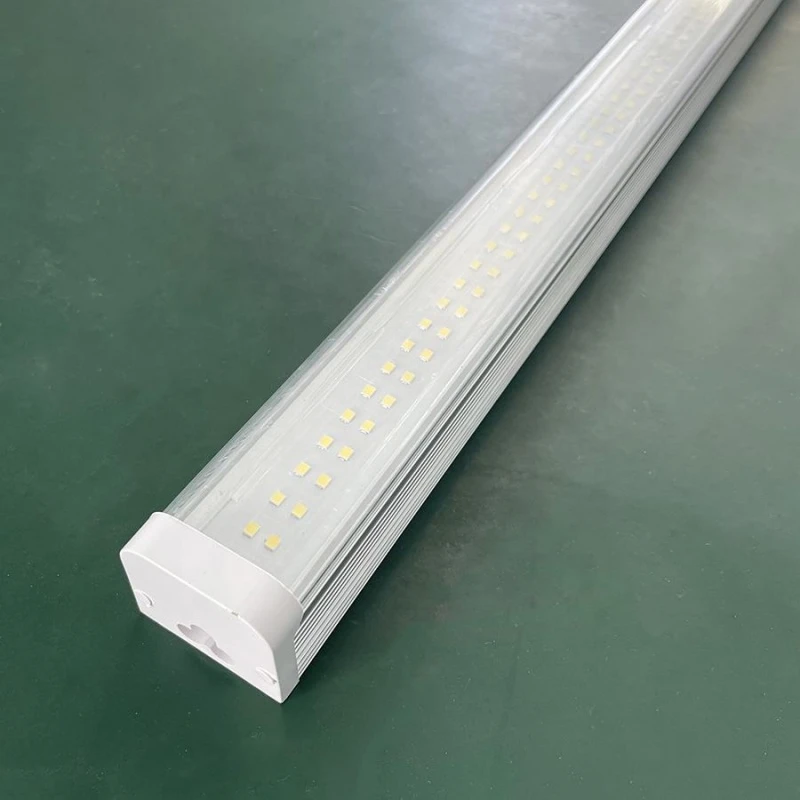
Replacing the entire fixture with an integrated LED unit: While the initial investment is higher, it offers a cleaner appearance and requires the least amount of long-term maintenance.
When selecting a replacement, focus on these key specifications: tube length, base type, power input method, wattage, color temperature, and whether dustproof or waterproof ratings are required. If you are unsure about the existing setup, taking a photo of the nameplates on your current tubes and ballasts is usually sufficient to determine the right solution.
Summary
T12: A traditional fluorescent tube with a diameter of approximately 38mm. These are characterized by low luminous efficiency and high energy consumption, and they are currently being phased out.
T8: Features a diameter of approximately 26mm and uses the same G13 base as the T12; it is the most common choice for retrofitting or upgrading.
T5: Has a diameter of approximately 16mm and offers the highest luminous efficiency. It uses a G5 base and requires an electronic ballast, meaning it cannot be used as a direct, drop-in replacement for T12 fixtures.
When retrofitting, first examine the base type and the ballast, then decide whether to switch to T8 tubes, LED tubes, or replace the entire fixture.
Need a replacement solution for T12, T8, or T5 tubes?
If you are struggling with retrofitting old lighting fixtures, sourcing LED tubes in bulk, or requiring custom specifications, please feel free to contact us directly. Simply provide us with the model, length, and application environment of your current tubes, and our engineers will help identify the ideal solution, along with providing quotes and samples. You can reach out via the inquiry form on this page or by sending us an email-we will respond as soon as possible.
Our address
No. 5-3 Niujiao Road, Yanchuan Community, Yanluo Subdistrict, Bao'an District, Shenzhen
bwzm18@ledbenweilighting.com






