

Purchasers and installers involved in outdoor lighting retrofits have likely encountered this common complaint: a batch of "corn-style" LED lamps works perfectly when tested in an open socket, but after being installed inside an enclosed post-top fixture-shielded by a glass or acrylic cover-they begin to suffer from lumen depreciation, flickering, or even premature failure within just a few months.
Given that the lamp body is made of aluminum and equipped with ample cooling fins, where does the problem lie? The answer usually isn't with the lamp itself, but rather with how the lamp interacts with the fixture. Let's break down the common causes.
The Prerequisite for Aluminum Heat Dissipation: Airflow
Many assume that "aluminum equals good heat dissipation." However, aluminum merely conducts heat from the LED chips to the lamp's surface; the heat must ultimately be dissipated into the surrounding air through convection and radiation.
Inside an enclosed fixture, there is virtually no airflow. As the surface temperature of the lamp rises, the surrounding air heats up as well. This reduces the temperature differential, causing heat dissipation efficiency to plummet. Even the best aluminum can only move heat to the surface-if it can't escape from there, it remains trapped.
Enclosed Fixtures Create a "Heat Bubble"
Post-top fixtures typically feature a glass, polycarbonate (PC), or acrylic cover, with a top cap and a base that seals against the socket. This structure functions much like a small oven:
Heat emitted by the lamp remains trapped inside, causing the air temperature to rise continuously.
The cover material itself is a poor thermal conductor, making it difficult for heat to escape to the outside.
In summer, direct sunlight can further exacerbate the issue by driving external heat into the enclosure.
In field tests, it is not uncommon for the air temperature inside such a fixture to be more than 30°C higher than the ambient temperature. It is often overlooked that a fixture's specified "operating temperature range" refers to the ambient environment, not the temperature inside the enclosure.
The Design of Corn-Style Lamps Hinders Heat Transfer
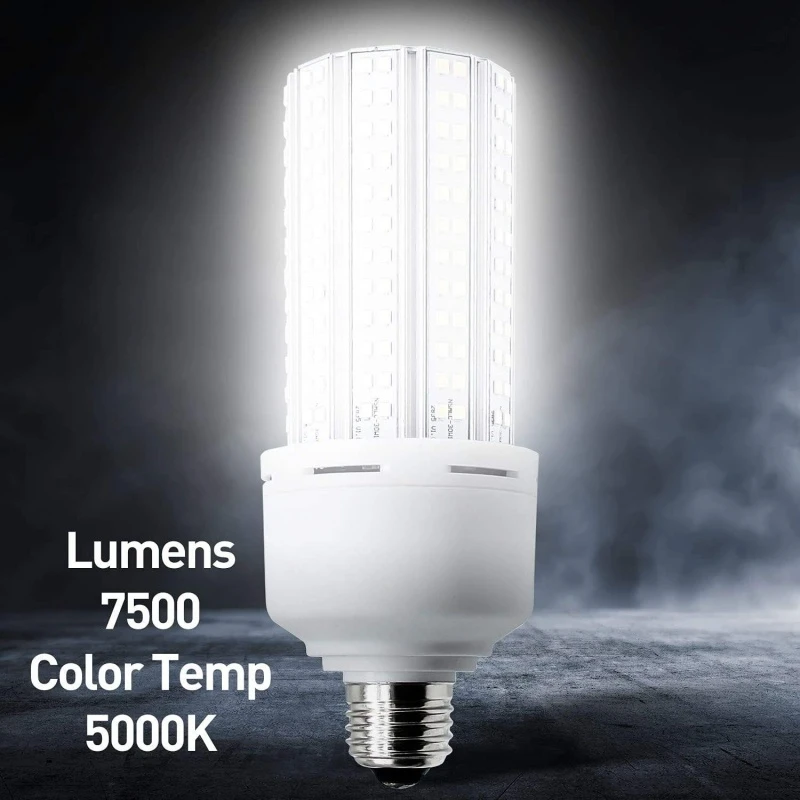
Corn-style LED lamps feature LED chips arranged around the entire body, a design intended to provide 360-degree light distribution. However, this structure has two major drawbacks regarding heat dissipation:
The distribution area for the LED chips is large, but the substrate is narrow: The PCB is typically a long, thin strip with limited thickness, resulting in a long thermal conduction path along its length.
Internal space is occupied: The center of the lamp body is often taken up by the power supply or structural supports, leaving little room for heat dissipation.
Furthermore, some low-cost products labeled as "aluminum" are actually made of plastic-encased aluminum or thin-walled aluminum shells. With poor thermal interface management, there is significant thermal resistance between the chips and the outer casing. While such lamps might barely function in an open environment, they are almost certain to overheat in an enclosed one.
Upward-facing installation leads to heat accumulation inside the lamp
Most post-top lights (pillar-top lights) are installed with the base facing up and the light source facing down. Whether a "corn" LED bulb is oriented upright or inverted depends on the orientation of the lamp socket; however, the principle that hot air rises remains constant:
Hot air collects at the top of the lampshade, causing the upper portion of the lamp body to reach the highest temperatures.
If the power supply or a dense cluster of LED chips is located in this upper section, that area becomes a "hot spot."
If the gaps between the cooling fins are too narrow, hot air can become "trapped" inside.
Many manufacturers conduct lumen depreciation (light decay) tests in open environments-with the lamp positioned horizontally or with the base facing down-which does not reflect the actual orientation of these bulbs when installed in post-top fixtures.
The gap between nominal power and actual usable power
A "corn" LED bulb rated at 54W, when operated continuously inside an enclosed fixture, often performs more like a 35W bulb. This is because:
As the junction temperature of the chips rises, luminous efficiency decreases.
To protect itself, the LED driver may reduce the current or cycle on and off frequently.
Prolonged exposure to high temperatures accelerates the degradation of the phosphor coating, leading to color temperature shifts and a drop in luminous flux.
Therefore, it is not advisable to use bulbs at their full rated power within enclosed fixtures. Opting for a lower-wattage bulb is generally more stable and results in a longer lifespan than forcing a high-wattage bulb into such an environment.
Risks associated with housing the driver within the lamp base
Most "corn" LED bulbs have their drivers built into the base or the main body of the lamp. Electrolytic capacitors-a key component of the driver-are among the parts most sensitive to heat. As a rule of thumb, for every 10°C increase in operating temperature, the lifespan of a capacitor is approximately halved.
In enclosed post-top lights, the LED driver is subjected to high temperatures for extended periods. Common failures include:
Capacitors bulging or experiencing a loss of capacitance, leading to flickering.
The driver IC triggering over-temperature protection, causing the light to dim or flicker intermittently.
The power supply failing before the LED chips themselves.
If you frequently receive customer complaints about "flickering" or the light "not turning on," the driver-rather than the LED chips-should be the primary suspect.
Additional Thermal Loads in Outdoor Environments
Beyond the fact that post-top lights are often enclosed, several other frequently underestimated factors come into play:
Solar Exposure: Dark-colored lamp posts and shades absorb significant heat; on summer afternoons, the temperature of the shade can become extremely high.
Dust and Insects: Dust accumulation on the inner surface of the shade or debris clogging the cooling fins of the lamp body hinders heat dissipation.
Moisture and Condensation: Large diurnal temperature variations can lead to condensation inside the fixture, which corrodes electrical contacts and compromises the stability of the power supply.
While these factors might have a minor impact individually, their cumulative effect can cause a fixture-which might otherwise be marginally acceptable-to fail prematurely.
Conclusion
Aluminum "corn" bulbs still overheat when used in enclosed post-top lights because aluminum only conducts heat; it does not dissipate it. An enclosed shade blocks convection, forcing both the LED chips and the driver to operate in high-temperature conditions for long periods. When combined with factors like inverted installation, solar exposure, and dust accumulation, failures are inevitable.
The solution is straightforward: reduce the power rating, opt for designs with solid aluminum heat sinks, ensure the driver capacitors have an appropriate temperature rating, and require suppliers to provide test data specifically for enclosed environments.
Need a "corn" bulb solution for your post-top lights?
We specialize in the R&D and production of LED corn bulbs. For applications such as enclosed post-top lights and garden lights, we offer a variety of power ratings and heat-dissipation designs. We also provide customization based on your fixture dimensions and operating environment, including comprehensive temperature-rise testing.
Our address
No. 5-3 Niujiao Road, Yanchuan Community, Yanluo Subdistrict, Bao'an District, Shenzhen
bwzm18@ledbenweilighting.com






