

Introduction: The Question Homeowners Stop Asking Too Soon
Every failed tube light tells the same story, and most occupants have heard it so many times that they no longer ask why. The tube blackens at the ends. The light flickers before it dies. A replacement lamp is installed, and within a year or two, the cycle repeats. The assumption settles in that linear lighting is simply a consumable-something to be bought, installed, and replaced on a rhythm the household cannot influence.
That assumption is technically obsolete. The failure modes that drive it have been identified, classified, and-in well-engineered fixtures-designed out. The problem is not that linear lighting must fail early. The problem is that most linear lighting is built in a way that permits early failure to proceed unchecked.
Two subsystems determine whether a fixture dies prematurely or endures. The first is the driver: the power electronics that convert mains electricity into the current the light source requires. The second is the thermal pathway: the physical route by which heat leaves the light source and the driver and reaches the ambient air. In conventional fluorescent systems, these functions are split between a ballast and a lamp envelope, with predictable consequences. In low-cost LED battens, they are too often treated as an afterthought, with consequences that are equally predictable.
This article proceeds in four parts. Section 2 examines why old tube lights fail, focusing on the lamp–ballast relationship and the thermal vulnerabilities of conventional LED drivers. Section 3 analyzes the intelligent constant-current driver as an electrical solution to instability and flicker. Section 4 examines the iron-clad base as a thermal solution that preserves the driver's electrical performance across the fixture's service life. Section 5 concludes with the case for treating the driver-and-base combination as the defining quality signature of a linear fixture.
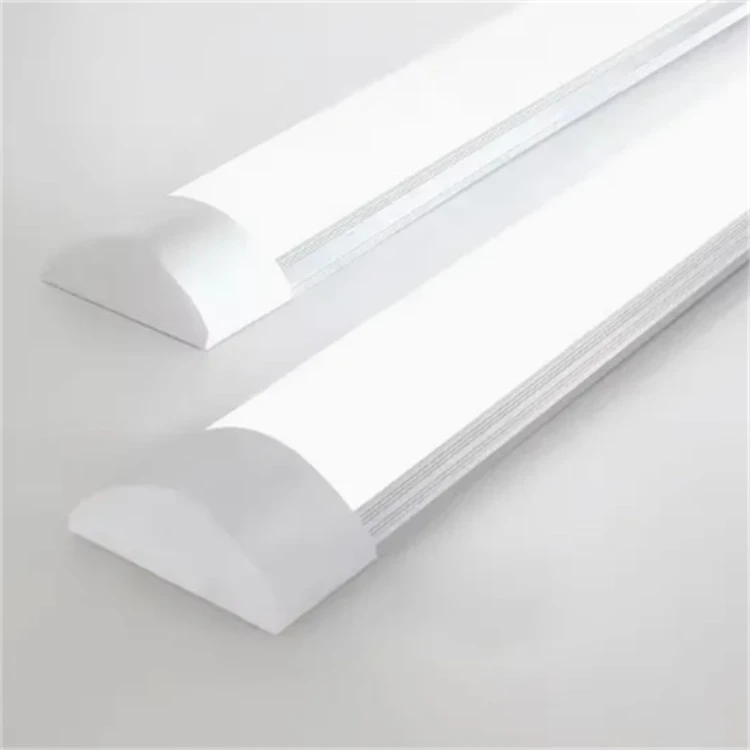
The Anatomy of Premature Failure: Why Tube Lights Die Before Their Time
Fluorescent Failure: Cathode Erosion and the Ballast's Burden
The fluorescent tube is a consumable by design. Its operation depends on thermionic emission from coated cathodes at each end of the tube. Every start cycle erodes the emissive coating. When the coating is depleted, the cathode can no longer sustain the discharge, and the tube fails. The visible signature of this process is end blackening-the darkening of the glass at the cathode positions as sputtered electrode material deposits on the tube wall. Dark bands at the tube ends are a reliable indicator that replacement is due.
The ballast is the silent accomplice in this process. A fluorescent lamp requires the ballast to provide adequate cathode heating at startup and during operation. When the ballast fails to deliver sufficient heating-whether because of design limitations, dimming below the recommended minimum, or simple aging-the result is premature end blackening, lamp failure, and flickering. The ballast is also a failure point in its own right. A dead or dying ballast produces the same visible symptoms as a failing lamp: flickering, delayed startup, or a tube that glows only at the ends. In many fixtures, replacing the lamp does not solve the problem because the ballast was the problem all along.
The fluorescent fixture is therefore a system in which two consumable components-lamp and ballast-are coupled in a way that accelerates each other's decline. This is not a design flaw in any single component. It is the structural logic of the technology.
The LED Batten's Different Failure: The Driver as the Weak Link
LED battens were expected to escape this cycle. The LED chip itself does not "burn out" in the manner of a filament or a depleted cathode; it degrades gradually through lumen depreciation, typically defined by the L70 or L80 metric, at which the fixture produces 70% or 80% of its initial output. A well-designed LED fixture can operate for 50,000 hours or more before reaching that threshold.
In practice, however, many low-cost LED battens fail far earlier-and the driver is the usual culprit. An LED module has two principal components: the LED chip and the driver that converts AC mains into the DC current the chip requires. In practice, "the driver tends to be the weaker link. Heat is the main enemy, and drivers generate heat during normal operation. Over years of cycling on and off, the capacitors inside degrade". When the driver begins to fail, the symptoms are familiar to anyone who has replaced a fluorescent tube: flickering that was not present before, delayed illumination, or a fixture that shuts itself off after warming up.
A comprehensive review of LED lighting system failures classifies these defects by subsystem: driver, semiconductor package, optical elements, thermal management, and mechanical components. The identified failure modes-interconnect failures, performance degradation, and thermal instability-are "typically driven by manufacturing inconsistencies, material aging, and adverse environmental conditions". The driver is not an accessory to the LED; it is the component that determines whether the LED's theoretical longevity is realized in practice.
The Low-Cost Driver Problem: Open-Loop Architecture and Its Consequences
The root cause of early LED batten failure is often the driver topology. Many inexpensive LED tubes use simple resistance-capacitance step-down schemes or open-loop constant-voltage driving. These circuits cannot respond to grid voltage fluctuations or to temperature-induced changes in the LED chip's impedance. They lack dynamic adjustment and real-time current monitoring. The result is that the LED operates under unstable current conditions, which "will cause irreversible light degradation, hasten the ageing of the lamp tube's internal components, and ultimately result in the lamp's premature failure".
The practical implication is that a low-cost LED batten can fail for reasons that have nothing to do with the LED chip's quality. The chip may be perfectly functional. The driver has ceased to provide the stable current the chip requires. This is the same structural vulnerability that afflicted fluorescent systems-a critical power-conditioning component that becomes the fixture's Achilles' heel-reproduced in a new technology.
The Smart Driver Solution: Electrical Stability as the First Line of Defense
Closed-Loop Constant-Current Regulation: Holding the LED Within Its Safe Operating Envelope
The intelligent constant-current driver addresses the low-cost driver's fundamental deficiency: the absence of feedback. A high-performance IC constant-current driver incorporates a closed-loop feedback mechanism that monitors the lamp's working current in real time and dynamically adjusts the output voltage in response to variations in the power grid and the chip's temperature-dependent impedance. The objective is not merely to regulate average current but to suppress the ripple and deviation that accelerate LED degradation.
The precision of this regulation matters. Premium constant-current drivers manage current control error within ±3%, compared with the ±10% error typical of conventional drivers. A current error of 10% means the LED is alternately overdriven and underdriven relative to its design point-overdriven in the peaks, which accelerates thermal degradation and light decay, and underdriven in the troughs, which produces insufficient luminous efficiency and abnormal chip aging. A ±3% error keeps the LED within a narrow band around its optimal operating current, where luminous efficacy is stable and the rate of material degradation is minimized.
Flicker Suppression as a Lifespan Indicator
The constant-current driver's suppression of current ripple has a second consequence that is often overlooked in lifespan discussions: the elimination of flicker. Flicker is not merely a comfort issue. It is a symptom of the driver's inability to hold current steady. The IEEE 1789-2015 recommended practice addresses this directly, providing guidelines for modulating current in high-brightness LEDs to mitigate health risks to viewers, including headaches and eyestrain. The standard recognizes that modulation frequencies in the invisible range-below the threshold of conscious perception-can still produce biological effects, and it sets recommended modulation limits accordingly.
A driver that suppresses ripple to the level required for flicker-free operation is, by definition, a driver that is holding the LED's current within a narrow tolerance. The absence of flicker is therefore an observable proxy for the presence of good current regulation. When a fixture begins to flicker, the driver is no longer regulating effectively-and the LED is beginning to experience the unstable current conditions that accelerate its decline. Flicker is the early warning sign of a driver that is failing to do its primary job.
Adaptive Current Control and Thermal Co-Design
The most advanced constant-current drivers go beyond fixed regulation. Adaptive current controllers use temperature sensing to adjust the driving current linearly, reducing output when thermal conditions would otherwise push the LED toward damaging junction temperatures. This approach reduces brightness slightly under adverse conditions but "avoid[s] the damage of the LED and extend[s] its life time," while simultaneously reducing flicker compared with systems that lack such control.
This is where the driver and the thermal design of the fixture begin to converge. A driver that can adapt to temperature is valuable only if the fixture's thermal pathway gives it accurate temperature information and a manageable thermal environment. A driver with adaptive control mounted in a housing that cannot dissipate heat is an electronic solution to a problem that is fundamentally physical. The driver can reduce current to protect the LED, but it cannot compensate indefinitely for a base that refuses to shed heat.
The Iron-Clad Base: Thermal Integrity as the Condition of Electrical Stability
Heat as the Universal Accelerant of Failure
Every failure mechanism discussed in Section 2 is thermally coupled. Driver capacitors degrade faster at elevated temperatures; a commonly cited engineering rule holds that capacitor life doubles for every 10°C reduction in operating temperature. LED lumen depreciation accelerates as junction temperature rises. Thermal stress drives interconnect failures and material aging throughout the fixture. Heat is not a secondary concern in lighting reliability. It is the variable that governs the rate of nearly every degradation process inside the fixture.
The driver's own heat generation makes this coupling particularly dangerous. The driver produces heat during normal operation, and that heat must be removed from the driver enclosure. If the housing cannot conduct heat away effectively, the driver's internal temperature rises, its capacitors age faster, and the current regulation that protects the LED begins to drift. The LED then experiences the unstable current conditions that the constant-current driver was designed to prevent. Thermal failure and electrical failure are not separate events. They are stages in a single cascade.
Iron as a Thermal Conductor and Structural Stabilizer
The iron-clad base interrupts this cascade at its origin. Iron offers a combination of properties that are well suited to linear lighting fixtures: high thermal conductivity for spreading heat from the LED board and driver across a larger surface area, structural rigidity that maintains the alignment of optical components over time, and corrosion resistance that preserves the thermal contact between components across years of service.
The consequence for lumen maintenance is measurable. A fixture with an effective thermal pathway can achieve L80 lumen maintenance at 50,000 hours-meaning that at least 80% of the initial luminous flux is retained at the end of that period, with the same proportion of the LED population still functioning. This is the operational definition of a fixture that does not "keep dying." The LEDs are not being asked to perform beyond their thermal tolerance, and the driver is not being subjected to temperatures that accelerate its internal degradation.
The Synergy: Why One Without the Other Is Insufficient
The case for the "iron-clad base + smart driver" combination rests on the recognition that neither component can deliver its full benefit in isolation.
A smart constant-current driver in a thermally inadequate housing is a temporary solution. The driver may hold current precisely at the factory and for the first several thousand hours. But as heat accumulates within the fixture, the driver's own components age, its regulation drifts, and the LED begins to experience the instability the driver was meant to prevent. The driver has not failed in the conventional sense; it has been defeated by its thermal environment.
An iron-clad base without a constant-current driver is equally incomplete. The base may dissipate heat efficiently, but if the driver is an open-loop constant-voltage design, the LED is still subjected to current variations driven by grid fluctuations and temperature-dependent impedance changes. The thermal pathway is doing its job, but the electrical pathway is introducing instability that no amount of heat sinking can correct.
The combination is what matters. The iron base creates the thermal conditions under which a constant-current driver can maintain precise regulation over tens of thousands of hours. The constant-current driver converts that thermal stability into electrical stability, holding the LED at its optimal operating point and suppressing the ripple that produces flicker and accelerates degradation. The base protects the driver; the driver protects the LED; and the LED's extended service life is the observable outcome of a functional pair, not of any single component.
Conclusion: The Combination Is the Quality Signature
The question "why do my old tube lights keep dying?" has a technical answer that is more useful than the fatalistic assumption of planned obsolescence. They die because the failure pathways inherent in their architecture-ballast-dependent cathode erosion in fluorescent systems, thermally compromised open-loop drivers in low-cost LED battens-are permitted to run their course. They die because the component responsible for electrical stability is placed in a housing that cannot protect it from the heat it generates. They die because the thermal and electrical functions of the fixture are treated as separate specifications rather than as a single reliability system.
The iron-clad base and the smart constant-current driver address this system at both ends. The driver provides the closed-loop current regulation that keeps the LED within its safe operating envelope, suppresses the ripple that manifests as flicker, and manages the current in response to thermal conditions. The iron base provides the heat-spreading capacity that keeps the driver's own components within their thermal limits, preserves the driver's regulation accuracy over time, and maintains the LED's junction temperature at a level consistent with long-term lumen maintenance.
For the buyer, the practical implication is a shift in what to look for. A fixture's rated lifespan is not a reliable guide if the driver and the thermal design are not specified. The questions that matter are whether the driver is a true constant-current design with closed-loop feedback, and whether the housing is a thermal component rather than a cosmetic shell. A fixture that answers both questions affirmatively is one whose service life is defined by its engineering rather than by its weakest link. A fixture that answers only one is a fixture that has relocated its failure point, not eliminated it. The combination-iron-clad base and smart driver together-is the quality signature that separates a light worth installing from a consumable destined for the replacement cycle.
How To Cooperate With Us?
We are happy to have total control over the manufacturing process and the calibre of our products since we have our own facilities. Since we are producers rather than just brokers, we are dedicated to providing our customers with the best pricing. Since we are certain that the price and quality of our products are clear, we invite customers to see our samples first. Our commitment to quality and customer satisfaction drives us to continuously provide top-notch goods.
Our address
3rd Floor, 5th Building, Hebei Industrial Park, Hualian Community, Longhua District, Shenzhen, China





